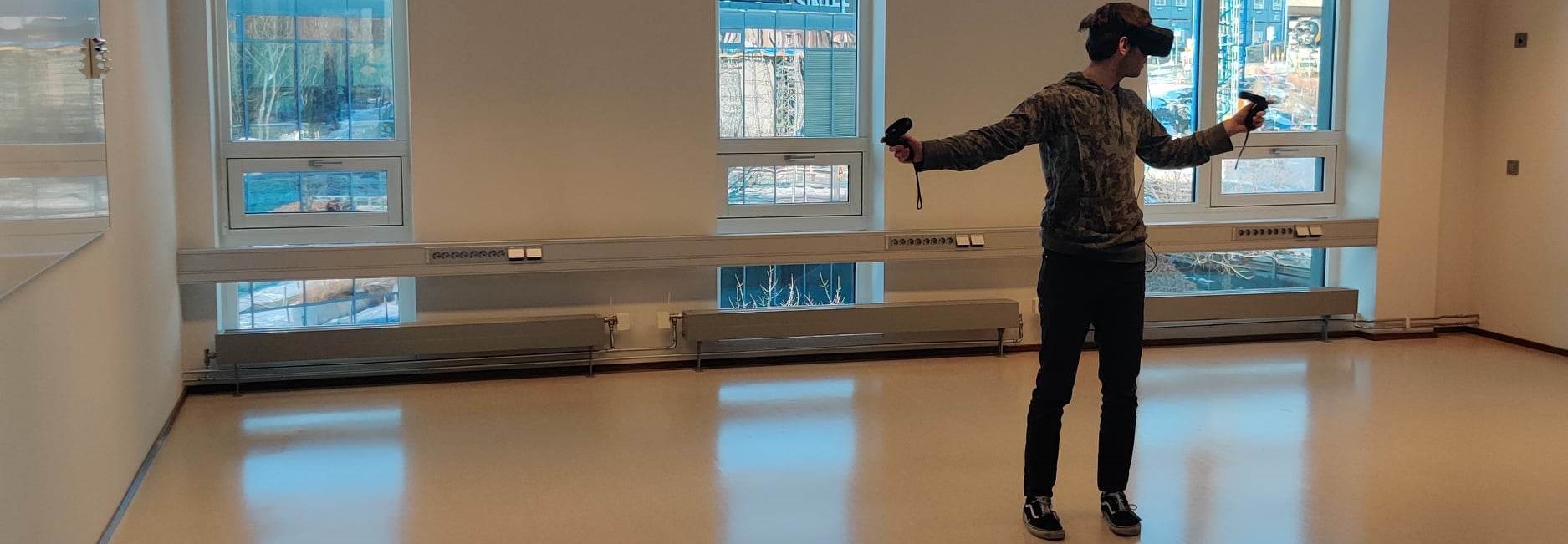
What is Redirected Walking?
Virtual reality (VR) allows us to dive into virtual worlds and experience them in first person. Several of our senses can be used in this experience, and the senses of vision, sound and touch work reasonable well. What we can also achieve is the sense of our own body, the so-called proprioperceptive or kinesthetic sense.
When we used VR headsets today, programs react to the motion of the head in real time, and mimic those moves in the virtual world. To some extent, also hand and body pose can be tracked or deduced. However, most of the time, we sit in a chair and to move our first-person avatar. This feels unnatural and restrictive as it removes a key physical aspect of moving around in the virtual environment.
Wearing VR headsets, we can walk around in the real world, and by way of of tracking, this motion can be brought into the virtual world as well. This translation creates a high level of immersion but it is limited. The physical space in the real-world is limited by things such as walls and obstacles in the real world, where these don’t exist in the virtual world. At this point, Redirected Walking appears.
The term describes the ”perceptually unnoticeable virtual camera motion offset from a user’s movement”. Essentially, the system assesses the layout of the real and the virtual world, and works continually to rotate the virtual world’s coordinate system against the real-worlds coordinate system.
Specific questions for these theses
In this thesis, you will extend our knowledge of redirected walking. You will make use of the software that we have already developed and extend it to conduct new research. Our own developments are documented in the master theses listed in the sidebar.
The existing software makes use of Unreal Engine on Windows, OpenXR and SteamVR, with VR devices comprising Oculus Rift and Quest headsets as Vive trackers.
Introducing prediction and latency into redirected walking
Our current results have been achieved with a direct connection between a PC running the Unreal game and an Oculus headset worn by the user. We did not attempt to introduce delays between the computer running the game and the headset where the player experiences it. This makes sense for many scenarios, but many game developers as well as players prefer Cloud Gaming. In Cloud Gaming, developers make compute resources available in the Cloud, where the game logic runs, video frames are rendered into a video stream, and this video is then live-streamed to the VR headset.
It is very obvious that this introduces greater delays than the delay between a computer and a directly connected VR headset. However, it is possible to attempt to partially hide this latency by predicting the human motion, and send those predictions to the server. We want to explore under controlled conditions what this means for players' interaction with virtual worlds when they use movement in the real world to control their first-person avatar in the virtual world, combined with redirected walking to do this when the virtual world is larger than their real-world environment.
The study of the latency impact, and our ability to predict human walking speed and direction comprise the central questions of this master thesis.
Combine prediction methods
The results of the referenced master theses investigated separately the effects of redirected walking by translation, rotation, and curvature with predefined scaling values. While they provided us with considerable insights, a real VR environment will require a combination of all three with scaling values that are chosen as necessary.
In this thesis, you will explore ways to investigate how you can choose a suitable redirection strategy (including its scaling parameters) at runtime while the user is moving around in the virtual world. You will combine your knowledge of the real environment's layout and of virtual world's layout as input for several algorithms that you develop.
You will determine suitable strategies and scaling parameters by conducting user studies, which will be aimed at discovering whether users can notice and tolerate the scaling that is performed.
Expand player tracking with the Rokoko SmartSuit
The referenced master theses relied on the location information that was reported by the Oculus Quest and HTC Vive headsets that the users wear to achieve presence in the virtual world. This has severely limited our ability to understand the users' body pose, meaning that an avatar would rotate when the user rotated their head. It prevented us also from using human kinematics to understand and predict motions and make better redirection decision.
SINLAB does now own a Rokoko SmartSuit, which is worn as an overall and can report the user's body pose in much detail. It makes is possible to move the avatar in human manner and render the actual body pose of the user in the virtual world. It can be assumed that users will appreciate when the avatar's motion reflect their own body pose.
More importantly for this thesis, the user's body orientation can be separated from the head orientation, and the prediction that is essential for redirect walking can be improved. This full body tracking, rendering of the avatar and suitable modifications of the redirected walking strategies will be developed in this thesis. The value of the modifications will be assessed in user studies.
Learning outcome
Experience
- in formulating, investigating and answering research questions
- with the development of VR scenarios with Unreal Engine
- conducting, evaluating and interpreting user studies
Conditions
We expect that you:
- have been admitted to a master's program in MatNat@UiO - primarily PROSA
- take this as a long thesis
- will participate actively in the weekly SINLab meetings
- are present in the lab and collaborate with other students and staff
- are interested in and have some knowledge of C/C++ programming
- are interested in conducting user studies
- are willing to share your results on Github
- include the course IN5060 in the study plan, unless you have already completed a course on classical (non-ML) data analysis