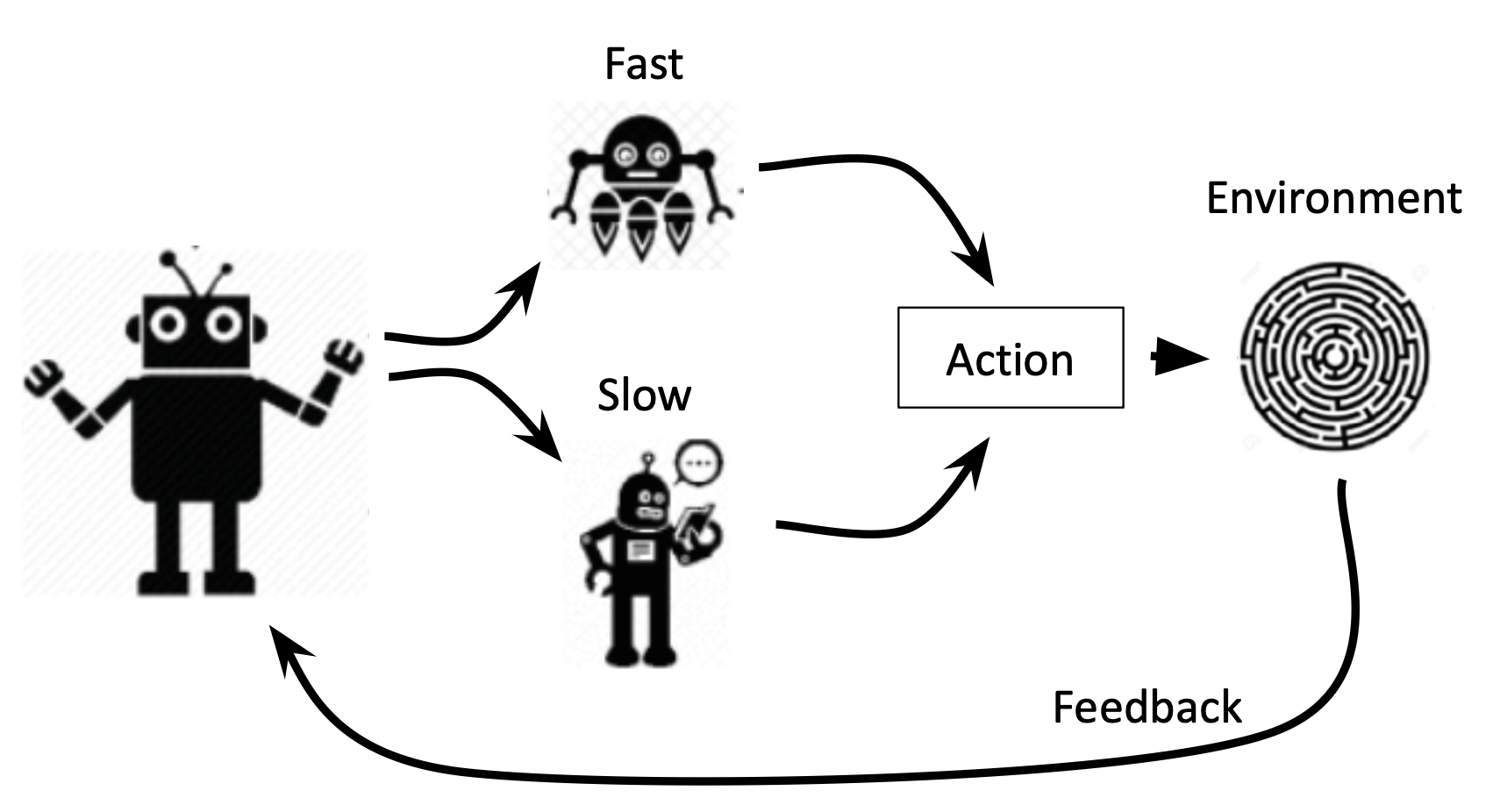
Typically when developing robots and computer agents, we let them have one decision-making process responsible for all actions. However, not all situations and tasks have the same requirements. As a consequence, the single decision-making process needs to strike a predefined balance between accuracy, reaction speed, and efficiency. According to psychology, this is not how we humans work as we have the ability to adapt how we think and make decisions. While several theories exist, a popular hypothesis is that we have two different systems, one fast and one slow, and seamlessly switch between them. The idea of this master thesis is to take inspiration from this and explore how such systems can be implemented into robots.
The theory in cognitive psychology behind humans having two different thinking systems is called dual process theory, but it is probably more well-known as "Thinking, Fast and Slow" after the popular book written by Nobel Prize-winning economist Daniel Kahneman. In the book the two thinking systems are clearly split up and named System 1 and System 2. System 1 is fast, efficient, and intuitive. On the other hand, System 2 is slow, costly, but also able to reason. Humans have evolved to switch between these systems depending on the situation and requirements of the world around us. Similar theories arise from other directions in psychology as well, with goal-based vs. habit-based thinking from behavioural psychology and model-free and model-based thinking from neuroscience.
The idea of this master thesis is not to go in-depth on the psychology, but rather to take loose inspiration from the theories and try to explore such systems in robots and agents using reinforcement learning. The hope is that this will lead to more adaptable and smarter robots in the future. There are several options and possible directions to take this work. Examples of concrete suggestions include:
- Combine classical robot control, Model Predictive Control, for the slow system, with an RL policy as the fast system.
- Add an LLM to do, or guide, the switching between the fast and slow systems.
- Let a big VLM be the slow system, and combine it with a much smaller RL policy as the fast system.
- Explore how "thinking fast and slow" systems will have an impact if reaction time is critical in some situations.
- Explore model-based RL and other advanced RL methods.
To summarize, this master thesis will take inspiration from psychology and combine RL algorithms, architectures, and models in new and novel ways.
Useful courses
- IN5490 - Advanced Topics in Artificial Intelligence for Intelligent Systems
- TEK5040 - Deep Learning for Autonomous Systems
- IN4310 – Deep Learning for Image Analysis
Sources:
- Thinking fast and slow - Daniel Khanman
- Thinking Fast and Slow in AI - https://arxiv.org/abs/2010.06002
- Fast or Slow: Adaptive Decision-Making in Reinforcement Learning with Pre-Trained LLMs - https://www.mn.uio.no/ifi/personer/vit/katrner/icdl25_0095_fi.pdf
- Dual Process Dreamer: Fast and Slow Decision-Making with World
- Models - https://www.scitepress.org/Papers/2026/142432/142432.pdf