1. Project description
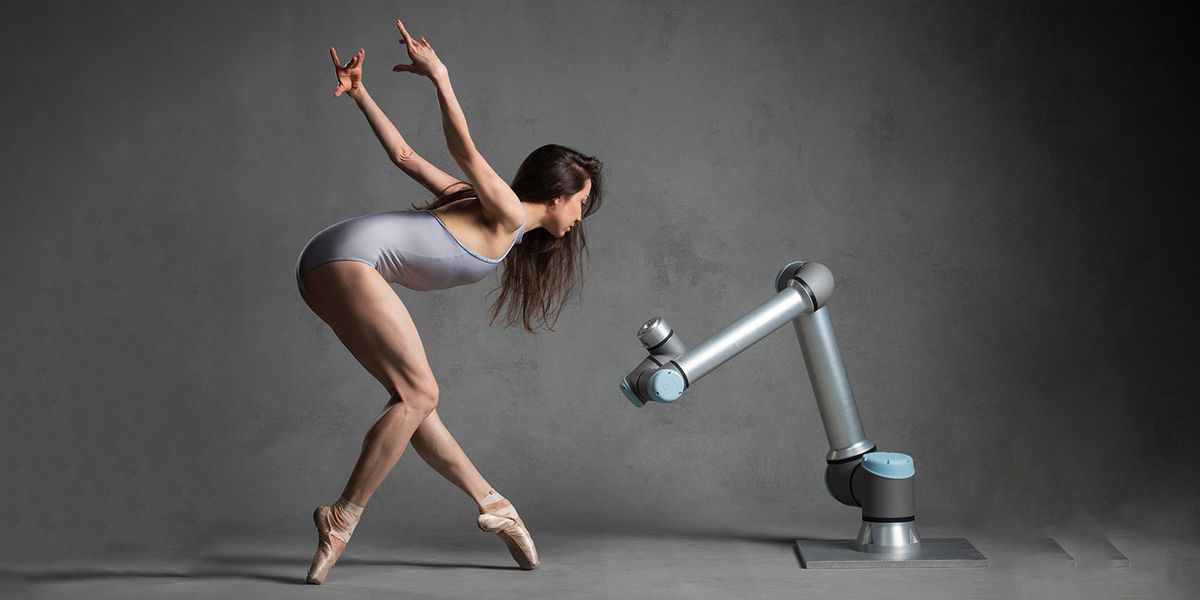
The integration of expressive movements in Human-Robot Interaction (HRI) holds the promise of creating more empathetic and relatable robots, ultimately fostering deeper connections between humans and their artificial counterparts. Robots have been used so far in research with children, senior adults, in therapy, care or other settings. But can we see robots as dancers, with or without human partners or even without music in the background?
This proposal suggests the use of deep learning or other methods to develop meaningful mappings between human dance movements and expressive robot movements. Through simulation and experiments with physical robots, this project aims to explore the impact of expressive robot movement on human perception. Laban Movement Analysis (LMA) theory can be used and/or eventual ideas from soma design. You do not need to be familiar with these theories before you start your master thesis.
GOAL OF THE PROJECT:
TIAGo and UR5 arm robots are available at ROBIN. We suggest a master thesis in which the student investigates expressive movements applied to robots with various morphologies, by using deep learning to map human dance movements onto the robot, and by conducting user studies. The research questions addressed can be, but are not limited to the following:
RQ1. How can we translate human dance performance into control of robot(s) (non-humanoid such as UR5, or anthropomorphic robots such as TIAGo)?
RQ2. Can we see robots as dancers, even without a human partner or music? (user studies)
2. Project tasks
A suggested set of tasks could be the following:
- Get an overview of earlier work on expressive movements on robots, using deep learning models and other methods.
- Implement a mapping from human dance onto one or two robots (UR5, TIAGo or others) to translate some expressive movements from human dancers to these robots. (To be able to control TIAGo, you will use ROS. ROS can also be used to control UR5).
- Conduct user studies (either a video-based survey, in-lab experiment, or an experiment outside of the lab with real users) - details to be decided in agreement with the student.
- Compare the results to previous work available.
- Write the master thesis.
3. Starting point for references
Some possible references that may start as a useful starting point include:
[1] T. Schulz, J. Torresen, and J. Herstad, “Animation Techniques in Human-Robot Interaction User Studies: a Systematic Literature Review,” ACM Trans. Hum.-Robot Interact., vol. 8, no. 2, Jun. 2019, doi: 10.1145/3317325.
[2] P. Abad et al., “Integrating an Autonomous Robot on a Dance and New Technologies Festival,” in ROBOT 2017: Third Iberian Robotics Conference, Cham, 2018, pp. 75–87. doi: 10.1007/978-3-319-70833-1_7.
[3] Eriksson, S., Unander-Scharin, Å., Trichon, V., Unander-Scharin, C., Kjellström, H., & Höök, K. (2019, May). Dancing with drones: Crafting novel artistic expressions through intercorporeality. In Proceedings of the 2019 CHI Conference on Human Factors in Computing Systems (pp. 1-12).
[4] Mason Bretan, Guy Hoffman, and Gil Weinberg. Emotionally expressive dynamic physical behaviors in robots. International Journal of Human-Computer Studies, 78:1–16, 2015.
[5] Sarah Jane Burton, Ali-Akbar Samadani, Rob Gorbet, and Dana Kuli´c.Laban movement analysis and affective movement generation for robots and other near-living creatures. Dance notations and robot motion, pages 25–48, 2016.
[6] Sarah Fdili Alaoui, Jules Fran¸coise, Thecla Schiphorst, Karen Studd, and Frederic Bevilacqua. Seeing, sensing and recognizing laban movement qualities. In Proceedings of the 2017 CHI Conference on Human Factors in Computing Systems, pages 4009–4020. ACM, 2017.
[7] Savvidou, Paola, 'Expressive Performance: Laban Movement Analysis', Teaching the Whole Musician: A Guide to Wellness in the Applied Studio (New York, 2021; online edn, Oxford Academic, 22 July 2021), https://doi.org/10.1093/oso/9780190868796.003.0006, accessed 4 Sept. 2024.
4. Course background
IN4140 Introduction to robot technology or good familiarity with ROS will be necessary to work with the robots.
IN4050 Introduction to artificial intelligence and machine learning can be useful for implementing or understanding algorithms
IN5590 Rapid Prototyping of Robotic Systems may be useful if you want to add to a robot
IN5490 Advanced Topics in Artificial Intelligence for Intelligent Systems can be helpful for understanding how to read articles and write your master's.