While lemmatization is not as useful in downstream tasks as it once were, it still has direct utility in fields such as lexicography and second language learning, among many others.
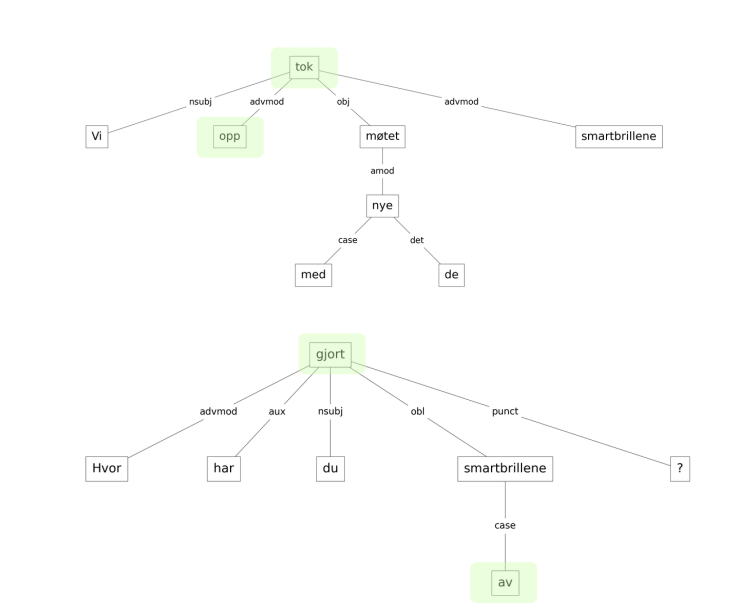
However, while there are techniques for lemmatization for Norwegian, these tend to be simplistic, and more importantly, do not allow for multi-token lemmas. This makes it difficult to identify fixed expressions and idioms, and it notably also presents a challenge for particle verbs, which are very frequent in Germanic languages. Examples in Norwegian are "ta opp" in the sense of "record" and "se til" in the sense of "make sure".
The newly published Humit-tagger (Yıldırım, Hagen and Haug 2026) marks an improvement in tagging of Norwegian text, exhibiting good results for POS-tagging. Stanza (Qi et al, 2020) further provides syntactic UD trees for Norwegian, which theoretically allow for the identification of verbal particles.
This thesis would investigate possible ways of using existing tools to extract this lexical information, as well as potentially training their own models, with the end goal of extracting lemmas and obtain a more accurate lexical representation of Norwegian text.
This thesis could be done in collaboration with the Norbruk center (Senter for norsk fagspråk i bruk), where lemmatization could be important in investigating lexical patterns in the data, especially since the large data material make manual lemmatization unfeasible.