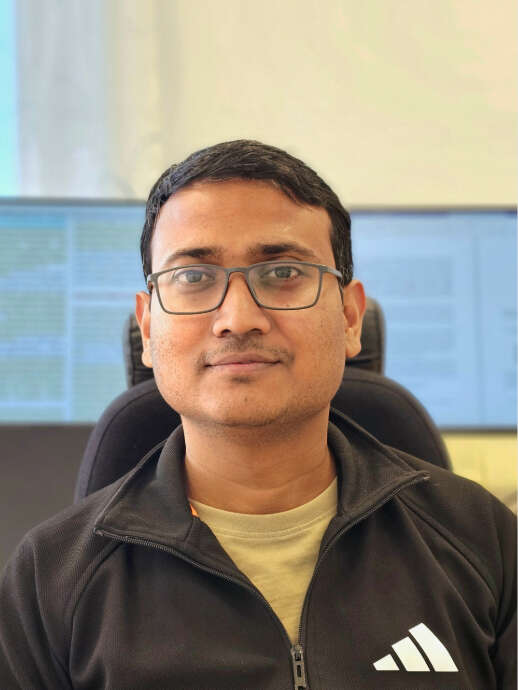
Delta på prøveforelesning - 17. august kl. 10:15 (rom 402, Institutt for teknologisystemer)
"Introduction and use cases of 6g ISAC, a 6g candidate technology".
Kreeringssammendrag
Maritim kommunikasjon påvirkes av store avstander, skygge fra fartøy og krevende forhold om bord på skip. Avhandlingen viser hvordan nye trådløse teknikker kan forbedre dekning, kapasitet og pålitelighet både mellom skip og land og inne på skip.
Hovedfunn
Towards Better Connectivity at Sea
Nine out of ten goods traded worldwide travel by sea, and modern ships increasingly depend on data for navigation, cargo tracking, engine monitoring, safety, and crew communication. Yet maritime wireless links remain unreliable. In near-shore environments, large vessels can block the direct signal between users and the shore, while sea reflections and changing propagation conditions make the signal unpredictable. Below deck, steel walls, doors, and narrow corridors create strong multipath reflections that distort signals. Communication may therefore fail precisely when it is needed most.
This thesis investigates practical ways to improve communication without relying only on costly satellites, conventional relays, or other infrastructure-heavy solutions. It proposes intelligent reflecting surfaces, which act like programmable mirrors for radio waves, together with advanced methods that allow several users to share the same frequencies more efficiently. The results show that these approaches can improve coverage, data rate, and reliability under vessel-induced shadowing and uncertain channel conditions. The thesis also shows that weak signal strength is not always the main onboard problem; delayed reflections can be equally important, and suitable signal-processing methods can reduce their effect. These findings support future maritime networks for safer navigation, remote monitoring, connected crews, and increasingly autonomous ship operations.
Leder av disputas
Prof., PhD Cecilie Rolstad Denby, Universitetet i Oslo
Bedømmelseskomité
1. Opponent: Professor, PhD, Kun Yang, Institute of Computer Science, College of Information Engineering, Zhejiang Ocean, Kina
2. Opponent: Senior forsker, PhD, Ole Grøndalen, Telenor Research & Innovation
Komitéleder: Prof., PhD, Anja Kohfeldt, Universitetet i Oslo
Veiledere
Hovedveileder: Prof., PhD, Pål Orten, Universitetet i Oslo
Medveileder: Senior forsker, PhD, Stig Petersen, SINTEF Digital
Kontaktinformasjon, kandid
Epost: Saurab.rauniyar@its.uio.no / rauniyar9@gmail.com]
Mobiltelefon +47 46253534
For mer informasjon
PhD-koordinator: Yvonne Baade