The 27 year old researcher from Sarzana, Italy, now living in Oslo and working at Centre for Space Sensors and Systems (CENSSS) at UiO Kjeller, obtained both his bachelor’s and master’s degrees at Italian universities, University of Pisa and Politecnico di Torino respectively, both in computer engineering. This subject studies computers both from the software point of view and from the hardware side.
- During the master, I specialized in computer systems used for automation and control, that is, used to control mechanical systems, such as aircrafts, spacecrafts, autonomous vehicles and robots, Virdis says.
- In the master thesis, I applied these techniques specifically to the control of satellite orientation. The thesis was carried out in collaboration with the European Space Agency (ESA) and Thales Alenia Space, a space company. In order to design an algorithm that allows a computer to steer a physical system in a desirable way, we need both a good understanding of its motion and of how to program these algorithms in computers. So it is a good mix between mathematics, physics, and computer engineering.
Researcher at the University of Turin
After the master thesis, Virdis spent an additional 6 months as a researcher at the same university in Turin (Politecnico di Torino). During this period, he focused on methods to guarantee the robustness of these control systems to uncertainty.
-This addresses the question: How can we (designers of a satellite) be sure that the system will behave as expected, even though we only have a rough and approximate understanding of its exact motion and of the environment in which it will operate?
Modern satellites need to be able to point a camera towards a certain point on Earth with extreme accuracy
This addresses one of the most difficult challenges in steering modern satellites, that is, they are required to perform increasingly complicated tasks while only having approximate information about the environment and its motion, says Virdis. For example, modern satellites used for Earth observations have extremely stringent pointing requirements, that is, they need to be able to point a camera towards a certain point on Earth with extreme accuracy. This in spite of disturbances, such as solar radiation pressure and vibrations, and limited knowledge about the physical parameters of the satellite itself, which tend to be difficult to exactly measure. All of these issues are especially true for smaller satellites, such as CubeSats, commonly used by smaller research institutes and universities that cannot operate under the same budgets compared to big aerospace companies.
Worked at Airbus Defence and Space in Germany for a year
After 6 months of research at Politecnico di Torino, Virdis wanted to apply the tools he learned on real satellites, and understand more about the real problems that real companies in the space industry face. He worked at Airbus Defence and Space in Germany for a year. During this year, he learned a great deal about how big satellites are designed, built, and tested. Due to the high risks involved in launching and operating a satellite, the researcher also learned about the big gap that still exists between the tools and topics discussed in academic research and the industrial practice.
-Can you tell the readers about your current research at CENSSS and UiO?
- My research at CENSSS and the Department of Technology Systems tries to reduce this academia-industry gap by proposing a way to include more recent advances in the field of control theory and automation to the control system of a real satellite, without sacrificing the safety and design capabilities enabled by the old methods which are still in use in the space industry. Also, it will demonstrate how it is possible to do so via neural networks, a famous class of machine learning tools that rose in popularity due to the recent successes in AI problems. In this sense, my work will also touch on the topic of safe and reliable AI, says Virdis.
Part of the CENSat-1 team
-At the same time, I am part of the CENSSS center and specifically part of the CENSat-1 team. CENSat-1 is the first satellite of the University of Oslo and will be the first in-orbit demonstrator for a certain number of scientific and technological advancements. As part of its daily operations, it will take measurements from within Earth’s atmosphere and will help answer a certain number of questions related to atmospheric and particle physics. In addition, it will also run a set of experiments designed by me and aimed at validating on a real system the future results of my research work.
Develops the first algorithm that will eventually fly on the satellite
These days, for Virdis, a significant amount of effort went into writing the satellite requirements that are part of the request for proposal. This is a step required in order to buy a satellite platform from New Space providers all over Europe.
- Now I will start developing the first algorithm that will eventually fly on the satellite. At the start I will focus on a small pointing problem, that will serve as the proof of concept for future developments.
- As part of this first proof of concept, the goal is to produce one paper to submit at the Conference on Decision and Control (CDC) 2025. This is the largest peer-reviewed conference in my research area and takes place once a year. This year it will take place in Rio de Janeiro in Brasil. The results of his master thesis were presented at the International Astronautical Congress (IAC) in 2021 in Dubai. This is the largest yearly conference on the general field of space and space technologies.
Research and career advice under supervision
Virdis works on his PhD under the supervision of Professor Mathias Hudoba de Badyn (UiO). They have regular meetings at the institute (ITS) at Kjeller.
-When we meet, we talk about research as well as planning my research and also for career advice. We also talk often outside of scheduled meetings. Other than my supervisor, I also interact often with other students, he says.
- In general, people at the institute (ITS) are always friendly and easy to talk to, and the environment is typically quite relaxed. I also meet many of my colleagues outside of work from time to time.
Into music and skiing
It is not only work that ooccupy Virdis life. He has several hobbies that helps him take his mind off of work and that helps him me recharge his batteries.
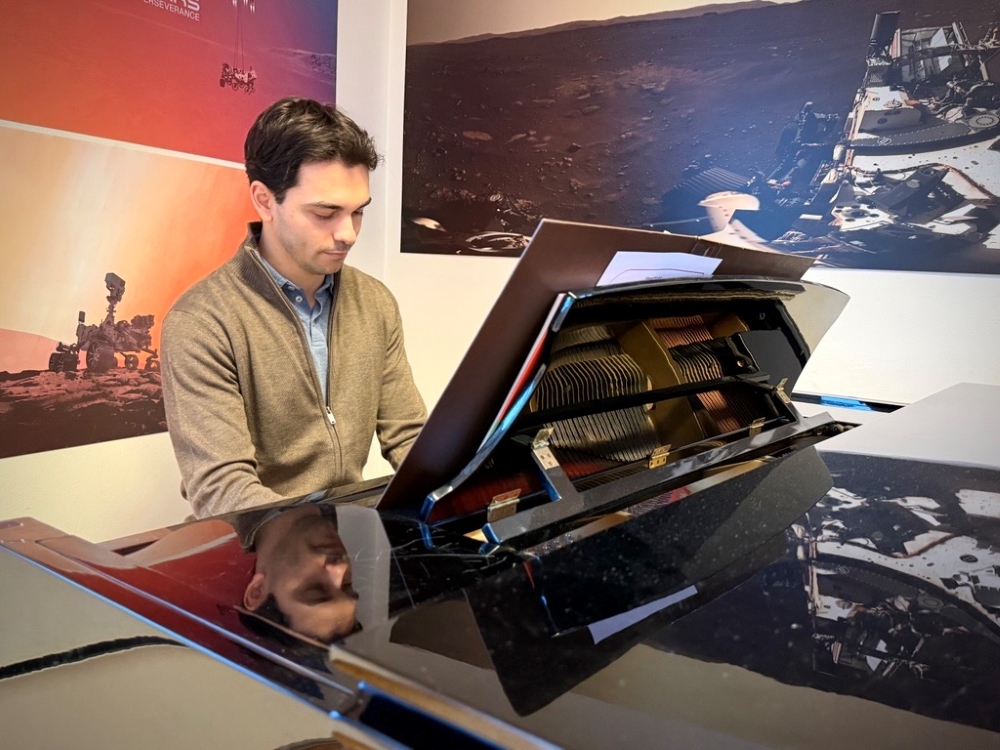
- I really enjoy playing piano and guitar, both classical music and more modern and jazz pieces. Especially piano which I play almost daily. Sometimes, I have also played together with some colleagues when we had some gathering at ITS, such as our monthly Lønningpils, as there are many music enthusiasts there. Another big hobby of mine is skiing. I really like alpine skiing and I have been doing it in the various countries where I lived since I was a kid. Recently, I have been introduced to the art of cross-country skiing and I go to practice from time to time. In general, I prefer doing outdoors activities, even in the winter, he says.
Takes longer to get used to the bread-based cold lunch
- I am really enjoying my time here in Norway. I find the people, both at work and outside, extremely friendly, and willing to help when I need. I did not struggle at all to make new friends. I suspect my Italian social side contributed to that. Also, I really like the city of Oslo, with all its different neighborhoods that feel like many smaller cities with their own differences in architectural style and variety of things to do and see. In general, I feel that the city has a lot to offer, also to young people. Complementing all of the city life experience, is all the amazing nature that can be reached very easily from the city center and that surrounds it. In the future I am planning to travel also to other famous destinations in Norway to explore it a little bit more. Of course, as with any country, there are also some cultural differences with respect to Italy. Nonetheless, it took me only a little bit of time to adjust and now I feel already like at home.
-To play a little bit up with the stereotype, the biggest difference that I can point out as an Italian is the approach to food. It takes a bit longer to get used to the bread-based cold lunch and the middag at 17 or 18 in the afternoon, he says with a smile on his face.
-Despite this, I have found it a lot easier here in Oslo to shop for a large variety of different ingredients than in Italy; ingredients that are needed when experimenting with cooking different types of food from all over the world.
-Where do you see yourself 10 years from now?
- As an early career researcher, it is very difficult to predict what I will be doing in 10 years from now. The research frontier moves very quickly and job markets have been really unpredictable. Nonetheless, I have always been leaning towards keeping my research applied and tackling problems of practical nature. I see myself as most likely working at some aerospace company, potentially to some extent with ties to the university, maybe as a lecturer or as a researcher. The role I feel I would like to have is to guide/lead some research project within a company in collaboration with university, also potentially involving students.
We are certain this ambitious and talented researcher will reach his future goals!