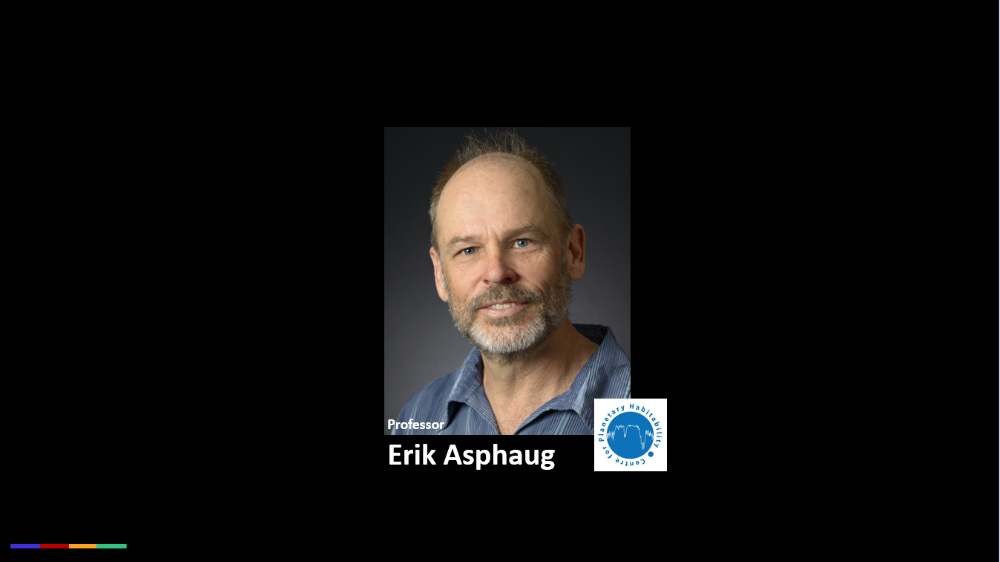
Our event series "ITS-Talks" will also showcase early career researchers and provide them with a platform for discussing their work on various topics. We welcome you to an Q & A after the presentations.
Program:
We are highly exited to host a special appearance from Erik Asphaug, who is a guest at Centre for Planetary Habitability (PHAB). Come and join us as he talks:
"Technological Realities of Asteroid Mining"
As mining activities on Earth become increasingly important, especially with regard to carbon-neutral energy production and electronics, yet increasingly costly, as economic investments and to the environment and quality of life, we take a more serious look at near-Earth asteroids and the technologies required to mine and utilize their resources. This talk is intended to start a conversation along these lines.
Compared to Earth’s crust, asteroids are rich in economically important materials such as platinum-group metals, cobalt, and rare earth elements like neodymium and yttrium. They have hydrated minerals and organic compounds invaluable for life support in space and fuel and food production; abundant iron and nickel; metallic copper; and bulk materials for construction and radiation shielding. I divide them into three categories: precious materials to be refined at the asteroid and returned for use on Earth; materials common on Earth but essential for human presence in space; and materials for manufacturing, medicine, electronics, and power production in space, leading to a near-Earth cislunar economy. The first could have a return on investment on a timescale of decades once we figure out the technologies of refinement, while the latter could dominate the human economy by the end of the century.
We have been standing at the door of this adventure for some time, yet no mission has ever flown to an asteroid for the purpose of economic gain. Indeed, there has never been a controlled landing on an asteroid. Demonstrating how to manipulate and process asteroid materials in situ is too pragmatic, and too challenging and high risk, for a science agency, and too costly in the near term for private industry. But we know what is out there, and how to get there, from international missions such as OSIRIS-REx and Hayabusa 2 that conducted touch-and-go sampling, and DART and the ongoing Hera mission that demonstrate planetary defense, and from the thousands of meteorites that have landed on Earth.
Most asteroids are rubble-piles beaten down by impacts, their surfaces weathered and comminuted, subject to intense thermal cycling and radiation. Their interiors are largely unknown. We can simulate a rubble-pile in the lab by piling meteorite fragments; however this is limited to Earth-gravity, or floating in zero gravity onboard a space station. We have only a very limited knowledge, much of it based on theory, of asteroid regolith in milligravity, where there is decidedly a “down” but with a gravitational force only ~1/100,000 that of Earth, an escape velocity ~10 cm/s. Without such knowledge, asteroid mining concepts often advocate heritage approaches such as excavators, bucketwheels and grinders, but such operations would have to slow to a crawl, lest the material fly off into space. There is no bedrock to anchor to; machines will displace or fluidize their terrain they rest on, and might flip over or float away. And there is no air, let alone water, to advect heat, process materials, or mitigate dust. The static pressure at depth is ~100,000 times lower, so internal friction is nearly zero until a load is applied by a machine or in a conveyance, creating nonlinear jamming conditions.
We need to erase the whiteboard and re-think mining technology from first principles: on an airless world with next to zero gravity, but enough gravity to segregate materials and hold things (eventually) to the ground; a place that cycles day and night every few hours with temperature swings of 200°C; a place where volatiles can be baked out of hydrated or carbonaceous rocks; a place where unconfined blasting would create a globally-encompassing debris ring that could mess with operations for months, or could be exploited as a part of the mining process, or could set the body or its debris on a hazardous trajectory; a place where electrostatic, thermal and radiative effects can have profound influence on particles in the very weak gravity, allowing material sorting based on size, dielectric, or photometric differences; a place where small gas flows can mobilize and potentially segregate large volumes of fines.
To succeed we need to identify and then exploit the operational advantages in the airless milligravity environment. This will require missions of fundamental investigation. But a mission to test mining concepts at an asteroid would easily cost $1B given the distance, and unknowns, and risks and requirements. Extended surface operations would require thermionic or other compact power generation, and autonomous control given the communication lag of minutes and limited bandwidth. Most critically it would be years between such costly missions, and this is unacceptable for technology development. To address this we have proposed low-cost “artificial asteroids” that would operate in low-Earth orbit for about a year: solar-powered 12U cubesat laboratories rotating at ~1 rpm with an enclosed meteorite bedload in vacuum, closely mimicking the asteroid environment. Manipulation, segregation and other science experiments, and robotic mechanisms, would be set up to operate repeatedly, monitored in real time and with high data rates via satellite networks or distributed ground stations. (We cannot do this inside the ISS because its ambient vibrations exceed the gravity of a small asteroid.) The modest investment threshold, ~$10M per mission, allows a high tolerance of risk, putting new ideas, instruments and operations to the test with a rapid pace of re-flight, raising payloads to TRL-9 for the first mining operations at an asteroid.
The seminar is open to anyone, so feel free to forward this invitation to anyone who might be interested.