Background
The core of an autonomous system such as a robot or a self-driving vehicle is its system intelligence. This can be thought to be specializing on two main areas:
- Perception: analyzing the sensor signals and hence understanding the environment and situation.
- Action: generating the appropriate set of actions to achieve the defined goals.
In traditional practice, perception and action modules are designed manually. However, applying machine learning, in particular deep learning, to design those modules has several advantages. Broadly speaking, we can think of three types of approaches to applying deep learning for design of autonomous systems.
- Deep learning for perception
- Deep learning for action generation
- End-to-end learning where perception and action generation are learned as a whole
This proposal includes a number of different projects which deal with using these approaches in connection with different platforms/datasets.

Platforms/Datasets
Hugin
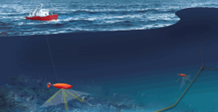
Hugin is an autonomous underwater vehicle (AUV) developed by FFI and Kongsberg. Hugin has several on board sensors, but the main one is a sonar sensor. Signals collected using the sonar sensor can be processed to form so called Synthetic Aperture Sonar (SAS) images of the seafloor. Such datasets of SAS images can be used for situation understanding of underwater environments.
BridgeData v2
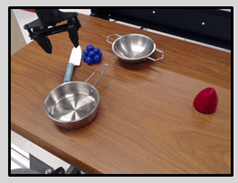
BridgeData V2 is a large and diverse dataset of robotic manipulation behaviors designed to facilitate research in scalable robot learning. This is basically a set of videos demonstrating how a manipulation robot performs different tasks.
NVIDIA Isaac SIM
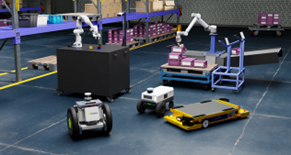
NVIDIA Isaac Sim is a powerful simulation platform that enables developers to test and validate robotics algorithms in realistic virtual environments. It integrates seamlessly with deep learning frameworks such as Pytorch.
Example Projects
Perception learning on Synthetic Aperture Sonar (SAS) images
The main challenge here is to understand the situation/environment using SAS images. Potential topics include
- Object detection and classification in SAS images
- Generation and use of SAS-like simulated data using techniques such as Generative Adversarial Networks (GAN) or Diffusion models
- Multimodal processing (i.e. using multiple inputs of different types of sensors) or multi-view processing (i.e. using multiple views of the same scene )
End-to-End learning with BridgeData-v2
The objective here is to train a manipulation robot using video demonstrations. Potential topics include
- Behavior cloning
- Action transformers
Reinforcement Learning with Isaac SIM
The Aim of this project is to train a mobile robot simulated in the Isaac SIM environment using reinforcement learning.
Topics and issues can include
- Becoming familiar with the Isaac SIM environment
- Deep Reinforcement learning
- Combining deep learning with concepts from control theory such as model predictive control (MPC).
Contact
Narada Warakagoda
Narada-dilp.warakagoda@ffi.no