Events - Page 11

Hydrogels are hydrophilic polymer scaffolds surrounded by adsorbed water. From a dry state, they are capable of swelling in volume by up to two orders of magnitude – becoming up to 99% water - whilst still remaining solid (if a little squishy).
Responsive hydrogels lose this affinity for water – sometimes quite profoundly – when an environmental stimulus, such as temperature or pH, transitions beyond a critical value. Conformational changes in the scaffold squeeze the water out, and the gel shrivels dramatically. This volume change is reversible (albeit non-reciprocal), allowing for cycles of activation and deactivation. As such, responsive hydrogels have important and exciting applications in microscale actuators.
This talk will describe some of the big open areas of hydrogel modelling, before detailing two (very) recent unpublished theoretical pieces of work on 1) thermoresponsive displacement pumps for microfluidic devices, and 2) coupling pH-responsive gels to oscillating reactions to enable communication and synchronisation.

QOMBINE seminar by Franz Fuchs and Ruben Bassa (UiO)

Doctoral candidate Ingrid Dæhlen at the Department of Mathematics will be defending the thesis The best of the bad: Precise and robust estimation and model selection for the degree of Philosophiae Doctor.

The first stage of sea ice formation is often grease ice, a mixture of sea water and frazil ice crystals. Over time grease ice congeals to a solid sea ice cover, often in the form of pancakes. Grease ice is usually not simulated in large-scale sea-ice ocean models, but impacts ocean heat loss and ice growth.
A set of laboratory experiments on frazil and grease ice in a turbulent flow is presented, showcasing the growth process and a frazil ice size spectrum. Existing 1D simulations illustrates how frazil ice crystals remain sub-surface and can aggregate with particles (sediments) in the water. A simple approach capturing basic grease ice properties for 3D climate models is presented and shows a 10-30% increase in mean winter Arctic Ocean heat loss compared to standard simulations. The grease ice layer is ‘hurdled’ towards existing floes and congeals as pancake ice. The onwards transition to a ‘normal’ congealed ice cover is assumed to take place over 24h when ∼50 % of the grease has formed solid ice, but new observations are needed to better resolve this transition. Grease ice also dampens waves and simulating this in wave models may be the focus of future research.
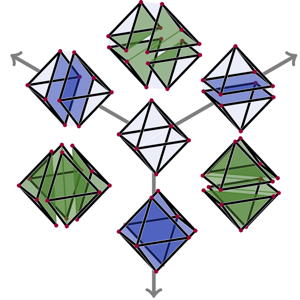
Positive geometry is a recent branch of mathematical physics which present exciting connections with real, complex and tropical algebraic geometry.
In this talk, we introduce the topic by developing the positive geometry of del Pezzo surfaces and their moduli spaces.
We will analyze their connected components, likelihood equations and scattering amplitudes.
The talk is based on joint work with Early, Geiger, Sturmfels and Yun.
Abstract: I will introduce a certain configuration space associated with a graph, and compute its cohomology ring. It turns out to be related to internal zonotopal algebras, which were introduced in the context of approximation theory and show up in many different contexts.
This is joint work with Colin Crowley, Galen Dorpalen-Barry, and Andre Henriques.

Positroids are a class of matroids that were introduced by Postnikov in 2006 that index a certain stratification of the totally non-negative Grassmannian. These matroids are famously in bijection with a “zoo” of combinatorial objects including Grassmann necklaces and plabic graphs. We introduce a new family of positroids called rook matroids that arise from restricted rook placements on a skew shaped board and discuss it in terms of this zoo. We highlight the transversal structure of rook matroids and the slightly mysterious relationship they share with lattice path matroids. This is joint work with Per Alexandersson and ongoing work with Irem Portakal and Akiyoshi Tsuchiya.

Gunnar Taraldsen is professor at Department of Mathematical Sciences, NTNU. His current research interest focusses on the foundational principles of statistical inference including quantum probability, artificial intelligence, and machine learning. The aim is to bridge foundations for statistical inferences, to facilitate objective and replicable scientific learning, and to develop analytic and computing methodologies for data analysis.
Earlier research includes quantum mechanics, mathematical physics, measure theory, probability, medical ultrasound, non-linear wave propagation, numerical acoustics, medical statistics, outdoors sound propagation, community noise annoyance, acoustic noise mapping, underwater localization, underwater wave propagation, and spherical microphone arrays.

Doctoral candidate Oriol Zamora Font at the Department of Mathematics will be defending the thesis Stochastic volatility modeling with self-exciting jumps: Applications to finance and life insurance for the degree of Philosophiae Doctor.
The Section 4 seminar for Spring 2025 will be held on Tuesdays at 09.10 am in room 1020.
The revised EU Renewable Energy Directive, adopted in 2023, sets an EU target for renewables of at least 42.5%, which will require that the installed wind capacity grows to more than 500 GW by 2030. A major part of this target is offshore wind energy, with bottom-fixed substructures in water depths up to about 70m, and floating platforms for deeper waters. Due to the coupling between loads, motions and control system, analysis of floating wind turbines is usually carried out with time-domain aero-servo-hydro-elastic simulation tools. The seminar will give a technology overview, state-of-the-art in modelling, and mention some of the scientific challenges currently being addressed in the wind energy community.
Workshop at University of Oslo

Emil Aas Stoltenberg is assistant professor at BI Norwegian Business School, and associate professor (20%) at the University of Oslo (UiO). He holds a PhD in statistics from UiO (2020). From the first of June this year, he will be full-time at UiO.
Doctoral candidate Pin-Tzu Su at the Department of Mathematics will be defending the thesis Tsunami-induced boulder and debris transport on sedimentary slope for the degree of Philosophiae Doctor.
Chebyshev varieties are algebraic varieties parametrized by Chebyshev polynomials or their multivariate generalizations. We determine the dimension, degree, singular locus and defining equations of these varieties. We explain how they play the role of toric varieties in sparse polynomial root finding, when monomials are replaced by Chebyshev polynomials. We present numerical root finding algorithms that exploit our results. Joint work with Zaïneb Bel-Afia and Chiara Meroni.
The amplituhedron is a semi-algebraic set given as the image of the positive Grassmannian under a linear map subject to a choice of additional parameters. We define the Infinituhedron as the limit of amplituhedra by sending one of the parameters to infinity. We derive its algebraic boundary in terms of Chow varieties and explain its geometric interpretation from the point of view of Positive Geometry in terms of secants of the rational normal curve. This discussion shows that the Infinituhedron is a positive geometry with a unique differential form. Joint work with Rainer Sinn.

Clara Bertinelli Salucci is a Postdoctoral Fellow at the Department of Mathematics, affiliated with the PLUMBIN' (Physics Learning Using Machines and Bayesian INference) project at the University of Oslo. She completed her PhD in Statistics and Machine Learning at the University of Oslo in April 2024, where she developed statistical and machine learning methods for diagnostics and prognostics of lithium-ion batteries for maritime applications. Currently, she is investigating the role of likelihood ratio test statistics for hypotheses tests in experimental and theoretical particle physics, focusing on deviations from Wilks' theorem in the search for new particles. Her postdoctoral research combines her expertise in statistics with her background in high-energy physics.
Atmospheric clouds are complex three-phase systems containing ice crystals, supercooled liquid droplets, and water vapor. They are responsible for rain/snow formation and play a primary role in the planet’s radiative energy budget and the water cycle. In this talk, after describing the peculiar thermodynamics problems of water below 0 °C and the relative open scientific questions, I will present our first results on the role of turbulence in the condensation/evaporation processes in mixed-phase clouds where ice crystals grow at the expense of liquid droplets.
Recent experiments have shown that epithelial monolayers can behave as self-propelled solid elastic membranes, and that global directed motion (polar order) emerges through the hierarchical annihilation of contractile elastic vortices and their anti-vortices[1]. Polar ordering dynamics in fluid cell layers is often modelled by neighbour alignment (Vicsek or Vicsek like models), another model is collective flow-alignment (move in the direction of flow). Here I will discuss the differences and similarities of these two mechanisms in solids. Both can give rise to interacting elastic vortices , but one model is essentially linear, while the other is non-linear and exhibit a rich dynamics which likely is relevant to many types of biological cell layers in the solid state. [1] E. Lång, A. Lång, P. Blicher, T. Rognes, P.G. Dommersnes, S. O. Bøe, Topology-guided polar ordering of collective cell migration, Sci. Adv. (2024)
Note the non-standard time!
In the first part of the talk, I will give an introductory talk to o-minimality, giving the definitions and some of intuition through understanding which Lie groups are amenable to being understood in o-minimal contexts.
In the second part I will state the two theorems which have had the most important applications to algebra and give some intuition of how (at least one of them) has been used.

Dr Kevin Burke is an Associate Professor of Statistics at the University of Limerick (UL) with research interests in flexible statistical modelling, penalised regression, neural networks, random effects, survival/reliability analysis, and industrial modelling. See https://kevinburke.ie/ for more details. Previously he was Director of UL's Industrial Mathematics Unit (from 2016 - 2020), and a Science Foundation Ireland Public Service Fellow with the Food Safety Authority of Ireland (2020 - 2021). He is the Vice President of the Irish Statistical Association, and the Chair of the International Workshop on Statistical Modelling (IWSM) 2025. IWSM 2025 will be hosted in Limerick City, Ireland, from Sunday 13th July to Friday 18th July 2025; the call for papers is currently open (https://iwsm2025.ie/call-for-papers).