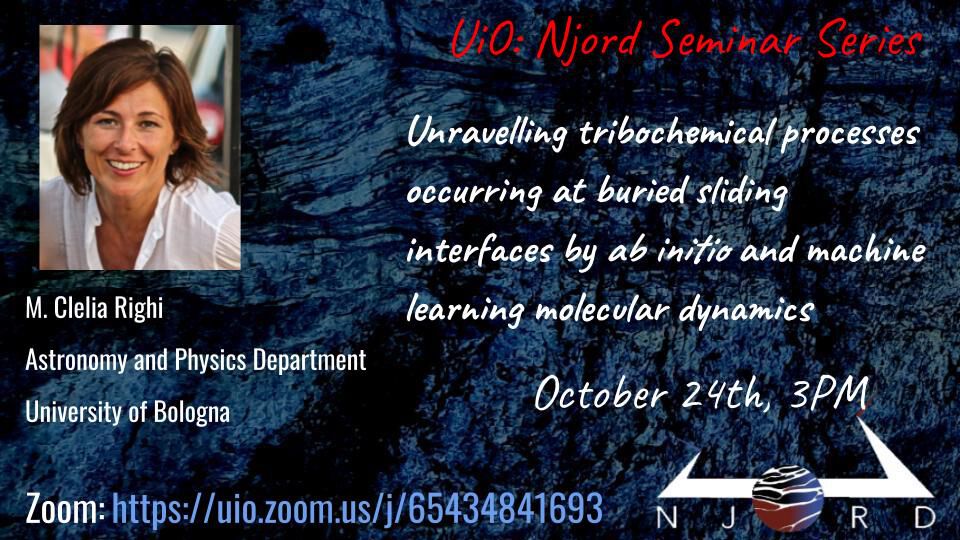
Unravelling tribochemical processes occurring at buried sliding interfaces by ab initio and machine learning molecular dynamics
Tribochemical reactions are chemical processes activated at the interface between two solids in relative motion. Understanding the activation mechanisms and pathways of tribochemical reactions is challenging, as they take place at the buried interface between two contacting solids, which cannot be directly probed in real time by experiments. Simulations can therefore play a key role, particularly those based on quantum-mechanical approaches, which allow for an accurate description of material behavior under conditions of enhanced reactivity.
I will describe how we used ab initio and machine learning-informed molecular dynamics (ML-MD) to identify key tribochemical mechanisms responsible for the frictional drop in different classes of materials. In particular, I will show that tribologically induced water dissociation can passivate reactive carbon dangling bonds formed during rubbing, thereby enhancing the lubricating properties of diamond and graphite.
I will also show that slippery 2D materials can form in situ via tribochemical reactions. For example, we demonstrated that graphene can be tribologically formed from methane or aromatic molecules, and that transition metal dichalcogenide layers can develop by sprinkling chalcogen nanopowders onto metal surfaces. Finally, I will show that large-scale ML-MD simulations can be used to perform in silico experiments to investigate the behavior of confined liquids, including friction-reducing molecules.
These results are part of the ”Advancing Solid Interface and Lubricants by First Principles Material Design (SLIDE)” project that has received funding from the European Research Council (ERC) under the European Union’s Horizon 2020 research and innovation program (Grant agreement No. 865633).
Short bio: M. Clelia Righi is full Professor at the Physics Department of Bologna University, Italy. Her research activity focuses on the development and application of computational tools to understand and predict the behaviour of materials from first principles, particularly of surface and interface phenomena. She adopted pioneering approaches in tribology and applied them for for understanding chemical reactions activated by mechanical stresses and designing materials to reduce friction. In 2019 she received an ERC consolidator grant for the project “Advancing solid interfaces and lubricants by first principles material design” (SLIDE). M. Clelia Righi collaborates with multinational companies operating in the automotive and lubricant sectors.
To get news, invitations to seminars and more from Njord, please go here to subscribe to our newsletter.