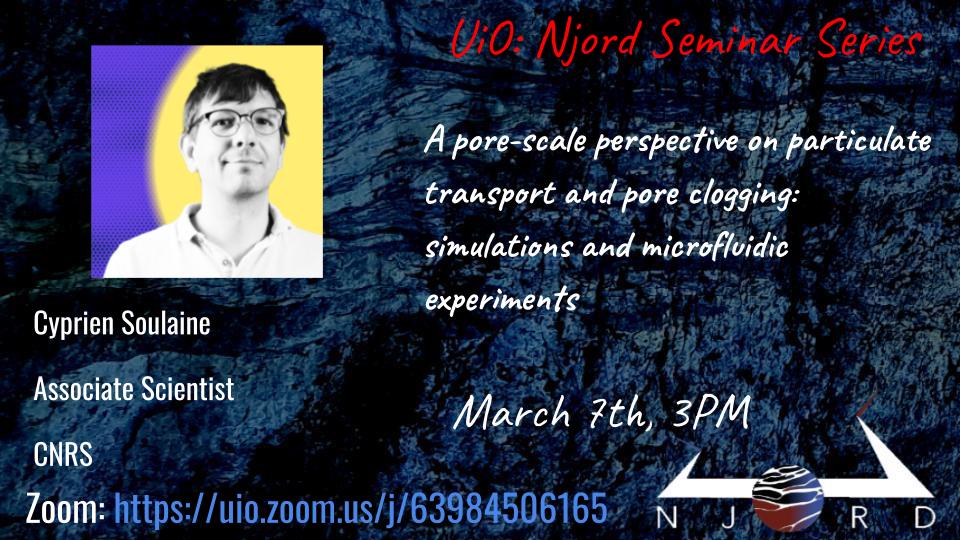
A pore-scale perspective on particulate transport and pore clogging: simulations and microfluidic experiments
In porous media, colloids (including nanoparticles, bacteria, and fine particles) are ubiquitous and lie in suspension in a carrier fluid or are attached at interfaces such as the pore walls or the interface between two immiscible fluids (air-water or water-oil for example). The nature of the particles can vary significantly and their presence in the soils and subsurface may be desired or on the contrary, avoided. For example, engineered metal nanoparticles are injected into the subsurface for groundwater remediation. Inversely, the in situ precipitation and subsequent transport of reactive solid particles in far-from-equilibrium conditions or the detachment and mobilization of fines – small particles of sand or clay loosely attached to the pore walls – by hydrodynamics forces threaten geothermal and oil reservoir productivity by reducing permeability near the wells. Other situations of prime interest include the transport of bacteria and viruses, the adsorption of asphaltenes at oil/water interfaces, and the fate of micro-nano plastics.
We developed a high-resolution pore-scale simulator to investigate particle depositions and permeability reduction for various flow, pH, and salinity conditions. Our approach relies on a four-way CFD-DEM (Computational Fluid Dynamics – Discrete Element Method) coupling in which fluid flow is governed by Navier-Stokes equations in a fixed grid and the particle dynamics is described in a Lagrangian frame. The model accounts for contact forces as well as long-range interactions including Van der Waals and electrostatic forces. Our model captures the different mechanisms responsible for pore-clogging: sieving, bridging, and aggregation of particles. The numerical model is successfully benchmarked using well-controlled microfluidic experiments.
Short bio: Cyprien Soulaine is an Associate Scientist at CNRS, the French National Center for Scientific Research, Europe’s largest fundamental science agency. Since 2009, he has been working at the Institute of Earth Sciences of Orléans (ISTO), where he leads the Porous Media Research Group. His research focuses on developing advanced numerical models for subsurface applications in the energy transition, leveraging the open-source platform OpenFOAM. He specializes in new energy vectors (e.g., geothermal energy, hydrogen), geological gas storage (e.g., CO₂, H₂), and water resource preservation. He holds a PhD in fluid mechanics from the National Polytechnic Institute of Toulouse, which he defended in 2012 under the supervision of Michel Quintard. He then spent five years as a Research Associate in Hamdi Tchelepi’s group at Stanford University, where he developed pore-scale models for carbon capture and storage (CCS).
To get news, invitations to seminars and more from Njord, please go here to subscribe to our newsletter.