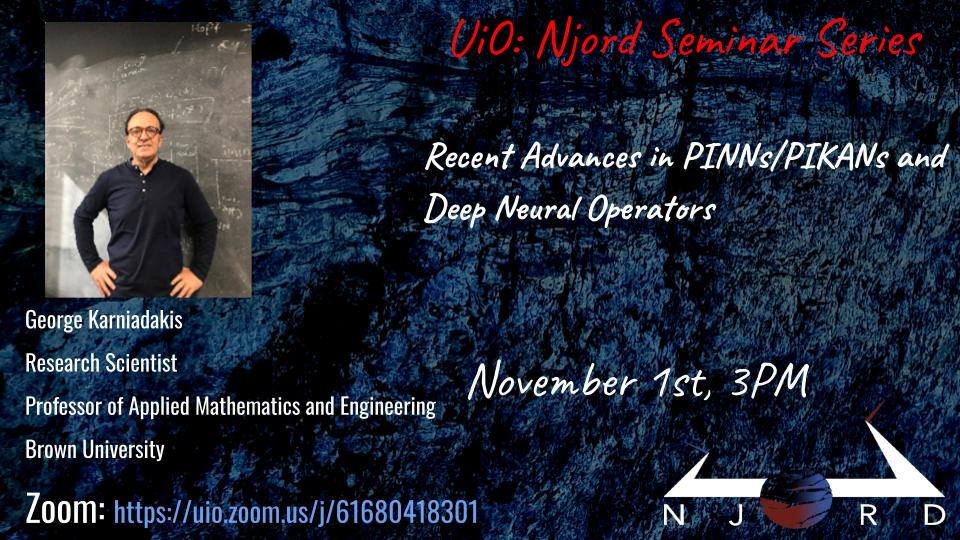
Title of the talk: Recent Advances in PINNs/PIKANs and Deep Neural Operators.
We will review physics-informed neural networks (PINNs) and summarize available
extensions for applications in computational science and engineering. One such extension is PIKANs, a new representation with Kolmogorov-Arnold Networks. We will also review new representations of interpretable deep neural operators that take as inputs functions and distributions for system identification and real time inference. We will then present how we can interface PINNs and neural operators, such as DeepOnet. with finite elements for data assimilation, inverse problems and multiscale problems. In addition, we will highlight how we can develop fast solvers based on preconditioning the linear systems using DeepOnet that leads to order of magnitude speed up and overcomes the problems encountered with multigrid methods. Finally, we will present new bio-inspired architectures, including spiking neural networks that are the best candidates for breaking the current trend of extremely steep demand for GPU computing using artificial neural networks.
Short bio: George Karniadakis is from Crete. He is a member of the National Academy of Engineering and a Vannevar Bush Faculty Fellow. He received his S.M. and Ph.D. from Massachusetts Institute of Technology (1984/87). He was appointed Lecturer in the Department of Mechanical Engineering at MIT and subsequently he joined the Center for Turbulence Research at Stanford / Nasa Ames. He joined Princeton University as Assistant Professor in the Department of Mechanical and Aerospace Engineering and as Associate Faculty in the Program of Applied and Computational Mathematics. He was a Visiting Professor at Caltech in 1993 in the Aeronautics Department and joined Brown University as Associate Professor of Applied Mathematics in the Center for Fluid Mechanics in 1994. After becoming a full
professor in 1996, he continued to be a Visiting Professor and Senior Lecturer of Ocean/Mechanical Engineering at MIT. He is an AAAS Fellow (2018-), Fellow of
the Society for Industrial and Applied Mathematics (SIAM, 2010-), Fellow of the
American Physical Society (APS, 2004-), Fellow of the American Society of Mechanical Engineers (ASME, 2003-) and Associate Fellow of the American Institute of Aeronautics and Astronautics (AIAA, 2006-). He received the SES G.I. Taylor medal (2014), the SIAM/ACM Prize on Computational Science & Engineering (2021), the Alexander von Humboldt award in 2017, the SIAM Ralf E Kleinman award (2015), the J. Tinsley Oden Medal (2013), and the CFD award (2007) by the US Association in
Computational Mechanics. His h-index is 145 and he has been cited over 112,000 times.
To get news, invitations to seminars and more from Njord, please go here to subscribe to our newsletter.