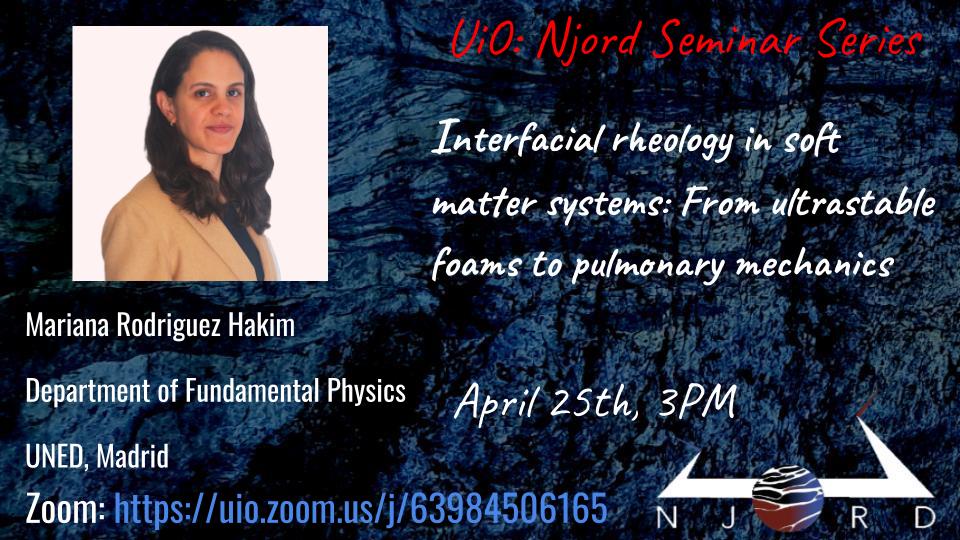
Interfacial rheology in soft matter systems: From ultrastable foams to pulmonary mechanics
A fluid-fluid interface is the boundary separating two immiscible fluids. “Simple interfaces” are fully characterized by a surface tension, which represents the excess free energy per unit area of a molecule at the interface compared to one in the bulk. Surface tension gives rise to intricate and fascinating effects such as capillary forces, which explain why the pressure inside a spherical drop or bubble exceeds that of the surrounding medium, and Marangoni flows, which drive everyday phenomena like tears of wine or the rapid spreading of oil films on water.
However, most interfaces of natural, biomedical, and technological interest are formed by adsorbed compounds – such as proteins, polymers, lipids, or particles – that laterally interact, forming extensive microstructural networks that mechanically oppose flow and deformation. Aside from a surface tension, these “complex interfaces” also exhibit a mechanical resistance to changes in area and shape, which bestow the interface with its own elastic and viscous properties. These mechanical properties can dictate the behavior of systems with large surface area to volume ratios (e.g., emulsions, foams, biological cells) and thin liquid films (e.g., tear film, lung surfactant film). The study of how complex interfaces respond to flow and deformation is known as interfacial rheology.
In this seminar, I will explore different interfacial phenomena at complex interfaces and their relevance to real-world applications, ranging from the design of ultrastable foams for concrete to the role of mechanical stresses in enabling lung function during breathing. Special attention will be given to describing the instruments (i.e., interfacial rheometers) and physical models used to measure and quantify the interfacial rheological properties. Using illustrative examples, I will demonstrate how interfacial rheology experiments are conducted, the types of quantitative data they provide, and how surface rheological properties can be tuned to optimize the function of complex interfacial systems.
Short bio: Mariana Rodríguez-Hakim obtained her Bachelors (2014) and Masters (2015) degrees in Chemical Engineering at the Massachusetts Institute of Technology (MIT, USA), followed by a Ph.D. from Stanford University (USA) in 2020 under the supervision of Prof. Gerald G. Fuller. Her doctoral research focused on transport and rheological phenomena at fluid-fluid interfaces, with emphasis on small-scale systems (thin films, emulsions) exhibiting complex and/or nonlinear interfacial boundary conditions. After completing her Ph.D., she joined the Soft Materials Group at ETH Zürich (Switzerland) as a postdoctoral researcher with Prof. Jan Vermant, where she developed custom experimental setups to study aerosol formation during sneezing and quantified foam stability for applications in concrete manufacturing. In 2023, she joined the Department of Fundamental Physics at UNED (Spain) as an Assistant Professor in the Laboratory of Complex Systems. Her research focuses on the design of custom instrumentation and analytical methods for interfacial dilatational rheology, as well as the study of structure-property relationships in interfacial lung surfactant films and their role in pulmonary function.
To get news, invitations to seminars and more from Njord, please go here to subscribe to our newsletter.