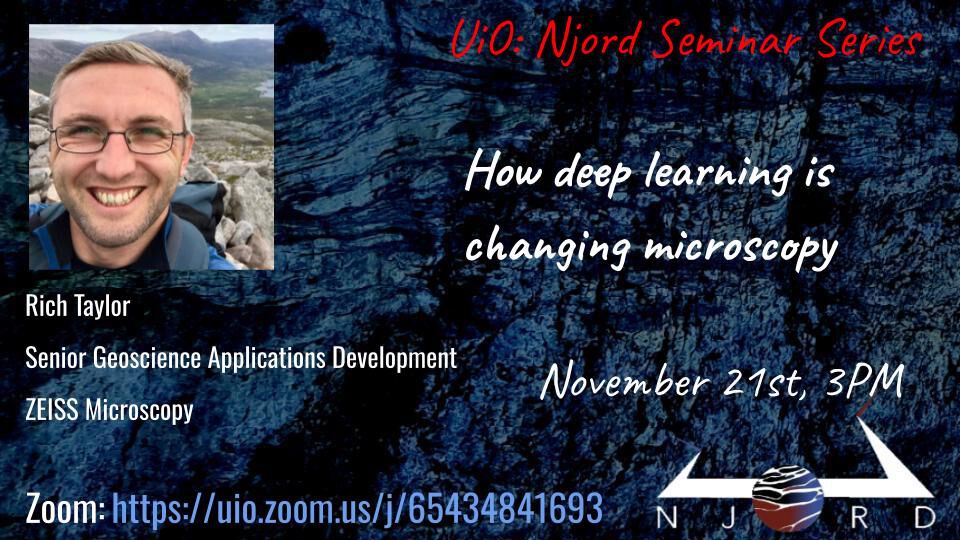
Title: How Deep Learning is Changing Microscopy
Geologists have always used a wide variety of microscopy and microanalysis tools for a broad range of rock and mineral characterisation. As datasets become larger and projects become grander in scale, we are increasingly seeing the use of machine learning techniques to streamline all kinds of data acquisition and processing. These techniques have often highlighted the inconsistent nature of data handling by the geoscience community.
In many ways this is not the fault of the geologist. The complex nature of rock samples, covering more orders of magnitude in scale, and requiring a detailed understanding of texture and chemistry, that goes far beyond other material sciences.
Right now we are seeing the rapid emergence of deep learning neural networks (DLNN) across light, electron and X-ray microscopy. These DLNN approaches cover many aspects of our data workflow, from improving image quality, upscaling resolution, segmentation and interpreting complex data. Electron and X-ray microscopy have their unique challenges, form the interpretation of chemical data for mineral identification, to noisy images and handling large data files. All these tasks are ideal territory for the implementation of a variety of DLNN methods.
However, light microscopy in particular provides a fantastic example of the personal nature of geological sample interpretation. Petrography training, and the subsequent ability to identify and interpret the mineralogy of a thin section, is the epitome of a standard geoscience task that has proved exceedingly hard to automate. Much of this is due to the vast number of minerals with overlapping optical properties, of which we use a dynamic (e.g. rotating polarisation) understanding to interpret a thin section. This is a combination of a huge amount of information with which we train our human brains, and standard data processing, even standard machine learning techniques are simply not “smart enough” to replicate.
In this talk we will cover a variety of implementations of DLNN across both open source academic software for bespoke applications, and the latest software technologies that are being developed to work alongside microscopy and microanalysis systems.
Short bio: Rich completed a PhD in Experimental Petrology at the University of Edinburgh in 2009, before moving to Curtin University in Western Australia as a SIMS laboratory specialist. He subsequently held research positions in the School of Earth and Planetary Sciences at Curtin studying geochemistry and geochronology, specialising in imaging and microanalysis. In 2017 he moved to the University of Cambridge to study magnetic inclusions in Earth’s oldest materials using novel microscopy techniques. In 2019 Rich moved to Zeiss based in Cambourne, UK to take on the global Geosciences Applications Development role.
To get news, invitations to seminars and more from Njord, please go here to subscribe to our newsletter.