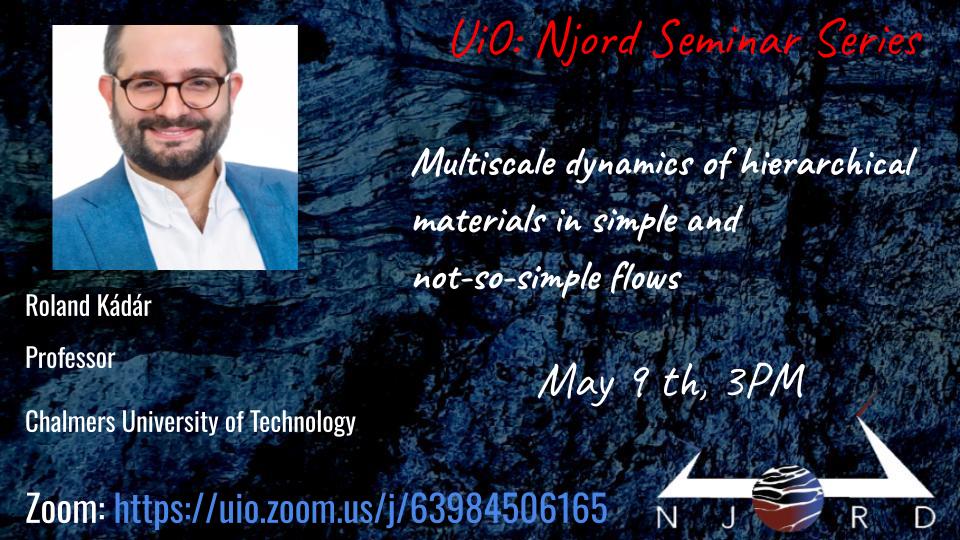
Multiscale dynamics of hierarchical materials in simple and not-so-simple flows
The seminar will give a broad introduction to what our current focus is in the Rheology and Processing of Soft Matter Group at Chalmers (www.rheo-chalmers.se). Thereafter, we will focus on a set of intriguing experiments related to flow dynamics of hierarchical materials. By hierarchical materials, we refer here to self-assembling nanostructured fluids (will refer mostly to cellulose nanocrystals and a little bit on graphene oxide and low molecular gelator systems). Simple and not-so-simple flows refer to experiments that cover viscometric flows but also simple flows beyond their laminar flow limit, e.g. Taylor-Couette flow. Thus, the presentation will outline how the propagation of orientation across lengthscales takes place based on experimental insights combining rheology, polarized light imaging, and small-angle x-ray scattering (Rheo-PLI-SAXS) and that flow alignment at mesoscale most often does not correspond to alignment as measured at nanoscale. Beyond the laminar flow limit, the presentation will outline how nanoparticle aspect ratio and / or morphology appears to determine whether or not nanoscale particle dynamics follow the same space-time pattern characteristics as macroscopic vortex patterns .
Bio: Roland is Professor at Chalmers University of Technology in Göteborg, Sweden. He joined the faculty on a tenured position in 2014 and is leading a research group focused on the Rheology and Processing of Soft Matter (www.rheo-chalmers.se). Current research revolves around (i) complex fluids flows, (ii) field-matter interaction in nanostructured fluids for multifunctional properties, and (iii) advanced rheometry. Some research highlights of the group include the development of a new class of antibacterial surfaces (https://news.cision.com/chalmers/r/graphite-nanoplatelets-on-medical-devices-kill-bacteria-and-prevent-infections,c3179198 ), a novel nanostructure orientation method using magnet arrays (https://news.cision.com/chalmers/r/graphene-spike-mat-and-fridge-magnet-technology-to-fight-against-antibiotic-resistance,c4041029), and novel rheo-SAXS-related techniques (https://www.chalmers.se/en/current/news/ims-new-method-reveals-how-materials-behave-across-multiple-length-scales/).
At Chalmers, Roland is Principal Investigator in the Wallenberg Wood Science Centre (WWSC), Vinnova Competence Centre '2D material-based technology for industrial applications' (2D-TECH), and the FibRe Vinnova Competence Centre. In addition to his activities at Chalmers, Roland is also an Affiliated Visiting Research Fellow at the MAX IV Laboratory, Lund University, Sweden, where he is part of a Science Initiative on Advanced Rheological Characterization (www.maxiv.lu.se/rheology) and is a Research Fellow at LINXS Institute for Advanced Neutron and X-ray Science, Lund, Sweden, where he leads a national theme on Advanced Rheometry for Neutron and X-ray Science (https://www.linxs.se/advanced-rheometry-for-neutron-and-x-ray-science). He currently serves on the executive council of the European Society of Rheology (www.rheology-esr.org) as a member-at-large and as a Nordic Rheology Society (NRC) representative to the International Committee on Rheology (www.icrrheology.org) and is past-president of the NRC (www.nordicrheologysociety.org).
Previously, Roland has served as an individual member delegate of the European Society of Rheology, President of the Nordic Rheology Society (2020-2024), and as Editor of the Annual Transactions of the Nordic Rheology Society (2014-2020). Prior to his work at Chalmers, Roland was a postdoctoral researcher at the Karlsruhe Institute of Technology (KIT; Prof. M. Wilhelm), Germany. He obtained his PhD degree from the Polytechnic University of Bucharest (REOROM Group, Prof. C. Balan), Bucharest, Romania, and has masters and bachelors degree from the same university.
To get news, invitations to seminars and more from Njord, please go here to subscribe to our newsletter.