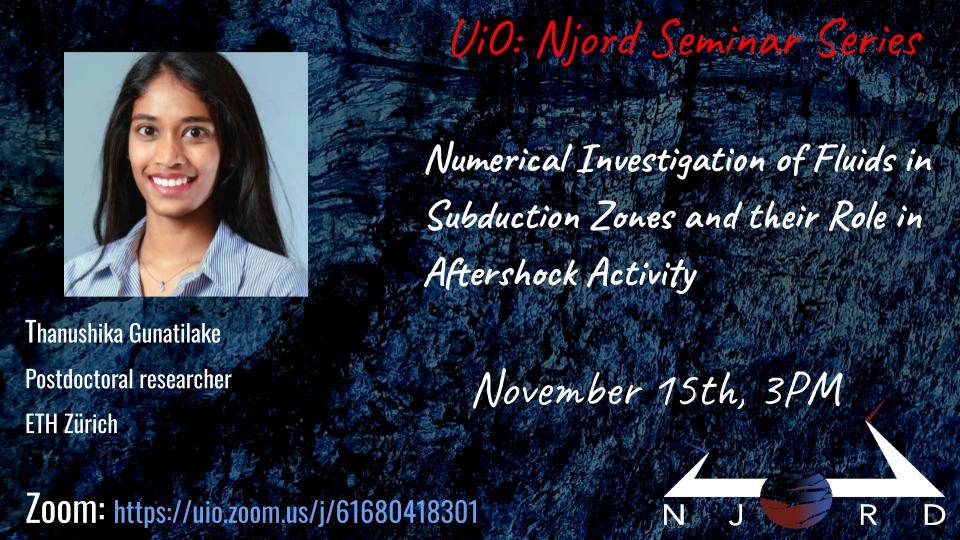
Title of the talk: Numerical Investigation of Fluids in Subduction Zones and their Role in Aftershock Activity.
Fluids within subduction zones play a crucial role in aftershock generation. This study investigates the impact of slab hydration and pressurized fluids, resulting from co-seismic frictional heating, on aftershock activity at the subduction interface. We analyzed ten significant-to-great earthquakes (Mw > 6.8) that generated thousands of aftershocks (Mw > 4), and eleven nearby earthquakes (Mw > 6.8) that produced few or no aftershocks. Our kinematic and petrological analyses reveal that earthquakes with abundant aftershocks ruptured along hydrated slab interfaces, containing serpentinized peridotite and oceanic crust rocks. In contrast, earthquakes with minimal aftershocks occurred in zones of flat subduction or along oblique rupture planes, where limited hydrous minerals hindered fluid production. Additionally, numerical studies were conducted to quantify water production across different subduction scenarios, further highlighting the role of fluid pressurization in driving aftershock sequences. This global analysis supports the hypothesis that coseismic pressurized fluid production is a key driver of aftershock activity in subduction zones.
Short bio: My research focuses on modeling fluid-driven earthquake sequences, where fluids like CO2 and H2O play a key role in triggering earthquakes and aftershocks in subduction zones and other geological settings. I aim to enhance understanding of subsurface fluid dynamics to improve geothermal energy use, advance carbon capture and storage (CCS), and reduce seismic risks. My work contributes to optimizing sustainable energy systems and lowering carbon emissions.
To get news, invitations to seminars and more from Njord, please go here to subscribe to our newsletter.