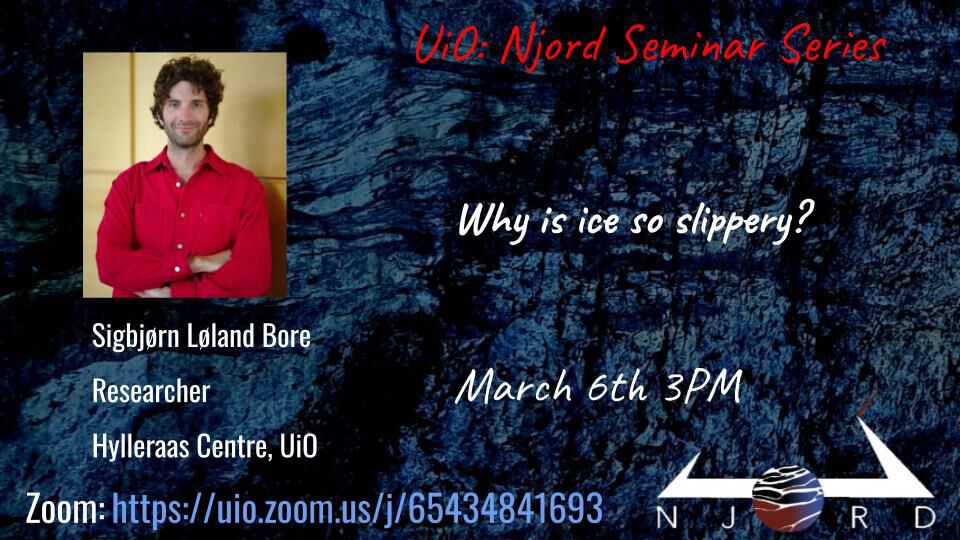
Why is ice so slippery?
The origin of ice’s slipperiness has been a subject of intense debate for centuries. In this talk, I will present work, in collaboration with Sveinsson, on modeling ice friction from first principles. Our approach uses machine-learning interatomic potentials trained on quantum-mechanical data to provide an unbiased description of ice friction at the nanoscale. By combining these molecular dynamics simulations with a frictional heating model, we connect our findings to the macroscale coefficient of friction. Our findings highlight the importance of frictional heating as a cause of ice slipperiness.
Short Bio: Sigbjørn got his PhD in 2020, with Michele Cascella, in computational chemistry at University of Oslo. After finishing his PhD, he went on to do a postdoc at the University of California, San Diego, under the supervision of Francesco Paesani. After finishing his Postdoc in 2022, he went back to the University of Oslo for a short postdoc with Cascella, before starting his own independent research group. Bore’s research combines advanced sampling techniques with machine learning to understand, from first principles, how water behaves under exotic conditions. He is a Norwegian Academy of Science YoungCAS fellow, leading the project Can ice be described from first principles?, and a Research Council of Norway Young Researcher Talent, leading a research project that aims to understand and develop high-conductive metal-organic frameworks for application as membranes in fuel cells.
To get news, invitations to seminars and more from Njord, please go here to subscribe to our newsletter.