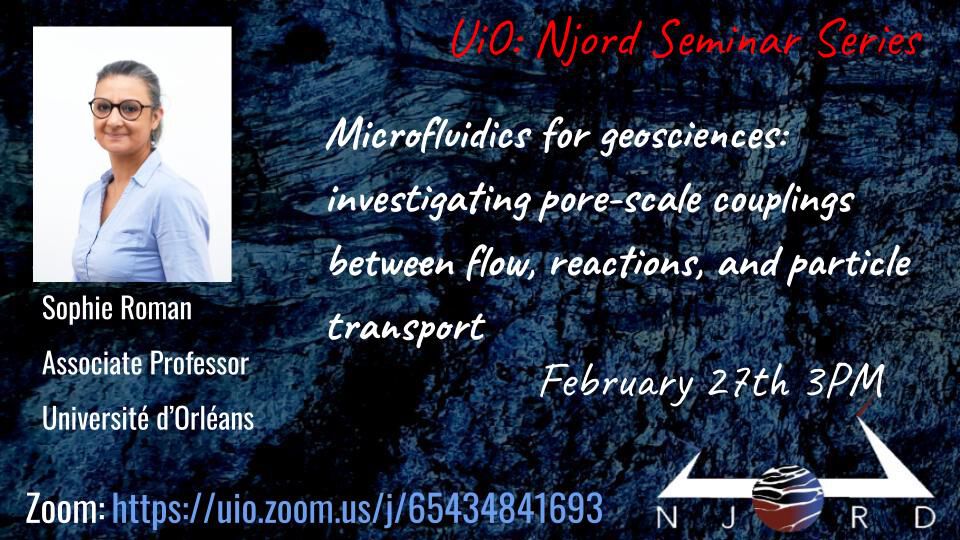
Microfluidics for geosciences: investigating pore-scale couplings between flow, reactions, and particle transport
Hydrogeochemical processes in porous media emerge from tightly coupled interactions between flow, solute transport, mineral reactions, and particulate dynamics at the pore scale. Yet key questions remain: how do local flow topology and chemical gradients control mineral dissolution patterns? Can colloidal transport be harnessed to either preserve permeability or deliberately inhibit reactive surfaces? And how can these couplings be observed and quantified in situ with sufficient resolution?
These questions are addressed using microfluidic investigations of reactive transport and particle dynamics in model porous media. Pore-scale experiments, coupled with numerical simulations, reveal how flow heterogeneity and evolving concentration fields shape mineral dissolution and wormholing, providing a framework to validate and inform pore-scale reactive transport models. Building on these insights, we show how solute gradients generated by mineral reactions can drive colloidal motion toward reactive interfaces, enabling the controlled formation of particle layers that passivate mineral surfaces and suppress further dissolution.
This work is supported by recent methodological advances in microfluidics for geosciences, including integrated geoelectrical monitoring and high-resolution quantification tools that capture the coupled evolution of flow, chemistry, and particulate transport. Together, these results highlight the value of microfluidics for probing and ultimately controlling hydrogeochemical couplings relevant to subsurface applications such as CO₂ sequestration and aquifer remediation.
Short bio: Sophie Roman is an Associate Professor at the University of Orléans (France) and at the Institut des Sciences de la Terre d’Orléans (ISTO) since 2017. She leads Nanoµlab, a cutting-edge micro-nanofluidic facility dedicated to studying multi-scale, multi-physical processes in geological environments. Combining microfluidic experiments with high-resolution imaging, advanced measurements, and numerical modeling, her team investigates multiphase flow dynamics, colloid migration, and reactive transport at the microscale. Microfluidics helps to better understand pore-scale mechanisms and improve large-scale models. Her research objectives include improving estimates of the storage capacity of geological reservoirs, reducing the footprint required for CO2 sequestration, assessing the long-term behavior of stored CO2 and proposing innovative methods for cleaning up contaminated aquifers.
To get news, invitations to seminars and more from Njord, please go here to subscribe to our newsletter.