Acoustic and Resonance Responses of Natural Cliffs to Temperature, Freezing, and Rainfall
Climatic forcing drives rock weathering and subcritical cracking, yet its effects on the mechanical state of natural cliffs remain difficult to quantify in situ. Here, we combine active acoustic measurements of relative wave-velocity changes dv/v with passive seismic monitoring of resonance frequencies to investigate the response of natural cliffs to temperature variations, rainfall, and freezing. To interpret temperature-driven velocity cycles, we further use a phenomenological model coupling instantaneous acousto-elasticity (AE) with rate-dependent slow dynamics (SD).
Daily temperature cycles produce pronounced near-surface velocity variations associated with thermoelastic stresses and microcrack opening and closure. The AE-SD model captures key features of these nonlinear cycles and highlights transient material softening. Rainfall mainly causes reversible velocity decreases through water infiltration, while rapid surface cooling can promote opening of the rear fracture separating an unstable pillar from the cliff. During freezing, both wave velocity and resonance frequency increase. Numerical modeling shows that the resonance-frequency increase is primarily caused by ice filling the rear fracture, while acousto-elastic estimates indicate that ice-induced stresses may be sufficient to produce irreversible damage. Together, these observations show how combined acoustic and seismic monitoring can resolve environmentally driven stress and fracture processes in natural cliffs.
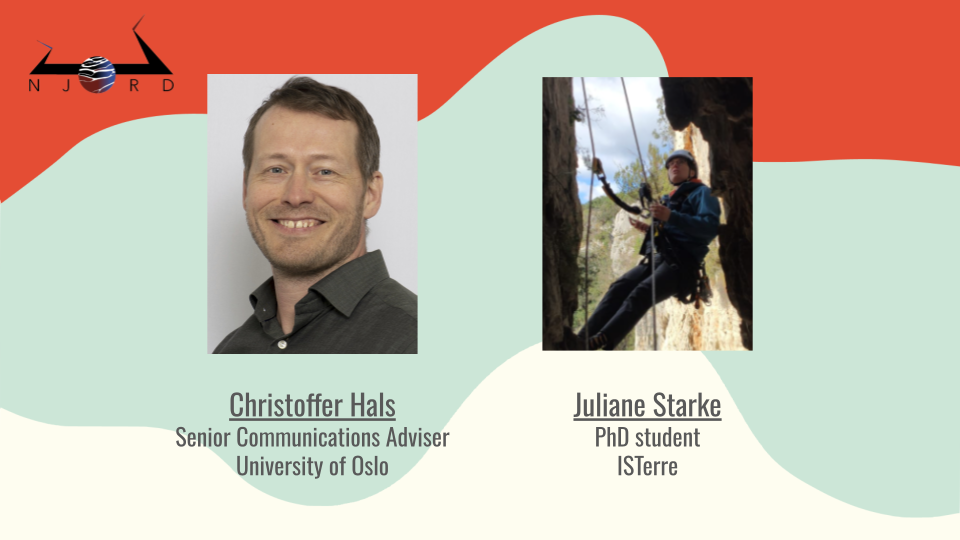
Short Bio: PhD student at ISTerre, Grenoble, with Eric Larose and Laurent Baillet about to finish her PhD in environmental seismology focusing rock weathering and subcritical cracking.
LinkedIn for Researchers: Why It’s worth using
We will look at why it can be worth having an active and updated presence on LinkedIn. Researchers can use the platform to make their expertise easier to find, build professional networks, share their research and potentially be discovered by new collaborators, journalists, funders and others who may be interested in their work.
Short Bio: Christoffer Hals is a Senior Communications Adviser at dScience, Centre for Computational and Data Science at the University of Oslo. He has a background in journalism and around 15 years of experience in communication.
At dScience, he works with research communication, digital communication and events, and helps researchers communicate their work to audiences both within and outside academia.
To get news, invitations to seminars and more from Njord, please go here to subscribe to our newsletter.