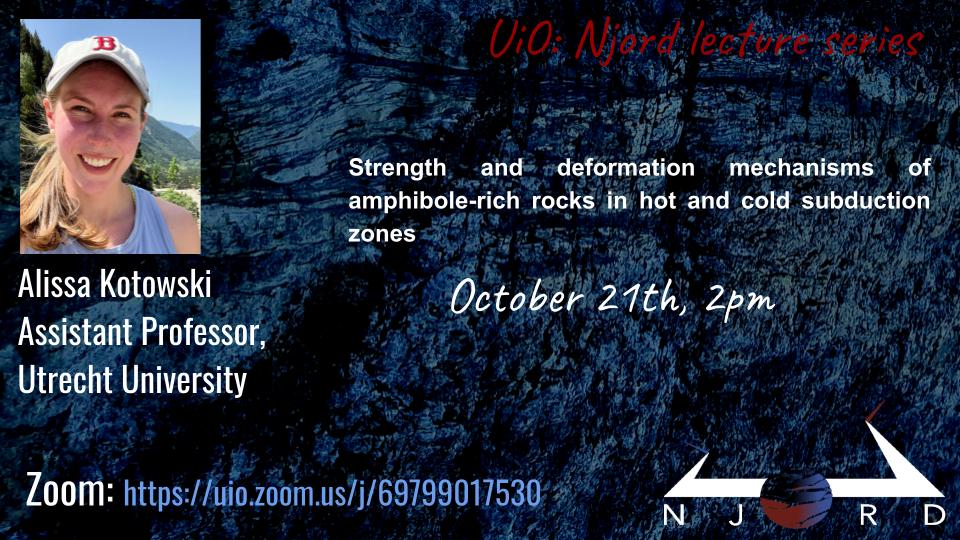
Abstract: Slow slip and tremor (SST) in subduction zones occurs over an incredible range of Pressure-Temperature conditions, but one common denominator is the presence of metamorphosed oceanic crust containing amphibole as a strain-accommodating phase. However, the rheology of amphibole is poorly constrained, so its contribution to steady-state strength and/or slip transients is unknown. I will compare natural amphibole microstructures from three exhumed subduction complexes that record hot, warm, and cold subduction geotherms, spanning a P-T range that encompasses observed SST in active margins, and discuss the deformation conditions and mechanisms that may produce transients. Using nanoindentation experiments, I will then provide new insight into low-temperature plasticity in glaucophane, to discuss the implications of dislocation-accommodated deformation in cold shear zones. Depending on temperature, the presence/distribution of other phases, and fluid content, amphibole may be capable of accommodating steady-state flow and/or deformation transients over the range of observed SST depths.
To get news, invitations to seminars and more from Njord, please go here to subscribe to our newsletter.