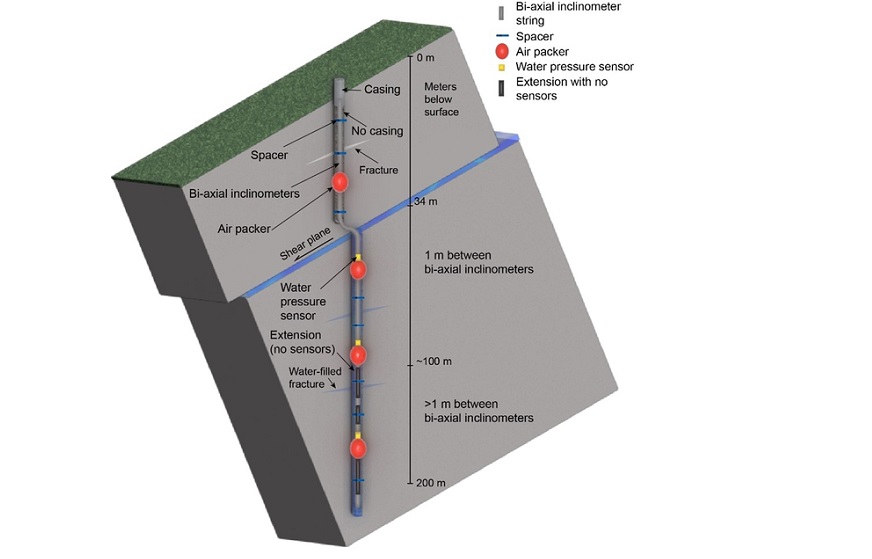
The research team analysed data on movements, earthquakes and water pressure, both on the surface, and deep within the Åknes mountain. The goal was to better understand what causes rapid accelerations and, in the worst case scenario, a major collapse followed by a tidal wave.
They identified several cases of so called "creep bursts" in the analyses, which are sudden accelerations that can alter the speed at which the mountain moves. At worst, these could lead to a major collapse.
It was also discovered that some of these accelerations occurred simultaneously in all boreholes, and they often coincided with increased water pressure and seismic activities. However, most of the sudden accelerations occurred individually and aligned with periods of both high and low water levels throughout the year.
The researchers propose that the sudden accelerations may be caused by rock deterioration, unrelated to the changes in water pressure. The largest accelerations, on the other hand, appear to be linked to variations in water pressure.
This study demonstrates that even with a unique dataset like this, explaining sudden accelerations remains highly complex.
The scientific article:
Aspaas, A., Lacroix, P., Sena, C., Kristensen, L., Langet, N., & Renard, F. (2024). Creep bursts on the Åknes landslide, Norway: Detection, characterization and possible mechanisms. Journal of Geophysical Research: Earth Surface, 129(12), e2024JF007733
Editor's highlight: Will It Run Away? Documenting Creep Bursts in a Slow-Moving Landslide, read here: https://eos.org/editor-highlights/will-it-run-away-documenting-creep-bursts-in-a-slow-moving-landslide