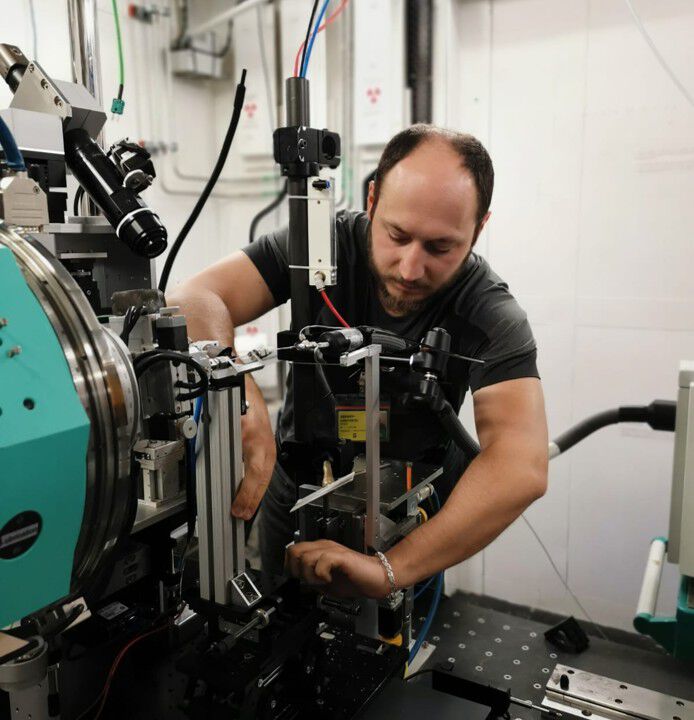
I completed my Ph.D. in Yekaterinburg, Russia, where I focused on the phase stability and defect chemistry of oxygen-conducting perovskite oxides—promising electrode materials for fuel cells. My doctoral research combined thermal analysis, X-ray diffraction, high-temperature calorimetry, and defect chemistry modeling to understand these materials at a fundamental level.
Before joining the Njord Centre, I worked extensively with magnesium carbonate minerals, particularly dypingite (Mg₅(CO₃)₄(OH)₂·5H₂O), a naturally occurring mineral with a distinctive desert rose morphology. Dypingite forms through the weathering of ultramafic rocks like serpentine, naturally trapping atmospheric CO₂ in stable carbonate minerals that ensure long-term storage under Earth's surface conditions. I played an active role in solving its crystal structure and shedding light on the nature of structural disorder in this mineral and its variability in nature. The solved crystal structure now provides the foundation for rational materials design, quality control protocols in both geological carbon storage projects and industrial manufacturing, and enables researchers to exploit dypingite's unique humidity-responsive behavior for novel functional materials.
As a Researcher in experimental mineralogy and CO₂ mineralization at the Njord Centre, I will provide fundamental insights into CO₂ mineralization potential in volcanic-sedimentary deposits at the nanoscale. My primary research activities will include:
- Investigation of In-situ carbonatization mechanisms at the nanometer to micrometer scales, providing detailed observations of mineral-fluid interactions during CO₂ mineralization.
- Investigation of the role of clay minerals in promoting calcite precipitation on rock surfaces, which is critical for understanding seal integrity in CO₂ storage reservoirs.
- Investigation of reactivity of volcanic glass and ashes at the nanoscale to understand their potential for CO₂ sequestration.
- Design of supporting batch experiments trying to reproduce natural carbonation processes with comprehensive analyses of obtained products using scanning electron microscopy (SEM), X-ray diffraction, and Raman spectroscopy to characterize reaction products and mechanisms.
- Evaluating how volcanic glass and ash reactivity varies with fluid composition, scrutinize precipitation mechanisms, identify preferential reaction sites, and estimate timescales for these reactions in volcanic-sedimentary reservoirs.
I'm really excited to join the Njord Centre team and work alongside such passionate and dedicated researchers. What I find most inspiring is being part of a community where we're all working on the same challenge—permanent CO₂ storage—just at wildly different scales, from nanometers to gigatons! If you're curious about CO₂-rock interactions or have questions about what's happening at the nanoscale with your materials, I'd love to chat. Don't hesitate to get in touch!