About the project
The oceanic crust, the part of the Earth's crust that lies beneath the ocean, is subject to chemical reactions. Seawater flows in and reacts with dry rocks like peridotite and basalt. When these rocks react with water, new minerals are formed with a larger volume than the original minerals. This leads to mechanical stresses in the rocks, and when the stresses become large enough, the rocks fracture. This process is called reaction-driven fracturing. The fracturing allows more water to access the rocks, sustaining the chemical reactions and continuing the reaction-driven fracturing.
Reaction-driven fracturing can be replicated in the laboratory. If water is added to a piece of periclase, it transforms into brucite, and the resulting volume increase causes the periclase to fracture during the process. However, this process can be stopped by putting the periclase under pressure. In fact, a few tens of megapascals are sufficient, which is far lower than the pressure in the oceanic crust, and also much less than the theoretically calculated pressure that this chemical reaction should be able to withstand. Nevertheless, fully reacted rocks are found in nature, where reaction-driven fracturing has occurred under much higher pressures, implying that reaction-driven fracturing can also occur under high pressure.
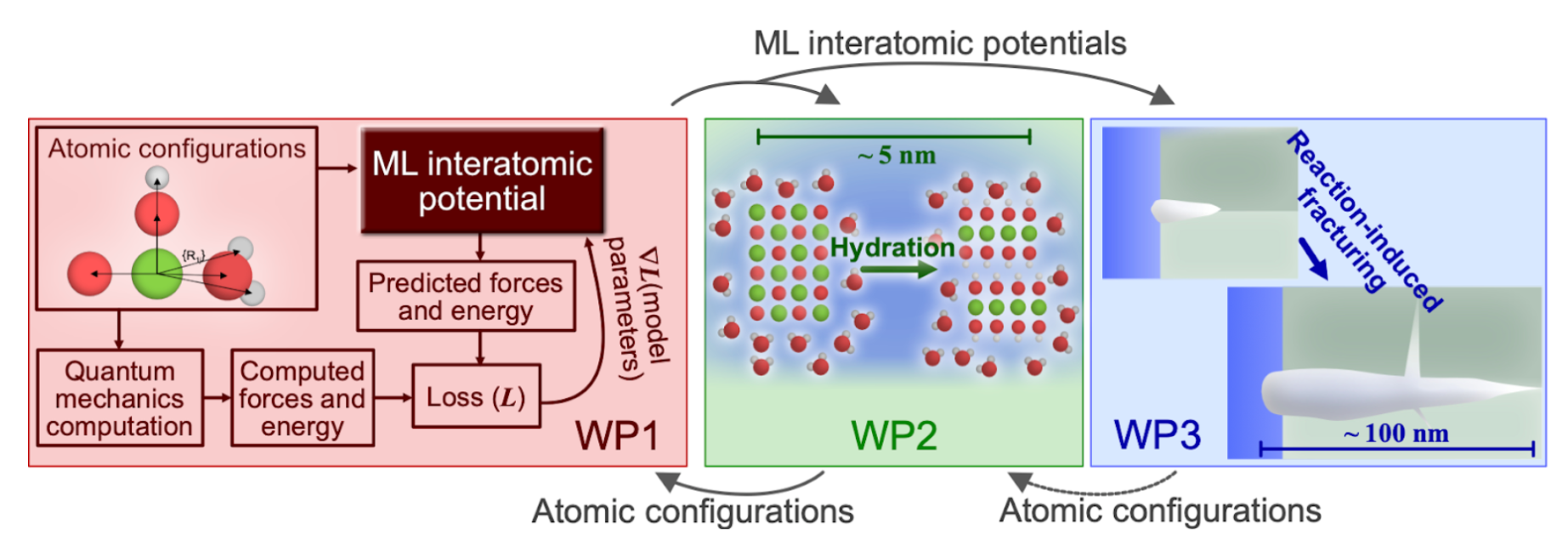
In the ChemFrac project, we will use a combination of quantum mechanical calculations and machine learning to create simulations where we can study reaction-driven fracturing directly at the nanoscale, atom by atom. From these simulations, we will identify the mechanisms that initiate and stop reaction-driven fracturing.
Objectives
To identify the nanoscale processes that start and stop reaction-induced fracturing in rocks and geomaterials:
- Develop a protocol for creating accurate interatomic potentials for water–mineral interactions that exhibit reaction-induced fracturing.
- Develop accurate simulation models for volume-expanding hydration reactions, and determine the conditions that maximize the hydration pressure.
- Develop simulation models to investigate reaction-induced fracturing. These models will be used to test: whether pressures greater than a critical pressure prevent hydration reactions from opening grain boundaries (a porous grain boundary should result in a critical pressure that is higher than the critical pressure for a water film between flat grain surfaces); and whether a pressure greater than a second critical pressure prevents reaction- induced fractures from penetrating into crystal grains, preventing fracture branching.
Project Summary
The oceanic crust is constantly being altered by hydration reactions, where dry minerals are replaced by hydrated minerals that have greater volumes, causing the surrounding rock to break. This exposes new, reactive surfaces, and accelerates the hydration process. Hydration reactions changes the rock rheology and density, and therefore have first-order effects on the global geochemical cycle. Over geological timescales, this exerts an important control on the global cycles of water and carbon dioxide, through the subduction of the crust into the interior of the earth near tectonic plate boundaries. However, it is not understood how the reaction-induced fracturing that exposes new reactive surface is allowed to progress at the stress conditions that the rocks are exposed to in their natural setting. The reaction itself should be able to carry on at gigapascals of confining pressure, but experimental analog processes stop at only tens of megapascals. It has been hypothesized for decades that megapascals of pressure is enough to close fluid pathways, and thus shut off the supply of reactants. But the occurrence of fully transformed rocks in geological samples calls for a mechanism that allows hydration even at high confining pressures. The goal of ChemFrac is to identify such mechanisms, and determine what may stop them both in the experimental setting and in natural environments. We will target the hydration of periclase, because it is simple and experimentally well characterized, and the hydration of olivine, because it is a very common hydration reaction in the crust. By exploiting recent breakthroughs in machine learning based molecular scale modeling, we will simulate directly–on the atomic scale–what happens during the hydration and the reaction-induced fracturing of minerals. ChemFrac will be carried out at the Njord Centre, a cross-disciplinary collaboration between physics and geology, and bring in external expertise in machine learning and quantum chemistry.
Cooperation
University of Bremen
Harvard University
Université Paris Cité
Financing
Research Council of Norway