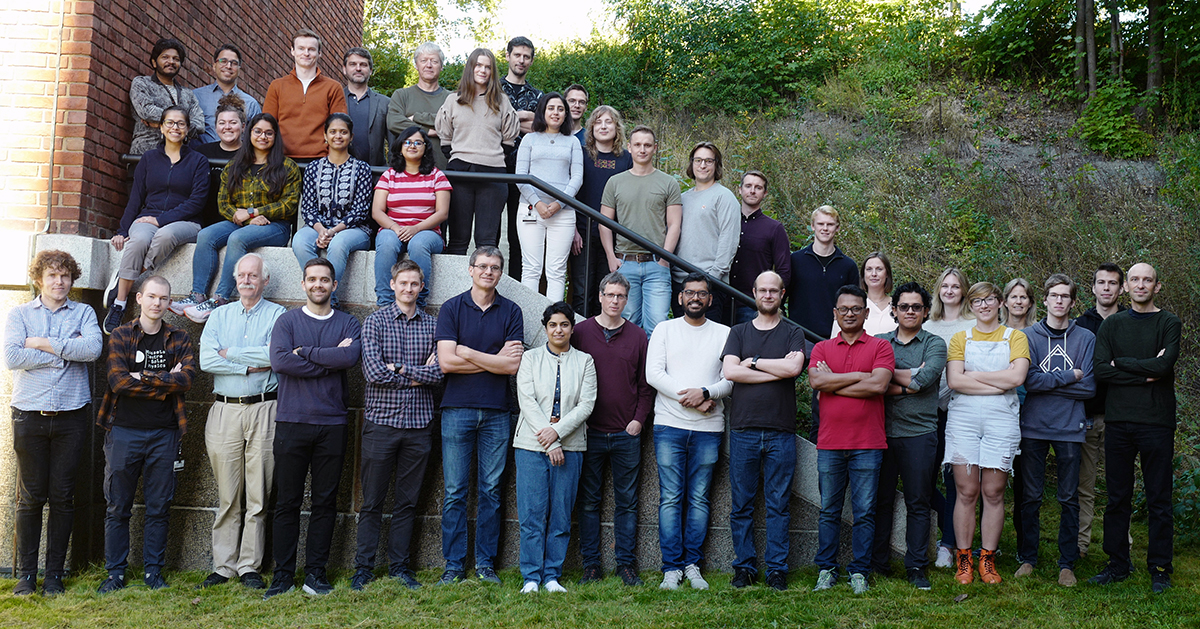
To better understand the violent explosions and activities in the Sun's atmosphere, RoCS has ten research projects (RoCS website). In addition, RoCS has six recently completed projects (RoCS website). In order to cope with the large activity, it has been necessary to grow at a rapid pace and a total of 58 people from 21 countries are now associated with RoCS. And there are still more to come. In November, they welcome the eighth Postdoctoral Fellow. The group also has 17 PhD candidates (plus those who have already finished their doctorate).
Not all employees work from RoCS' premises at Svein Rosseland's house, ITA, UiO. Some researchers are connected to the environment through foreign institutions.
- Director Mats Carlsson at RoCS, what does it take to build a center for excellence?
- There is a lot that needs to be in place to get a center up and running. It took - (as expected) - longer than what we had optimistically planned for in the application. Hiring people in particular takes time. The employees are the most important resource we have, so it is important to take the time it takes to get hold of the best. The other thing that took time was getting our own premises in place and when we were finally able to move in (around the second anniversary in November 2019) it wasn't long until the pandemic meant we had to close again.
- What does RoCS hope to have accomplished after the end of the term?
- We expect to have made a major contribution to a much better understanding of solar storms and solar explosions.
- What is the most important work you do to understand the Sun?
- We are developing new methods to simulate the processes on the Sun in a computer. We then collect new observations at one of the best solar telescopes in the world. We compare these models and observations and when we have a good model we can go into it and "experiment" - what would happen if this were changed etc. That is something we cannot do with the real Sun.
Facts about RoCS
RoCS - Rosseland center for solar physics started on November 1st 2017. The employees come from: Norway, Sweden, Denmark, USA, Belgium, India, Italy, Lithuania, Austria, Netherlands, Poland, Portugal, Slovakia, Spain, Switzerland, UK, Germany , France, Colombia, Guatemala, Iran and the Netherlands.
Norwegian Centres of Excellence scheme
The SFF scheme gives Norway’s best researchers the opportunity to organise their research activities in centres that seek to achieve ambitious scientific objectives through collaboration. The research conducted at the centres must be innovative and have major potential to generate ground-breaking results that advance the international research frontier. SFF centres may receive support for a total of ten years (an initial six-year period with the possibility of a four-year extension).