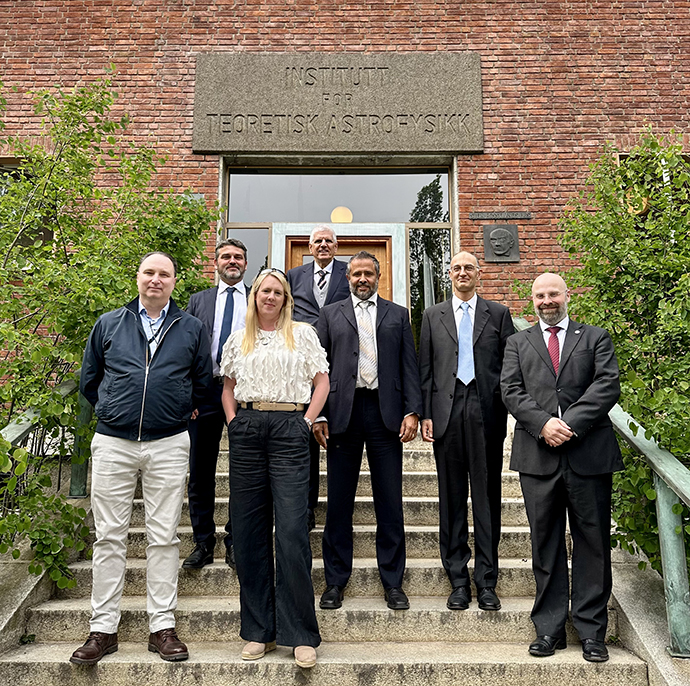

Purpose of the agreement
The goal of the Solaris project is to place a radiotelescope on Svalbard and/or near Tromsø to complement solar observations already taking place in Antarctica. Professor Sven Wedemeyer, the project coordinator at RoCS, UiO, stated: - The sun cannot be observed from Antarctica during the northern summer, making Northern Norway a crucial supplement.
Key Collaborators
The Solaris collaboration involves several Norwegian and Italian institutions, including:
- National Institute for Astrophysics (INAF), Italy
- The University of Milan
- University of Oslo
- Tromsø Geophysical Observatory, UiT The Arctic University of Norway
- UNIS - The university centre in Svalbard
Solar activity research
Since 2017, RoCS - Rosseland Center for Solar Physics at the Institute of Theoretical Astrophysics has contributed to a deeper understanding of solar activity through advanced observations and numerical simulations. The center has specifically focused on the dynamic processes in the sun's atmosphere, which are essential for uncovering the mechanisms behind sunspots, coronal eruptions, and other solar phenomena that affect space weather and have consequences for Earth.
RoCS has developed significant expertise in solar observations at millimeter and radio wavelengths, allowing researchers to study solar activities in detail.
The team behind RoCS is now seeking to establish a new center focused on space weather. Wedemeyer explains: 'With the new center, we aim to further expand our research by studying the sources of space weather on the Sun. This will not only enhance our scientific understanding but also have practical implications for technology and public safety.
The importance of the Solaris project
Magnar Gullikstad Johnsen from the Tromsø Geophysical Observatory explained in a lecture at UiO the same day that Solaris will enable the prediction of solar eruptions up to 30 hours in advance. - This will be a significant advancement in space weather forecasting. Norwegian and European space weather forecasting needs to be strengthened to become independent of American space weather data, said Johnsen.

Currently, solar eruptions can only be alerted as they occur, relying on probabilistic forecasting. Johnsen noted that this is insufficient for protecting technical installations.
Community and infrastructure impact
Johnsen highlighted that space weather poses risks to critical infrastructure, including offshore operations, power grids, navigation, and satellites. - Norway’s position under the auroral zone makes it particularly vulnerable to space weather effects, he said.
Geography and vulnerability
Norway's location under the Auroral Zone makes the country particularly susceptible to space weather. Johnsen warns about the daily effects of space weather and their potential impact on critical services: - If the power grid goes down, it can create a domino effect.
Interdisciplinary collaboration
Research on space weather requires collaboration with sectors such as the power and oil industries. Johnsen mentions the ongoing partnership with the Norwegian Mapping Authority and the Meteorological Institute to establish a national space weather warning service.
The future of space weather research
Regarding future trends, Johnsen emphasizes the need for better models to predict the effects of solar phenomena: - We want to address space weather with preparedness and safety in focus. He draws inspiration from the northern lights and recognizes the importance of building on the rich history of the Northern Lights Observatory: - We have proposed to the government to include a national space weather warning service in the state budget.
About the SOLARIS Project
Purpose: SOLARIS is an innovative project developing a continuous monitoring system for the Sun at high radio frequencies.
Focus: The project is aimed at fundamental physics, space climatology, and solar-terrestrial interactions.
Results: Initial results were achieved one year after approval, including solar maps at 95 GHz during the 40th Italian expedition to Antarctica.
Technology: The OASI telescope was put into operation at the Mario Zucchelli Station and observed active solar regions, including the cause of the New Year's aurora.
Support: SOLARIS is part of the national Antarctic research program (PNRA) and is supported by several Italian universities, the Italian Space Agency, and the Air Force.
Installation: Radio receivers on 2.6-meter antennas at Italian bases in Antarctica enable studies of solar activity, such as coronal eruptions and geomagnetic storms.
Observation Conditions: With the optimal conditions in Antarctica, SOLARIS can provide continuous monitoring of the Sun when it is visible, record chromospheric activity, and predict geomagnetic storms.
Monitoring: SOLARIS will be able to observe the Sun for more than 20 hours each day during the summer, with support from antennas placed elsewhere for year-round monitoring.