Safy, Mohamed E. A.; Rama, Raquel J.; Both, Niklas F.; Badia, David Balcells; Junge, Kathrin; Beller, Matthias & Nova, Ainara (2026). Leveraging Diamines to Unlock the Mn‐MACHO Catalyst in the Reduction of CO2 to Methanol. Angewandte Chemie International Edition. ISSN 1433-7851. 65(10). doi: 10.1002/anie.202524012. Full text in Research Archive
Leveraging Diamines to Unlock the Mn-MACHO Catalyst in the Reduction of CO2 to Methanol
The conversion of CO2 into energy-dense liquid fuels, such as methanol, represents a cornerstone of sustainable chemistry; however, most homogeneous catalytic systems still rely on noble metals or Lewis acid additives. Here, we report the first protocol for amine-assisted CO2 hydrogenation to methanol using a Mn–MACHO catalyst without any Lewis acid co-catalyst, achieving turnover numbers up to 45.2, the highest reported for Mn systems. A combined computational, microkinetic, and experimental study reveals that diamines dramatically enhance activity compared to monoamines by promoting a highly exergonic double amidation step. This thermodynamic driving force shifts the equilibrium away from formate resting states toward the active catalyst, thereby accelerating methanol formation. The correlation established between amidation free energies and methanol productivity provides a rational design principle for tailoring amine promoters across Ru- and Mn-based MACHO catalysts. These insights advance the development of sustainable, base-metal-catalyzed CO2 conversion strategies and open opportunities for integrated carbon capture and utilization.
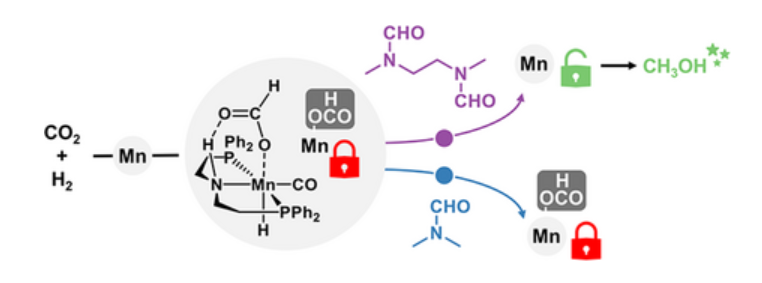
CO2 hydrogenation to methanol using a Mn–MACHO catalyst
Published Apr. 28, 2026 2:04 PM
- Last modified Apr. 29, 2026 12:33 PM