Tags:
SMN,
Nafuma
Publications
-
Park, Heesoo & Koposov, Alexey
(2025).
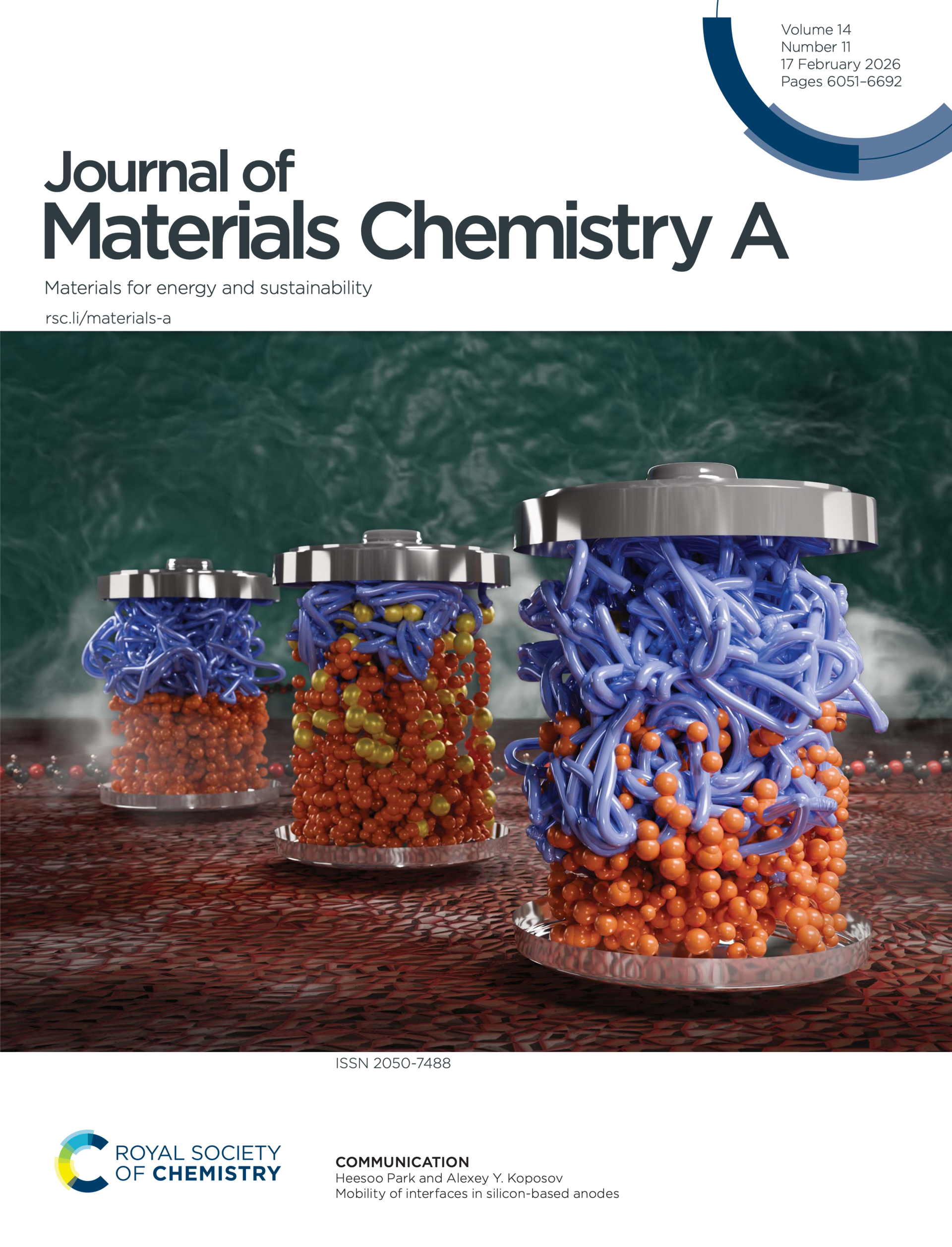
Mobility of interfaces in silicon-based anodes.
Journal of Materials Chemistry A.
ISSN 2050-7488.
14(11),
p. 6242–6249.
doi:
10.1039/d5ta08284f.
Full text in Research Archive
Show summary
Silicon (Si) is a promising anode material for next-generation lithium-ion batteries (LIBs), but its practical use is limited due to severe degradation during electrochemical cycling. The morphological changes of Si are affected by the selection of an electrolyte, and its role in such transformations remains a subject of debate. The lack of experimental and computational methods to examine these interactions at the molecular level also impedes the accurate chemical characterization of this complex system. This study evaluates the interaction of Si nanoparticle(s) with ether-based electrolytes using a reactive force field approach. The interplay between the Si nanoparticles and the electrolyte during (de)lithiation leads to a significant structural deformation of the Si particles and the formation of a thick interdiffusion layer where Si atoms are mixed with the electrolyte moieties. This layer is mainly formed during delithiation, whereas lithiation leads to constrained interdiffusion. The intermixing and mobility at the Si/electrolyte interface highlight the electrolyte's critical role in mitigating the degradation of Si-based anodes during delithiation.
-
Dai, Tian; Park, Heesoo; Brennhagen, Anders; Andersen, Niels Højmark; Giorgetti, Marco & Valldor, Björn Martin
[Show all 7 contributors for this article]
(2025).
Role of Dual-Redox Couples in Antiperovskite Li2FeSeO Cathodes.
Chemistry of Materials.
ISSN 0897-4756.
37(22),
p. 9091–9104.
doi:
10.1021/acs.chemmater.5c01341.
Full text in Research Archive
Show summary
In recent years, cathode materials for Li-ion batteries with antiperovskite (AP) structure have attracted growing interest due to their high capacity, chemical flexibility, low cost, and relatively simple synthesis. Among AP cathodes, Li2FeSeO has emerged as a promising candidate, demonstrating high capacity and good cycling stability. However, the lack of fundamental knowledge of the operating mechanism of AP cathodes significantly impedes efforts for further improvement. In this work, the redox mechanism and structural evolution of Li2FeSeO cathode material during electrochemical cycling are revealed through a combination of operando and ex situ X-ray diffraction, X-ray absorption spectroscopy, and Raman spectroscopy coupled with density functional theory calculations. Within the voltage range of 1–3 V vs Li/Li+, two stages in the (de)lithiation process during the initial cycle are determined, involving simultaneous redox activity of Se2– and Fe2+ with strong local structural distortion, leading to the formation of Se22– and Fe3+ species in the delithiated state and possible formation of Fe0 in the lithiated state. While the dual-redox activity of Se2– and Fe2+ ions is the key to high capacity, the −O–Fe–O– framework serves as a crucial element for reversibility during cycling. The study highlights the potential for optimizing the structural frameworks of AP cathodes.
-
Fjellvåg, Øystein Slagtern; Park, Heesoo; Veillon, Fabien; Lyu, Jike; Medarde, Marisa & Amedi, Salah Bra
[Show all 10 contributors for this article]
(2025).
ACrF3 Jahn–Teller-Distorted Fluoroperovskites: Expanding to RbCrF3 and CsCrF3.
Inorganic Chemistry.
ISSN 0020-1669.
64(36),
p. 18316–18322.
doi:
10.1021/acs.inorgchem.5c02668.
Full text in Research Archive
Show summary
The Jahn–Teller effect significantly affects the CrF6 octahedra in Cr(II) fluoroperovskites. Here, we report the synthesis, crystal structures, and magnetic properties of RbCrF3 and CsCrF3, thereby completing a comprehensive investigation of the ACrF3 fluoroperovskites. Powder samples are prepared using a wet-chemical method, which allows stabilization of Cr(II). RbCrF3 predominantly adopts the P4/mbm space group; however, the absence of the expected (211) peak suggests a limited correlation length, and we demonstrate that this is a result of stacking faults in the rotation of the distorted CrF6 octahedra along the c-axis. We estimate around 5–10% of I4/mcm-type stacking in P4/mbm for RbCrF3. In contrast, CsCrF3 showcases a two-phase coexistence of I4/mcm and P4/mbm polymorphs and, as such, parallels to KCuF3. We discuss and highlight the interplay between the impact of A-site cations and the Jahn–Teller effect acting on CrF6 octahedra. Antiferromagnetic interactions dominate the paramagnetic regime, and RbCrF3 and CsCrF3 both have a Weiss temperature of −12 K, associated with Néel temperatures of 50 and 47 K, respectively. The effective paramagnetic moments of 4.65 and 4.68 μB for RbCrF3 and CsCrF3 are in good agreement with S = 2 spin configuration.
-
Skurtveit, Amalie; North, Erlend Tiberg; Park, Heesoo; Chernyshov, Dmitry; Wragg, David Stephen & Koposov, Alexey
(2025).
Stepwise Structural Relaxation in Battery Active Materials.
ACS Materials Letters.
7(1),
p. 343–349.
doi:
10.1021/acsmaterialslett.4c02058.
Full text in Research Archive
Show summary
Whenever the cycling of Li-ion batteries is stopped, the electrode materials undergo a relaxation process, but the structural changes that occur during relaxation are not well-understood. We have used operando synchrotron X-ray diffraction with a time resolution of 1.24 s to observe the structural changes that occur when the lithiation of graphite and LiFePO4 electrodes are interrupted. Assessing the kinetics of the relaxation processes coupled with molecular dynamics simulations allows us to identify three relaxation stages in graphite. The atomistic origin for the relaxation process within the partially lithiated graphite structure is driven by the reorganization of Li ions into Li clusters. Relaxation in LiFePO4 electrodes is considerably slower than for graphite, but the observed structural changes is also attributed to reorganization of Li ions. These insights highlight the nature of the structural changes that occur during relaxation and the importance of using operando structural studies to avoid misleading conclusions about the reaction mechanisms in battery materials.
-
Park, Heesoo; Wragg, David Stephen & Koposov, Alexey
(2024).
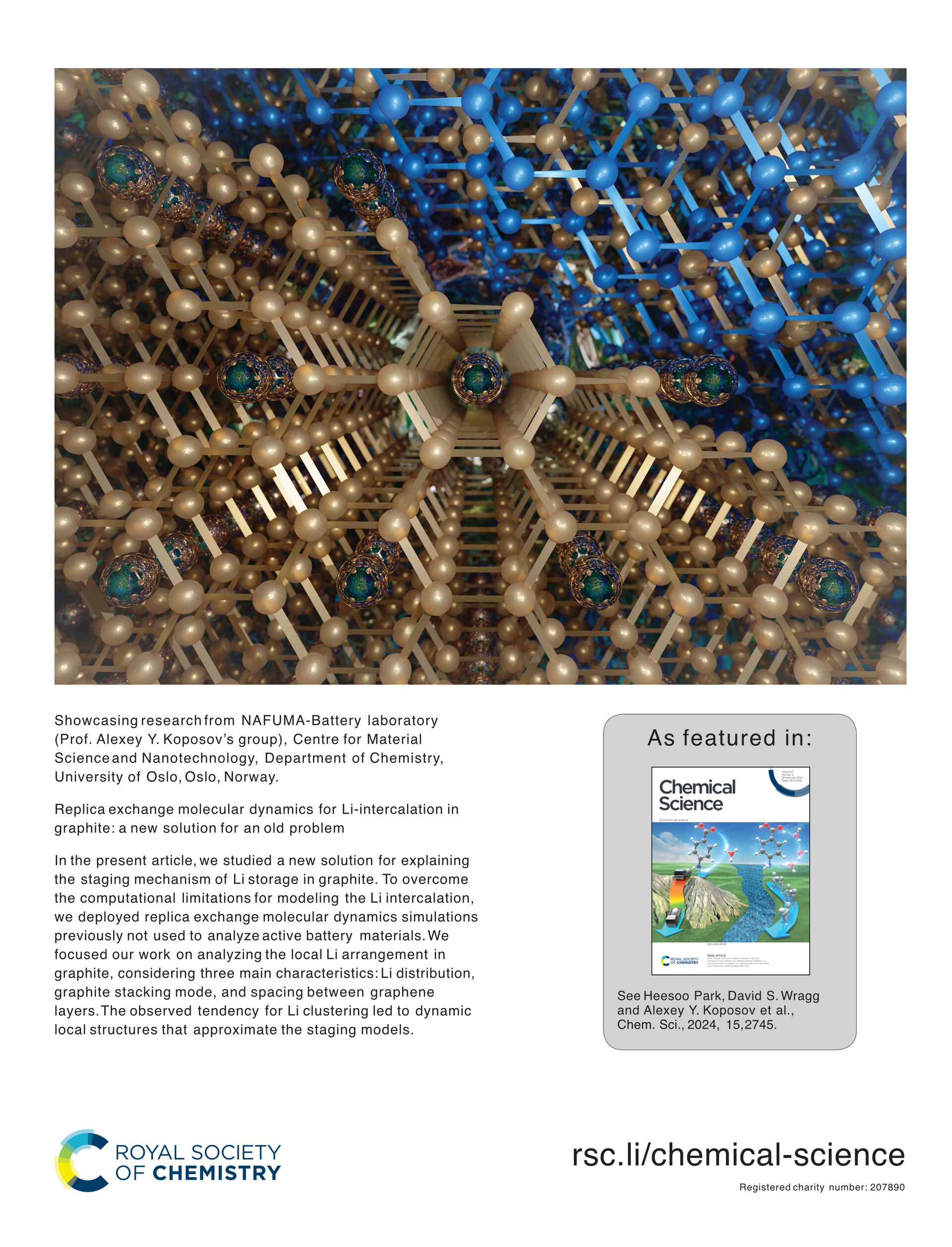
Replica exchange molecular dynamics for Li-intercalation in graphite: a new solution for an old problem.
Chemical Science.
ISSN 2041-6520.
doi:
10.1039/d3sc06107h.
Full text in Research Archive
Show summary
Li intercalation and graphite stacking have been extensively studied because of the importance of graphite in commercial Li-ion batteries. Despite this attention, there are still questions about the atomistic structures of the intermediate states that exist during lithiation, especially when phase dynamics cause a disordered Li distribution. The Li migration event (diffusion coefficient of 10−5 nm2 ns−1) makes it difficult to explore the various Li-intercalation configurations in conventional molecular dynamics (MD) simulations with an affordable simulation timescale. To overcome these limitations, we conducted a comprehensive study using replica-exchange molecular dynamics (REMD) in combination with the ReaxFF force field. This approach allowed us to study the behavior of Li-intercalated graphite from any starting arrangement of Li at any value of x in LixC6. Our focus was on analyzing the energetic favorability differences between the relaxed structures. We rationalized the trends in formation energy on the basis of observed structural features, identifying three main structural features that cooperatively control Li rearrangement in graphite: Li distribution, graphite stacking mode and gallery height (graphene layer spacing). We also observed a tendency for clustering of Li, which could lead to dynamic local structures that approximate the staging models used to explain intercalation into graphite.
-
Bentria, El Tayeb; Shenai, Prathamesh Mahesh; Sanvito, Stefano; Park, Heesoo; Béland, Laurent Karim & Laycock, Nicholas
[Show all 7 contributors for this article]
(2024).
Computational demystification of iron carbonyls formation under syngas environment.
npj Materials Degradation.
8(1).
doi:
10.1038/s41529-024-00429-x.
Full text in Research Archive
Show summary
Iron pentacarbonyl (IPC) gas forms upon the reaction of carbon monoxide with Fe containing metallic surfaces under gas reforming conditions. IPC formation can sometimes reach alarming levels that cause metal loss, pipeline thinning corrosion, catalyst poisoning, and contamination of sensitive industrial equipment. In this work, we demystify using multiscale computational modeling the mechanism of Iron pentacarbonyl formation: Density functional theory (DFT) is used to explore various catalytic reactions that involve a Fe adatom reacting with adsorbed carbon monoxide. Our calculated carbonyls desorption barriers on a perfect and clean Fe surface are too high to allow the carbonyls to form then desorb at temperatures <500 K at the rates reported experimentally. Most importantly, our calculations indicate that a high CO surface coverage, in addition to the presence of Fe adatoms, favors carbonyl formation and its desorption towards the flowing gas medium. Using insights extracted from ab initio molecular dynamics simulations, we propose that the most plausible IPC formation mechanism consists of: (1) on surface reactions of adsorbed CO molecules with an Fe adatom to form iron tricarbonyl (Fe(CO)3*) molecules; (2) an adsorbate assisted movement of iron tricarbonyl on top of the CO adlayer; and (3) the interaction of iron tricarbonyl with CO molecules from the gaseous medium eventually leading to iron adatom removal as Fe(CO)5 gas.
-
Park, Heesoo; Duin, Adri C. T. van & Koposov, Alexey
(2023).
Toward Atomistic Understanding of Materials with the Conversion–Alloying Mechanism in Li-Ion Batteries.
Chemistry of Materials.
ISSN 0897-4756.
35(7),
p. 2835–2845.
doi:
10.1021/acs.chemmater.2c03603.
Full text in Research Archive
Show summary
The need for practical anodes for rechargeable batteries calls for new materials with improved storage capacity and cycling stability compared to the materials of today. Materials capable of alloying with alkali metals have been long viewed as a promising pathway to address this challenge. Meanwhile, severe drawbacks associated with the use of such materials led to the development of suitable alternatives, in which governing the reaction mechanism in a battery combines conversion and alloying reactions. These materials feature a high storage capacity and long-term stability during electrochemical cycling. However, the development of these materials is impeded by a lack of fundamental structural understanding due to the complexity of the chemical transformations taking place during battery cycling. Furthermore, amorphization, which is prevalent in these materials, also severely limits the conventional methods of characterization. In the present work, we propose a computational methodology for understanding the structure and reaction mechanism of these conversion–alloying materials by using amorphous substoichiometric silicon nitride as a model system. The developed ReaxFF parameter set allowed exploring the atomistic structure of this material and verify the resulting models through a comparison of calculated and experimentally obtained pair distribution functions (PDFs). The developed methodology also allowed exploring the structural changes occurring during lithiation and delithiation, i.e., operation mechanism in a battery. The analysis of the atomistic structure demonstrates that initial lithiation results in the formation of a Si network, which later participates in further lithiation process. Delithiation also influences the evolution of the amorphous Si network facilitating separation of nitrogen-rich and Si-rich regions and, therefore, confirming the conversion mechanism proposed earlier. Furthermore, the proposed approach allows modeling not only changes at the atomistic scale but also predicting the experimental PDF at different stages of cycling which allows experimentally verifying the outcome of modeling.
-
Skurtveit, Amalie; Brennhagen, Anders; Park, Heesoo; Cavallo, Carmen & Koposov, Alexey
(2022).
Benefits and Development Challenges for Conversion-Alloying Anode Materials in Na-Ion Batteries.
Frontiers in Energy Research.
10.
doi:
10.3389/fenrg.2022.897755.
Full text in Research Archive
Show summary
Over the past decade, Na-ion batteries (NIBs) have gained a substantial interest within the research community and relevant industry. NIBs are now emerging as a cost-effective and sustainable alternative to modern Li-ion batteries (LIBs). Similar to the parent LIB technology, NIB requires a new set of materials, which can boost battery capacity without sacrificing cycling stability, rate capabilities, and other performance targets. In NIB chemistry, anodes have received less attention compared to cathode chemistry, leaving hard carbon as a primary anode material, although its intercalation/adsorption mechanism limits the allowed number of Na-ions. Promising alternative groups of anodes are materials that undergo the combined conversion and alloying reactions (i.e., conversion-alloying anodes), due to the beneficial high theoretical capacity and good cycling stability. The conversion reaction in conversion-alloying anodes can be either reversible or irreversible, each possessing its advantages. However, the complexity of their operating mechanism(s) severely impedes their development. The present mini-review provides a survey of the recent developments of conversion-alloying-type anode materials for Na-ion batteries discussed in the context of their operation mechanism(s). Considering the chemical complexity of the conversion-alloying materials, the suggestions and guidance on characterization are provided along with theoretical considerations.
-
View all works in NVA
-
Skurtveit, Amalie; North, Erlend Tiberg; Park, Heesoo; Chernyshov, Dmitry; Wragg, David Stephen & Koposov, Alexey
(2024).
Elucidating relaxation mechanisms in Li-ion batteries through operando X-ray diffraction: Spontaneous Li-ion clustering as a structural origin of relaxation in battery electrodes.
Full text in Research Archive
-
View all works in NVA
Published
May 25, 2022 11:07 AM
- Last modified
Feb. 18, 2026 1:21 PM