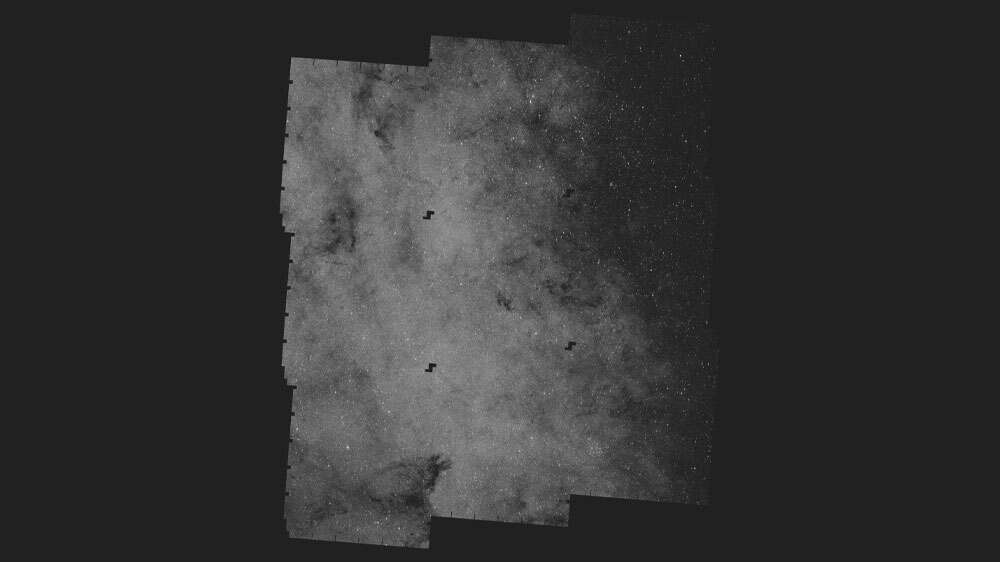
Microlensing + Euclid = the ability to measure planet masses for cold planets that other methods miss
Microlensing occurs when a foreground star (and its planets) briefly magnifies a background star; planetary signals are short (hours–days) and require precise follow‑up to recover planet properties. Euclid’s VIS mosaic supplies the high‑precision positions and deep imaging over a wide area needed for this work.

Credit: ESA
“This time baseline makes it possible to track the motion of the host stars and better characterise the planetary systems, ultimately enabling more accurate mass estimates for planets as small as Mars” states Eamonn Kerins, astrophysicist at Manchester University.
Many microlensing planets discovered over the last two decades lie in the observed area. This high‑resolution image will allow researchers to measure the masses of approximately 60 previously discovered planets in the EGBS footprint, improving our knowledge of cold planet demographics.
The team behind the picture
The image was processed by the OU‑VIS team in the Euclid Science Ground Segment (SGS), whose pipeline was adapted from its main cosmology purposes to handle extreme stellar crowding. The teams had to tune source‑detection thresholds, adjust astrometric references, and mitigate false cosmic‑ray detections. These careful adjustments made the high‑precision astrometry and photometry needed for exoplanet mass measurements possible.
“While going through the astrometry code in detail, I noticed that the algorithm’s default number of iterations was very low. I changed this parameter just to test it—and it worked!” concludes Olivier Herrent, engineer at the Institut d’astrophysique de Paris (IAP).
Future observations and synergies with other experiments
The EGBS footprint overlaps the region NASA’s Nancy Grace Roman Space Telescope will repeatedly monitor beginning in 2027. Euclid’s pre‑survey images will help identify and characterise foreground lens systems that Roman will later detect, enabling combined Euclid+Roman analyses with much improved mass determinations and demographics of cold planets.
“The NASA Roman mission will discover at least 1200 planets, including ~200 in 2027. Euclid will provide precise mass measurements, and ultimately give the distribution of cold planets in the Universe.” adds Etienne Bachelet, Assistant professor at the Université Marie et Louis Pasteur/UTINAM.
Notes for the public and media
- Instrument: VIS visible‑light camera aboard Euclid; VIS is a 600‑megapixel instrument that delivered the mosaic.
- Observations: Nine contiguous fields observed on 23 March 2025, covering 4.8 square degrees.
- Data releases: This image is part of the Euclid Galactic Bulge Survey and of Euclid’s Q2 “Quick Release” campaign; the full DR1 (one year of observations) is scheduled for late 2026 and will further expand the scientific reach.