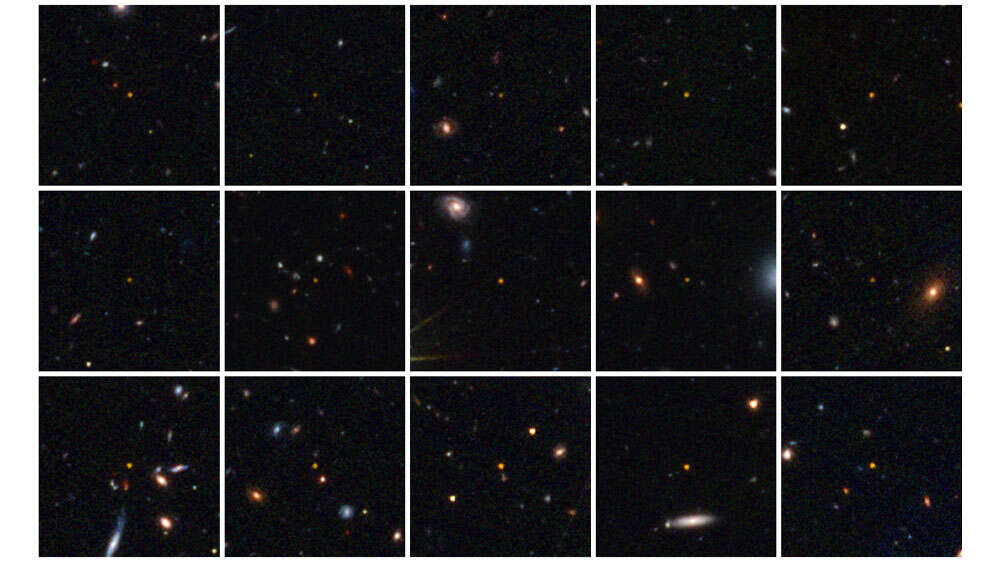
New discoveries
31 new high‑redshift quasars were discovered, with their redshifts measuring between z = 6.6 and z = 7.8. The highest‑redshift source, EUCL J172902.75+641018.1, lies at z ≈ 7.77 and sets a new record for the most distant quasar ever discovered.
Many of these quasars are fainter in rest‑frame ultraviolet light than previously known high‑z quasars, helping to populate the faint end of the early quasar population.

The Euclid experiment
The discoveries come from the first one and a half years of Euclid’s Wide Survey (about 3000 square degrees of sky). Euclid’s combination of wide area and deep optical + near‑infrared (IR) imaging is uniquely suited to find quasars during the epoch of reionisation.
Candidate selection used machine‑learning and probabilistic algorithms on Euclid’s IE, YE, JE, HE bands, plus supplementary ground‑based imaging to strengthen selections. Spectroscopic confirmations were obtained with multiple ground telescopes.
“The exquisite Euclid data, processed by the Euclid Science Ground Segment, enabled us the application of advanced selection techniques that have resulted in an extremely efficient survey, with a success rate in confirming quasars of ~30%. This might not seem like a lot, but it is 10 times better than previous efforts!” adds Francesco Guarneri, postdoctoral researcher at the University of Hamburg.
What this tells us about our Universe
These quasars probe the Universe during reionisation, a key phase when the first luminous sources ionised intergalactic hydrogen. Finding more and fainter quasars at z ≳ 7 helps us understand early black‑hole growth, the environments of the first galaxies, and how quickly the intergalactic medium became ionised.
The sample will enable follow‑up with facilities such as the James Webb Space Telescope (JWST), ALMA, and NOEMA to characterise host galaxies, gas, and dust, and to measure black‑hole and host properties.
Future milestones for the Euclid mission
Follow‑up observations are ongoing. Euclid will continue building a much larger sample as the survey expands; the first z > 8 quasars may be found as the footprint and depth increase.
Data products (cutouts and 1D discovery spectra) will be made publicly available upon journal publication via the ESA Euclid High‑Level Science Product repository.