Looking for dual and lensed AGN at sub-arcsec separations
We will describe a large, on-going observational project using high-resolution imaging and spectroscopy to discover and study the properties of a large sample of dual AGN at sub-arcsec separations, the parent population of the massive BHs that eventually merge emitting gravitational waves. Studying these systems is of great importance for many reasons, including:
1) predict the LISA GW event rate and the PTA background;
2) provide an astrophysical interpretation of the GW data;
3) sample many previously untested results of galaxy/black hole formation and co-evolution models;
4) understand the role of galaxy merging in producing AGN activity;
5) understand the role of merging in the grow of SMBHs.
These results can achieved by comparing model predictions with the observed properties of dual AGN, such as primary/secondary BH mass function, separation distribution, dual fraction, etc..
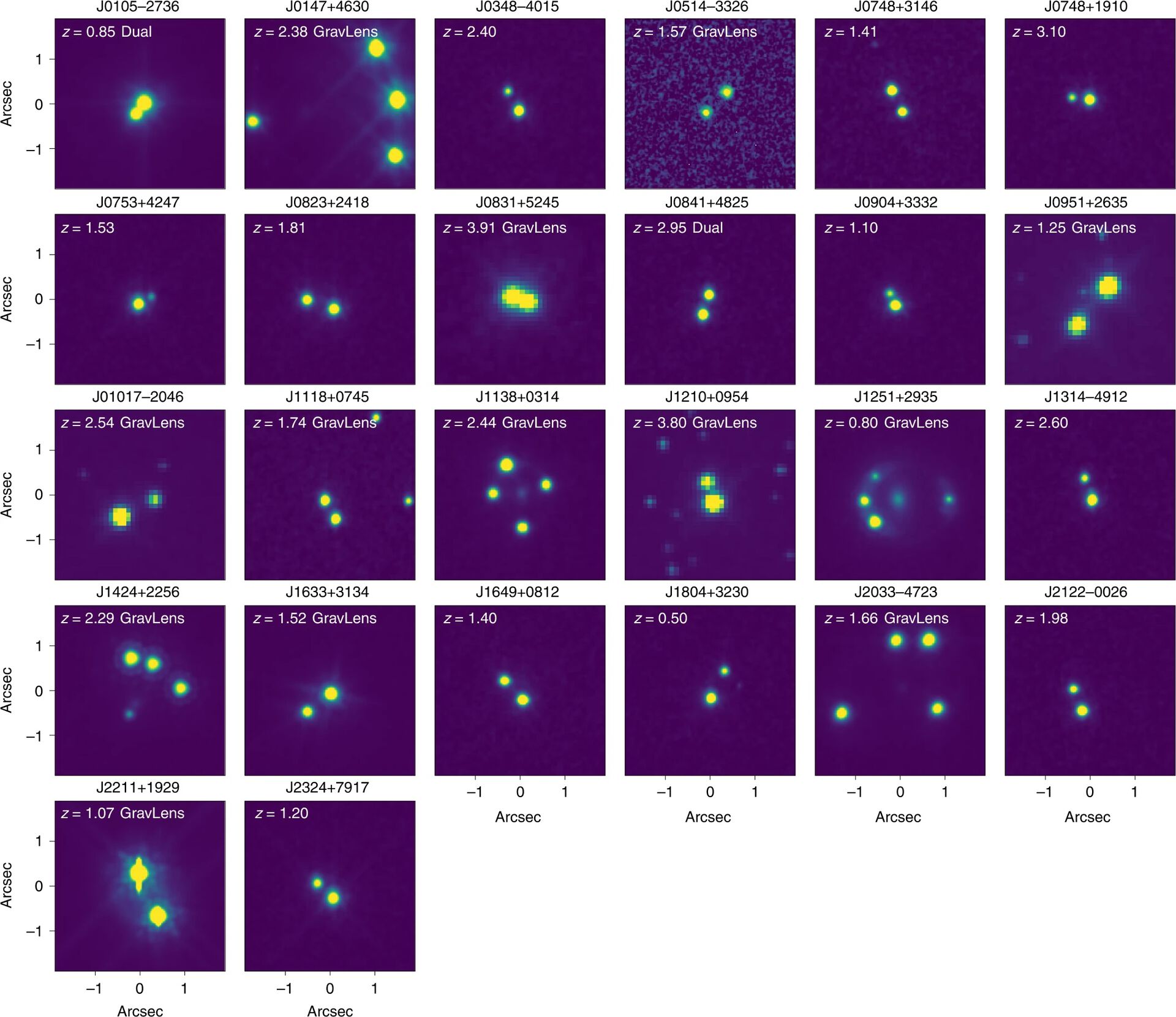
Using Gaia and Euclid we have selected hundreds of dual AGN candidates and observed many tens of them with HST and with the AO-assisted, IFU spectrographs VLT/MUSE (with a recently-approved ESO large program), VLT/ERIS, and Keck/OSIRIS, confirming tens of dual AGN at z>0.5 and separations of 1-7 kpc.
We have also discovered tens of very compact lensed QSOs, including the smallest Einstein Cross ever discovered (Einstein radius ~ 0.2”). We will present the observed physical properties of these systems in terms of dual fraction and BH mass distribution, and how they compare with the predictions of current models of galaxy formation and galaxy/SMBH co-evolution.
We will also present how the lensed systems can be used to sample the IMF and the dark matter fraction in the inner ~kpc of the lens galaxy.