Cold gas in and around galaxies: the key factor in galaxy growth and feedback
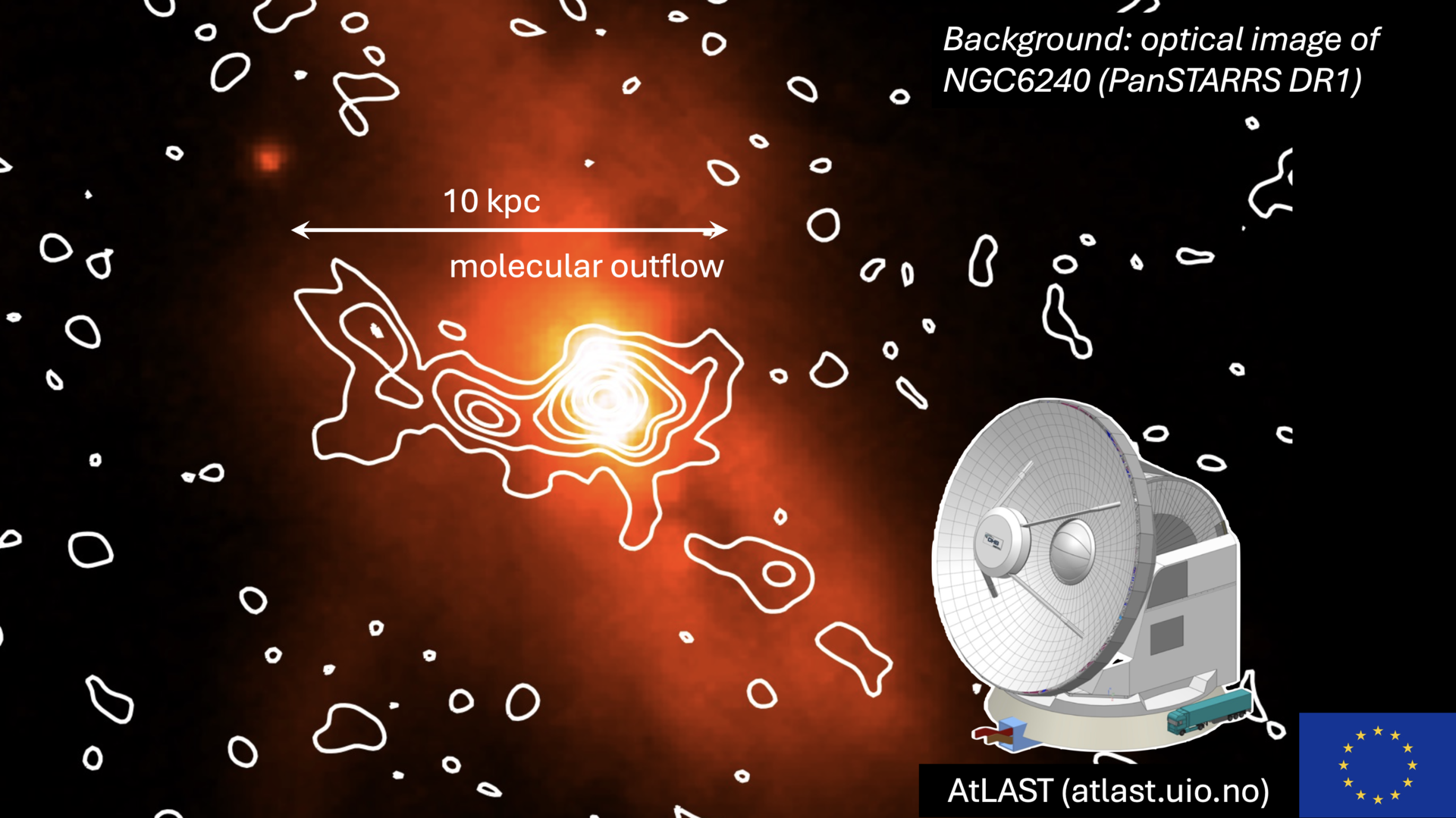
The growth and evolution of galaxies is tightly linked to their cold gas content, as stars form in dense and cold molecular gas filaments. One of the biggest challenges in galaxy formation and evolution is understanding the mechanisms that cause galaxies to stop forming stars, once they reach a certain stellar mass. These mechanisms are commonly referred to as 'feedback', a generic term that includes a wide variety of physical processes, all little understood from a statistical and physical point of view. Mass-loaded galactic outflows (or winds) are thought to be one of the most effective negative feedback mechanisms, as they can eject large amounts of gas from galaxy halos hence removing the fuel for star formation. In the past decade, a growing number of observations at submillimeter/millimeter (sub-mm) wavelengths revealed that galactic outflows can embed gas in the molecular phase.
The most massive and powerful molecular outflows have been detected in infrared-bright galaxy mergers: ultra luminous infrared galaxies can launch > 108 solar masses of cold and dense molecular gas at 100s to 1000 km/s. Despite the growing number of observational constraints, theoretical models and numerical simulations are still struggling to explain this phenomenon. Furthermore, we are starting to detect cold molecular gas at 10s to 100s kpc distance from galaxy nuclei, in the circumgalactic medium. However, due to the lack of a sensitive, wide-field sub-mm single dish telescope such as the proposed AtLAST, current observations struggle to probe extended, low surface brightness molecular gas reservoirs.
In this seminar, I will give an overview of our group’s research efforts devoted to gain a comprehensive understanding of the role of cold molecular gas in galaxy evolution.