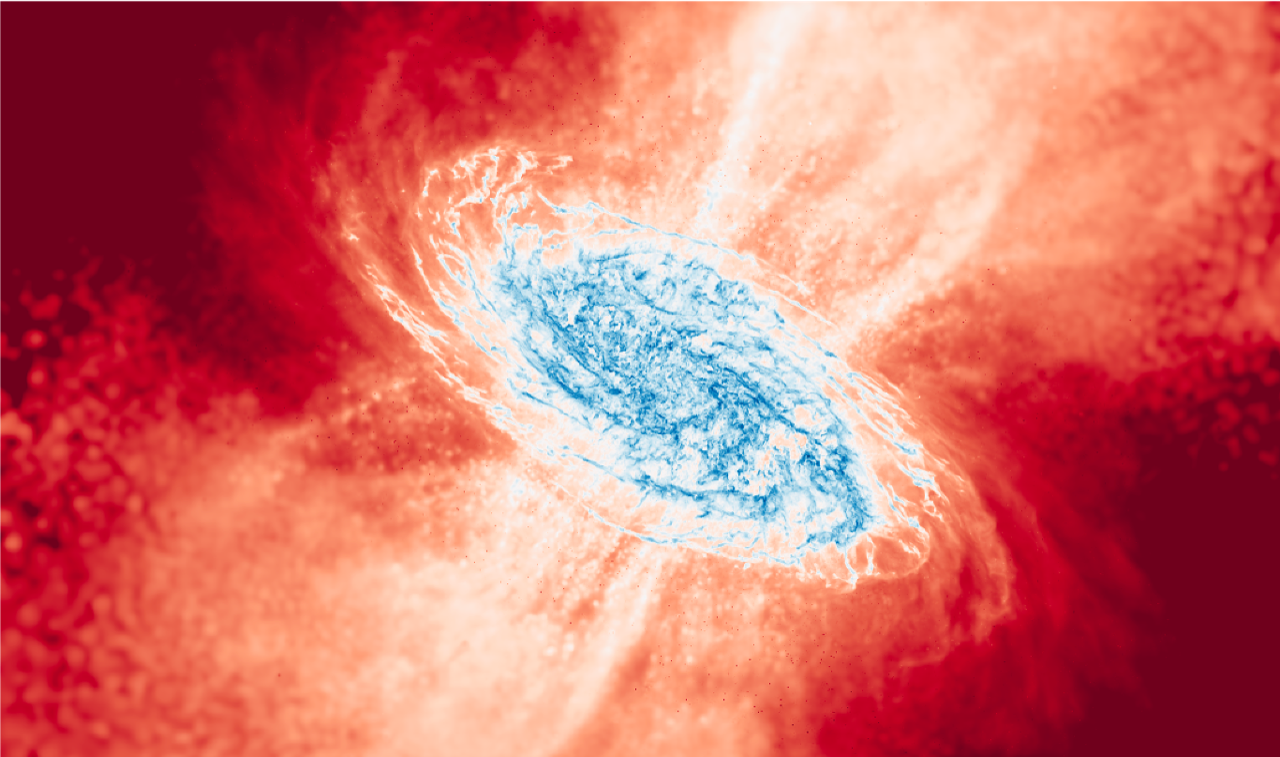
Cosmological simulations are powerful tools that allow us to explore the formation and evolution of the universe at various scales, from individual galaxies to large-scale structures. However, these simulations pose significant computational challenges, as they must account for a vast range of spatial and temporal scales while accurately modeling numerous complex astrophysical processes. In this talk, we will explore these computational hurdles and how they are addressed in modern cosmological codes, with a particular focus on the ChaNGa (Charm N-body GrAvity solver) code.
One of the greatest challenges in cosmological simulations lies in achieving efficient parallelization and scaling. As computational power and simulations grow in size, ensuring that computations are distributed evenly across thousands or eventually even millions of processors becomes increasingly difficult. We will discuss how ChaNGa addresses these issues by leveraging the Charm++ parallel programming model, which provides dynamic load balancing, fine-grained decomposition of work objects and asynchronous messaging. We will also present the recent progress and future plans of ChaNGa as part of the SPACE (Scalable Parallel Astrophysical Codes for Exascale) EU centre of excellence.