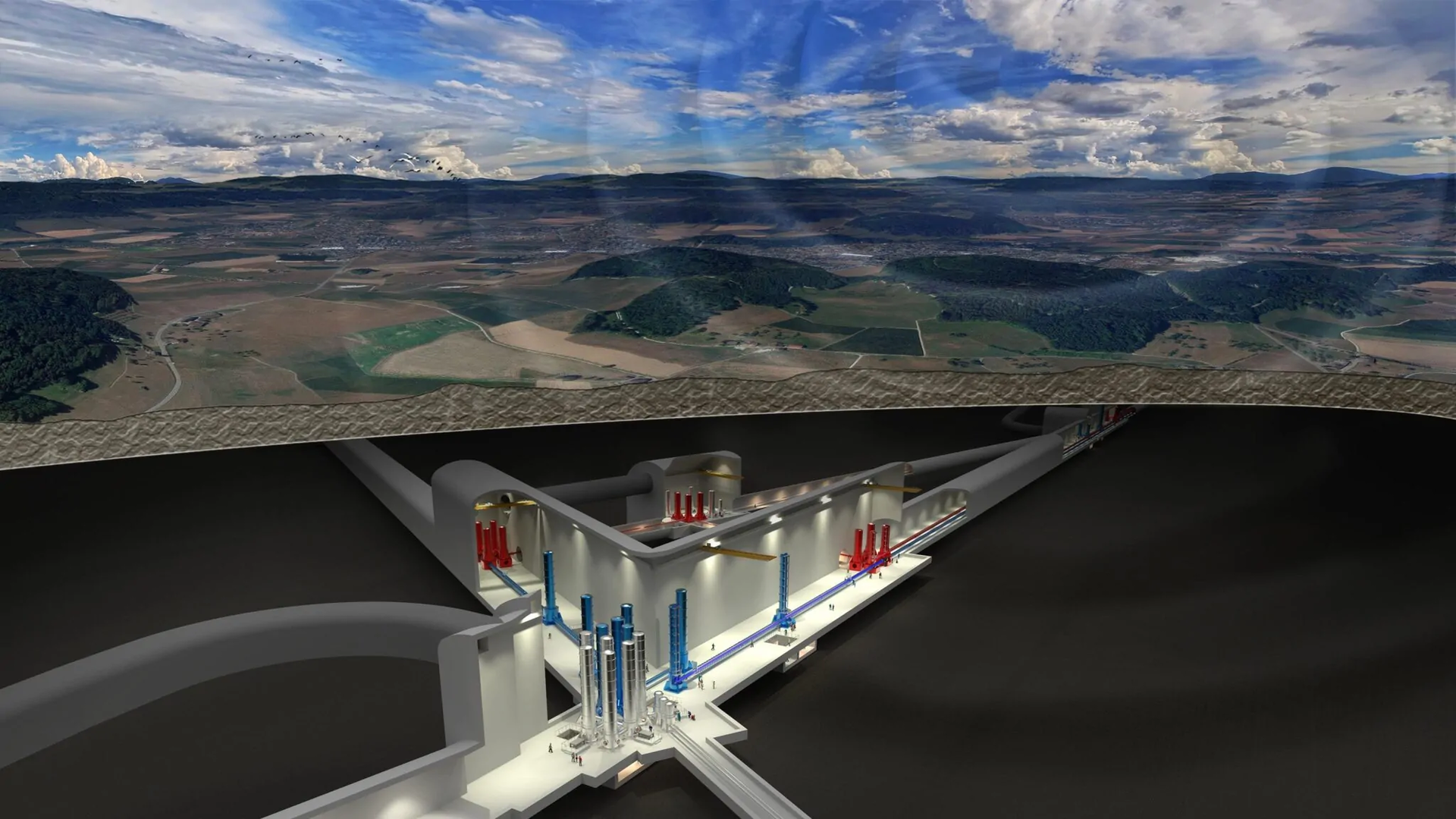
The discovery of Gravitational Waves has opened an entirely new and remarkable field of research. The first GW detectors were built in Germany (GEO600), the United States (LIGO), Italy (Virgo), and Japan (KAGRA). It was LIGO that achieved the first detection of a gravitational wave in 2015—one hundred years after Einstein’s prediction.
The Einstein Telescope (ET) represents the next crucial step in this journey and will be the first third-generation GW detector. The aim of ET is to take that next step: to measure on a broader scale than our cosmic backyard, to probe deeper into the past, and to expand the types of gravitational-wave sources from compact-object mergers to a much wider range of phenomena. The ET will help us unveil and understand dark matter and dark energy.
The Einstein Telescope will deliver ten times higher accuracy than previous detectors, increasing the number of detections by a factor of a thousand. Building this new instrument will require advances across all technical and scientific fronts.
During this colloquium we present the science and the technical challenges of ET, and the proposal to construct the ET in the border region between Belgium, Germany and the Netherlands.

Dr. Ing. Jürgen Van Gorp is Senior Project Manager, FWO Business Developer and R&D coordinator at Einstein Telescope Vlaanderen.
Prof. Stan Bentvelsen is scientific director of the Einstein Telescope project office in the Eu region Meuse-Rhine. He’s also director of the Dutch National Institute for Subatomic Physics (Nikhef) and a professor at the University of Amsterdam.