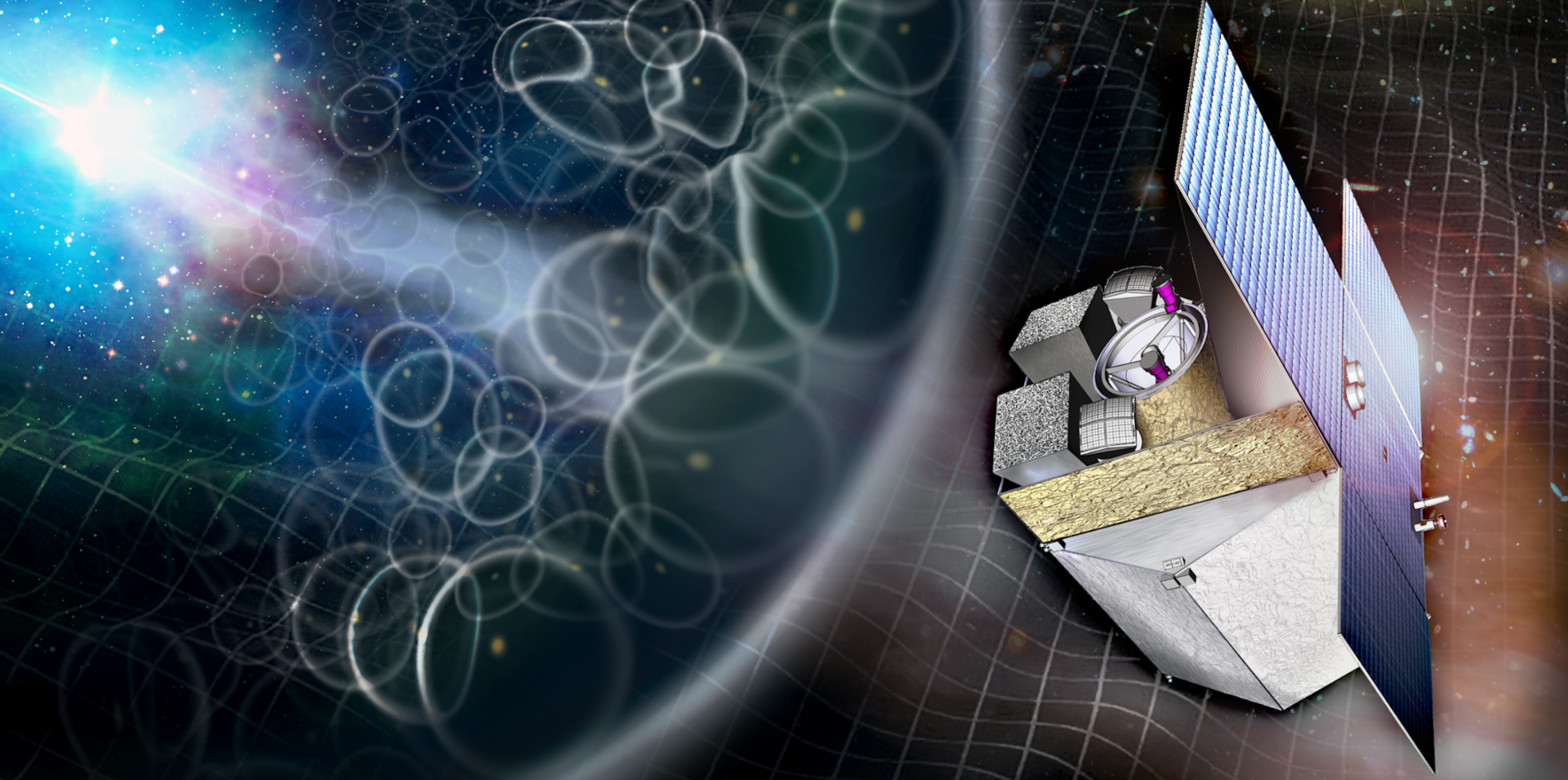
The Transient High-Energy Sky and Early Universe Surveyor (THESEUS) is a mission concept aimed at fully exploiting Gamma-Ray Bursts (GRB) for investigating the early Universe and as key phenomena for multi-messenger astrophysics.
Developed by a large European collaboration (Lead Proposer L. Amati at INAF, Italy), and under study by ESA since 2018, THESEUS is currently one of the three candidate M7 missions for a launch in the mid '30s. By providing an unprecedented combination of X-/gamma-ray monitors, on-board IR telescope and spacecraft autonomous fast slewing capabilities, this mission would be a wonderful machine for the detection, multi-wavelength characterization and redshift measurement of any kind of GRBs and many classes of X-ray transients, including high-redshift GRBs for cosmology (pop-III stars, cosmic reionization, SFR and metallicity evolution up to the “cosmic dawn”) and electromagnetic counterparts to sources of gravitational waves (e.g., short GRBs, soft X-ray and KN emission from NS-NS / NS-BH mergers).
Through these unprecedented capabilities and a flexible guest observer programme, THESEUS will also have a great impact on general time-domain astrophysics and, in all respects, will provide an ideal synergy with the very large astronomical facilities of the future in the e.m. (e.g., ELT, CTA, SKA, Athena) and multi-messenger (e.g., Einstein Telescope, Cosmic Explorer, km3NET) domains.