
PhD candidate
Research group | Cosmology and Extragalactic Astrophysics
Main supervisor | Sijing Shen
Co-supervisor | Hans Winther
Affiliation | Institute of Theoretical Astrophysics, UiO
Contact | tim.zimmermann@astro.uio.no
Short bio
Before starting my position as Ph.D. Research Fellow at the Institute of Theoretical
Astrophysics here in Oslo, I completed both my Bachelors (2018, Thesis: A Simple Model for the Temporal Evolution of Cold Dark Matter) and Masters degree (2020, Thesis: An Investigation of the Lower Dimensional Dynamics of Fuzzy Dark Matter) at Heidelberg University under the supervision of Prof. Luca Amendola and Prof. Sandro Wimberger.
Research interests and hobbies
In short, I’m a computational physicist with a strong interest in cosmology.
More specifically, my primary research interest focuses around the dynamical behaviour and observable consequences of alternative dark matter models such as ultralight dark matter. This work happens at the interface of theoretical modelling, high-performance computing and data/statistical analysis.
CompSci project
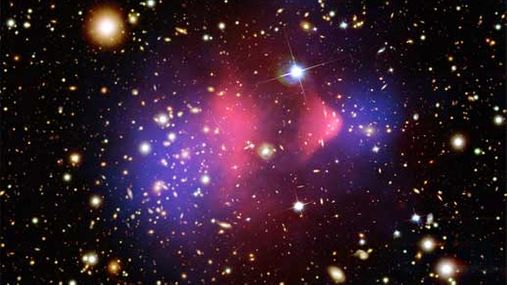
Constraining the properties of wave-like dark matter
in the presence of baryons
The role of dark matter as essential ingredient to the standard model of cosmology is a seldomly disputed fact in the scientific community. Although a variety of observations provide convincing evidence for its existence, its fundamental character remains largely elusive. The lack of evidence for the correctness of Cold Dark Matter (CDM) - our best effective theory - on sub-galactic scales justifies why alternative dark matter models remain an active field of research.
Within the last decade, ultralight dark matter (ULDM), one potential substitute for CDM, has seen considerable interest in the astrophysics community due to its (i) model simplicity (ii) intriguing wave-like dynamical behaviour and (iii) well motivated theoretical origin. If tuned properly, ULDM produces distinct signatures such as cored DM halos and a suppression, or smoothing, of matter structures on length scales smaller than implied by Heisenberg’s uncertainty principle.
In this project I’m interested in how these signatures behave if we increase the model fidelity by adding baryonic -observable- matter and it’s associated feedback processes into the mix. Questions of interest are: How transient are ULDM structures? What observable effects does ULDM imply if baryons are added? Can we distinguish ULDM-effects from baryon-induced signatures? And of course, can we sharpen existing constraints (or find new bounds) of the ULDM parameter space if we increase the physical fidelity of the model?
Simulating these kind of systems is computationally daunting. It is for this reason that I’m also interested in developing cheap surrogate models for ULDM that may help to understand certain aspects of its phenomenology, say quantised vortices, without simulating ULDM from scratch.
Doctoral thesis
On the wave-like nature of fuzzy dark matter: Modeling, phenomenology, and limits from the bottom up
Since the advent of observational evidence for the mysterious, gravitationally interacting substance dubbed dark matter (DM) about a century ago, physicists have worked relentlessly to uncover its microphysical nature. Impressive theoretical frameworks have been developed, and increasingly sophisticated detectors constructed—yet, no direct detection has been achieved. Astrophysics offers a complementary perspective: rather than asking what dark matter is, we ask how it behaves.
In this thesis, I focus on ultralight (or “fuzzy”) dark matter—a class of models that posits the DM particle to be roughly a hundred billion billion billion times lighter than a proton. So light, in fact, that its dynamics resemble those of a wave rather than a classical particle, giving rise to a distinct set of phenomena in a “fuzzy” universe.
To this end, I decompose FDM’s dynamics and phenomena into their elementary building blocks. Lower-dimensional considerations allow me to compare and further develop numerical solution strategies. By reconstructing all possible FDM wave states within the dwarf galaxy Leo II, I derive a robust mass constraint that updates four-decade-old folk wisdom. Finally, by assembling a population of simplified yet fuzzy cosmic filaments, one at a time, I statistically reproduce results of fully-fledged simulations at significantly lower cost
Publications
CompSci publications
- Nico Schwersenz, Victor Loaiza, Tim Zimmermann, Javier Madroñero, and Sandro Wimberger (2024) “Comparison of two different integration methods for the (1+1)-dimensional Schrödinger-Poisson equation” Computer Physics Communications 300, 109192
https://doi.org/10.1016/j.cpc.2024.109192 | Full text in Research Archive - Tim Zimmermann, D.J.E. Marsh, K.K. Rogers, Hans Arnold Winther, and Sijing Shen (2025) “Interference in fuzzy dark matter filaments: Idealized models and statistics” Astronomy and Astrophysics 696, A145
https://doi.org/10.1051/0004-6361/202554232 | Full text in Research Archive - Tim Zimmermann, James Alvey, David J. E. Marsh, Malcolm Fairbairn, and Justin I. Read (2025) “Dwarf galaxies imply dark matter is heavier than 2.2x10^-21 eV” Physical Review Letters 134 (15) 151001
https://doi.org/10.1103/physrevlett.134.151001 | Full text in Research Archive
Previous publications
- Tim Zimmermann, Nico Schwersenz, Massimo Pietroni, and Sandro Wimberger (2021) "One-dimensional fuzzy dark matter models: Structure growth and asymptotic dynamics" Physical Review D 103 (8) 083018
https://doi.org/10.1103/PhysRevD.103.083018 - Tim Zimmermann, Massimo Pietroni, Javier Madroñero, Luca Amendola, and Sandro Wimberger (2019) "A Quantum model for the dynamics of cold dark matter" Condensed Matter 4 (4):89
https://doi.org/10.3390/condmat4040089
