Previous events - Page 104
Mapping fish diversity in the Oslo fjord by combining eDNA and citizen science
The Numerical Methods in Quantum Chemistry workshop will take place June 5-8 2023 in Tromsø.
The ichthyotoxic algae Chrysochromulina leadbeateri – an investigation into favorable conditions for growth and toxicity

Hylleraas seminar, hosted in Tromsø
Welcome to our GEOHYD Lunch Seminar Friday 2nd of June @ 12:15 in Aud. 2, Geology building or via videolink using Zoom. The seminar is helt by Holger Lange (NIBIO).

The human brain has no lymphatic vessels, so how does the brain clear metabolic waste? In 2012, Iliff et al. proposed a theory about waste clearance of the brain, called the "glymphatic" theory. The theory suggest that the waste clearances is bio-mechanical, and that impaired clearance may be the cause of some neurodegenerative diseases and disorders. The inaccessibility of the human brain have been a hurdle in the research, as experiments on rat brains do not translate to the human brain. Researchers at Oslo university hospital Rikshospitalet have shown clearance using tracers visible in magnetic resonance images (MRI). However, the MRI only provide snapshots of different states in time, therefore computational modeling is needed to fill in the gaps. In this presentation, we will look at computational modeling with the MRI to infer material parameters in the brain.

Doctoral candidate Lene Maria Sundbakk at the Department of Pharmacy, Faculty of Mathematics and Natural Sciences, is defending the thesis "Benzodiazepines and z-hypnotics in pregnancy and child neurodevelopment - With focus on causal inference methods in perinatal pharmacoepidemiology" for the degree of Philosophiae Doctor.
Predicting Frictional Properties of Graphene Kirigami Using Molecular Dynamics and Neural Networks
When hungry meets harmful: investigating the toxic relationship between haptophytes and copepods

Stalagmites grow on the floor of caves by precipitation of calcium ions found in the residual water film covering the top of the stalagmite, which is progressively drained away. Drops dripping from stalactites ensure the renewal of these ions.
Previous models of stalagmite growth assumed that drops fall on a straight vertical line from stalactites. Through high-speed imaging during field experiments in caves, we however observe that the impact point position of the drops is scattered. Using a Langevin-like equation to describe the fall of drops in response to gravity and aerodynamic forces, we then propose a prediction of the impact point dispersal. We show that measured stalagmite widths are correlated to the impact point dispersal of the drops.
In a second time, we focus on the mixing of calcium ions between the drop and the film during impact. The drop produces a crown when impacting the film, accompanied by a large amount of secondary droplet ejections. This is at the very heart of the film thickness variability post-impact. We record high-speed imaging of drop impacts on films of controlled thickness in a lab environment and assess the mixing between the drop and the film. We deduce how much liquid coming from the initial drop remains in the film.
By Ian Barnes from the Natural History Museum, London, UK

Title: The impact of secondary ice production on clouds and climate
Speaker: Georgia Sotiropoulou , EPFL
Welcome to our weekly lunch seminar held in the dScience lounge area! This event is open to PhD candidates and postdocs.
Mikkel Jensen:
Various theoretical models and experimental results propose different governing mechanisms for friction at the nanoscale. We consider a graphene sheet modified with Kirigami-inspired cuts and under the influence of strain. Prior research has demonstrated that this system exhibits out-of-plane buckling, which may cause a decrease in contact area when sliding on a substrate.
According to asperity theory, such a decrease in contact area is expected to reduce friction. However, to the best of our knowledge, no previous studies have investigated the frictional behavior of a nanoscale Kirigami graphene sheet subjected to strain.
William Hirst:
This thesis explores a diverse array of Machine Learning (ML) models as they search for chargino-neutralino pair production in three-lepton final states with missing transverse momentum. The study is based on a data set of sqrt(s) = 13 TeV proton-proton collisions recorded with the ATLAS detector at the LHC, corresponding to an integrated luminosity of 139 fb−1. The ML models applied in the study were three variants of Deep Neural Networks (DNN), and Boosted Decision Trees (BDT). The DNN variants included an ordinary dense Neural Network (NN), Parameterized Neural Network (PNN) and ensemble models utilizing pattern-specific pathways created by competing neurons. In the latter variant I included a novel layer introduced in this thesis, the Stochastic-Channel-Out (SCO).

A flexible predictive density combination is introduced for large financial data sets which allows for model set incompleteness. Dimension reduction procedures that include learning allocate the large sets of predictive densities and combination weights to relatively small subsets. Given the representation of the probability model in extended nonlinear state-space form, efficient simulation-based Bayesian inference is proposed using parallel dynamic clustering as well as nonlinear filtering, implemented on graphics processing units. The approach is applied to combine predictive densities based on a large number of individual US stock returns of daily observations over a period that includes the Covid-19 crisis period. Evidence on dynamic cluster composition, weight patterns and model set incompleteness gives valuable signals for improved modelling. This enables higher predictive accuracy and better assessment of uncertainty and risk for investment fund management.

Welcome to the next seminar of the semester, where we will host a talk by Krubeal Danieli (PhD candidate, Fyhn Group, FYSCELL, IBV).

Every second Tuesday, CBA members gather for lunch and a talk. On May 30th 2023, we have a presentation given by CBA professor Dag O. Hessen.

Doctoral candidate Samiran Sen at the Department of Chemistry, Faculty of Mathematics and Natural Sciences, is defending the thesis "Advances in Hamiltonian Hybrid Particle—Field Theory: Improving the description of interfacial systems" for the degree of Philosophiae Doctor.
Welcome to our GEOHYD Lunch Seminar Friday 26th of May @ 12:15 in Aud. 2, Geology building, or via video link using Zoom. The seminar is held by Junbin Zhao (NIBIO).
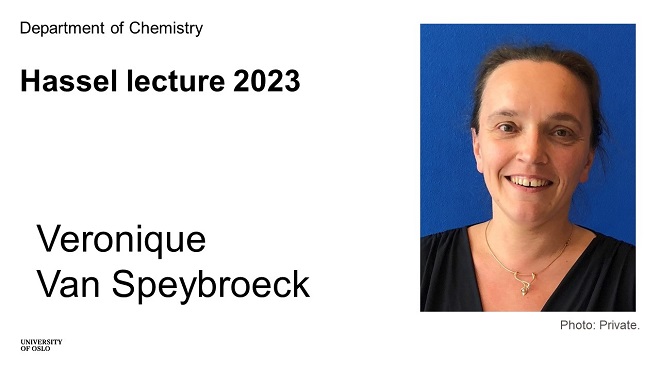

This year's Hassel lecture is headed by Professor Veronique Van Speybroeck. The second day Professor Speybroeck will present the lecture "From quantum mechanics to machine learning: Bridging length and time scales in modeling nanoporous materials at operating conditions."
Dancing in the (moon) light: diel vertical migration and the behaviour of krill (Meganyctiphanes norvegica) during midwinter and midsummer nights