The Glass Solution Companion app is a simple software to assist with using thermal methods for predicting the glass solubility of drugs in polymers (amorphous solid dispersions, ASDs). It can be used to do the necessary calculations and optimization for generating solubility models over temperature ranges, as well as form the basis of making an efficient experimental and analytical plan for finding the most suitable thermal method for your ASD formulation.
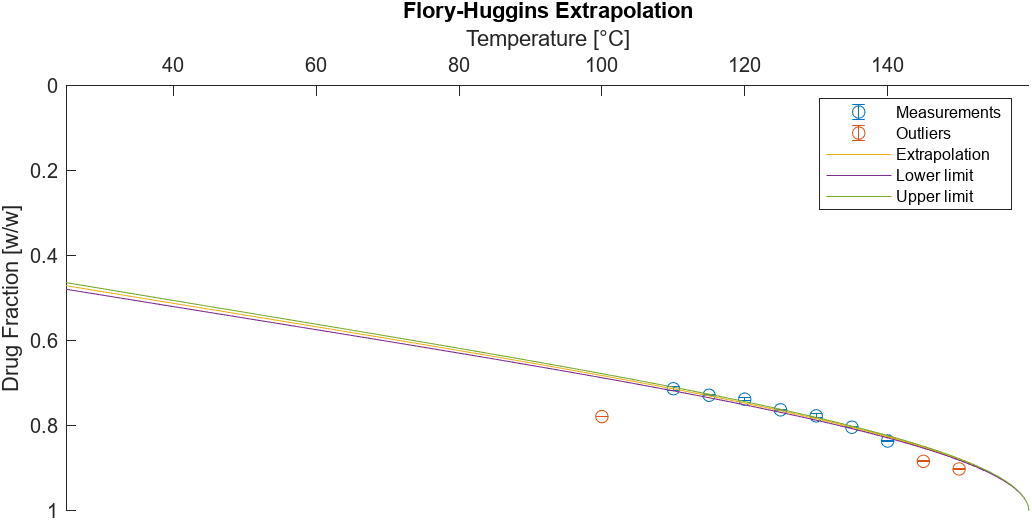
Currently, the software is capable of making predictions using the Melting-Point-Depression, Recrystallization and Melting-and-Mixing method. For more information on how to approach the experimental planning, it is advised to check out our publications on the topic: Larsen et. al. (2024). While for more information on how to use the Melting-and-Mixing method check out this publication: Meiland et al. (2022).
The software application relies on an Excel spreadsheet filled out with experimental data and physical-chemical properties of the drug and polymer. A template for this spreadsheet, together with a step-by-step guide can be found below. The software application can be installed from the exe-file. As an alternatively for people proficient in Matlab, the project folder containing the source code has also been made available.
- Glass Solution Companion app (exe-file)
- Excel template - (Filled example)
- Step-by-step guide to using the software
- Matlab project folder

The software was originally developed to assist with using the new Melting-and-Mixing method. However, it is indeed possible, though somewhat tricky, to perform the calculations for the method through optimizations performed in Excel. The following Excel spreadsheets can be used to determine the soluble drug loads from experimental data. This requires a mathematical optimization to be done on the results from each individual experimental sample. A step-by-step guide can also be found below.
- Excel spreadsheet for mathematical optimization
- Step-by-step guide to using the Excel spreadsheet
The Melting-and-mixing method, as well as the Glass Solution Companion app, was made through a collaboration between the University of Copenhagen and the University of Oslo. Funding was received for the project by Nordic POP through NordForsk for the Nordic University Hub project #85352. In case of inquiries regarding the software or potential collaboration, contact details on participants can be found below.
|
 Bjarke Strøm Larsen b.s.larsen@farmasi.uio.no |
 Peter Meiland peter.meiland@food.ku.dk |
|
 Professor Ingunn Tho ingunn.tho@farmasi.uio.no |
.png) Professor Thomas Rades thomas.rades@sund.ku.dk |
|
 Eidan Tzdaka |
|
Supplementary Information can be found as
Corrigendum to Meiland et al., Int. J. Pharm. 629 (2022) 122391 in International Journal of Pharmaceutics, 662 (2024) 124554.