Guest lectures and seminars - Page 3
Lund, Sweden, will soon host two of the most advanced particle accelerators for photon and neutron science, MAX IV - an electron synchrotron, and the European Spallation Source - a high power proton linac. This double seminar (25 + 25 min) will give an overview of both facilities, covering the complementarity of the two facilities as well as the accelerator science challenges. The seminar is suited for students as well as staff.
Talk given by David R. Nelson, Lyman Laboratory, Harvard University.
From Birkeland’s Gun to Cosmic Accelerators.
Electromagnetic and Electrostatic Wave Acceleration of Matter.
Professor Rickard Lundin, Swedish Institute of Space Physics.
Leave the lunch box at home - the "Felleskollokvium" is back.
The Strategic Research Initiatives DIATECH and REALOMICS will present status and their plans for the future.
Speaker: Vadim Makarov. Institute for Quantum Computing, University of Waterloo, Canada.
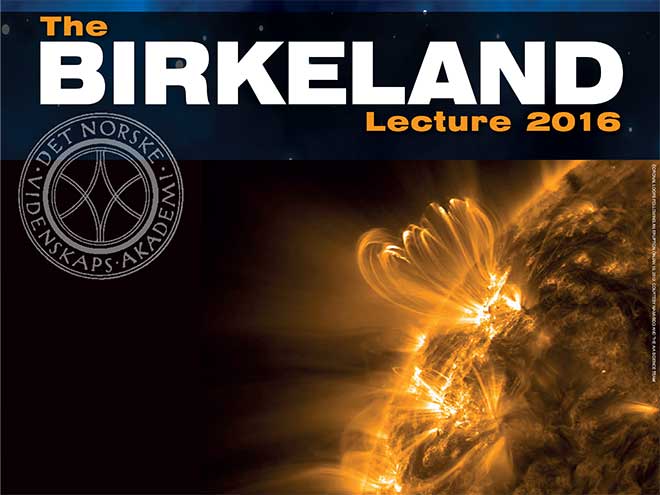
Professor Eric Priest, St Andrews University, Scotland:
Our Dynamic Sun
Alfredo Galindo-Uribarri, Oak Ridge National Laboratory / University of Tennessee, Knoxville.
Dr. Terry Onsager, National Oceanic and Atmospheric Administration, USA/Space Weather Prediction Center, USA.

The research centre for dark matter, The Strategic Dark Matter Initiative - SDI, will officially be launched on Friday, and invites you all to a popular science lecture, with coffee and snacks.
-A new window on our Space environment: The polarization of the auroral emissions. A French – Norwegian discovery.
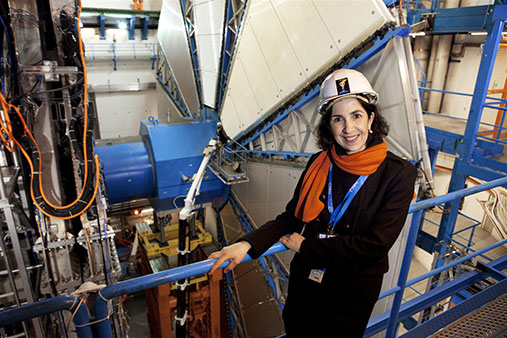
Fabiola Gianotti is a new honorary doctor at the University of Oslo. This is her acceptance speech.
The event is free and open to all, no registration necessary.

Open seminar on “Thermoelectric power generators” by Prof. Anke Weidenkaff
What auroral and geomagnetic observations tell us about long term variations of the sun.
Seminar with Mike Lockwood
- life on small scales in the oceans
Earth Flows seminar | Talk by Hans Pécseli
Joint seminar of the Theory group and the AMCS group
Speaker: Professor Constantino Tsallis, Brazilian Center for Physics Research and National Institute of Science and Tech