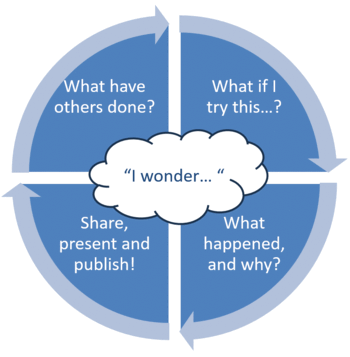
What is SoTL?
Sholarship of Teaching and Learning, SoTL for short, aims to improve teaching practices and student learning outcomes. To achieve this, SoTL encourages teachers to approach their own teaching as researchers. What works, and what doesn't? Why is this? How can this understanding be used to improve teaching and learning?
Also, SoTL encourages teachers to build a community to think about teaching and learning, transforming teaching from an often solitary pursuit to a collegial one. And yes, you can do SoTL with your students as collaborators!
Why engage in SoTL?
There are many reasons to do SoTL, and you may be motivated by more than one. You might want to address a teaching challenge, explore the impact of a new teaching approach, or understand why students (dis)engage with certain tasks. Perhaps you wish to collaborate with colleagues and students on a shared challenge? Or you may want to support your academic development, for example through LINK’s General pedagogical training programme, an application for Distinguished Educator, or promotion to full professor.
So you want to do a SoTL project?
Then welcome to the SoTL community! There are many resources online to get started with SoTL. The Faculty of Mathematics and Natural Sciences has a resource page in Norwegian here. For an example in English, you can check out Elon University.
It's a great idea to involve collegues and students in your project, and why not brainstorm your project with someone at the departments section for Geoscience education?! If you think you're idea may be of interest to many collegues at the department, don't hesitate to get in touch about organising a collaborative investigation!
Funding for SoTL Projects
Do you have an idea for exploring or improving teaching and learning in your course or programme? Funding can provide time, resources, and opportunities to develop, investigate, and share your SoTL project.
UiO offers several funding sources that may support SoTL-related initiatives. You can start here to see some sources!
Communicating SoTL
Underlying SoTL is the idea that teaching and learning will improve when we build on each others results. Numerous dedicated journals and conferences have therefore grown up around SoTL. Many regular academic journals also accept teaching and learning articles. This is a great source of inspiration, make sure to take a look at existing work before starting out!
But communication of your teaching project and results related to SoTL can take many forms, from presentations at your institute and conference contributions, via workshops and podcasts, to peer reviewed publications.
Below are some examples of staff and student SoTL projects at our department for inspiration. And don't hesitate to get in touch!
/Mattias, Section of Geoscience education
¨¨¨¨¨
Get inspired by collegues' SoTL work
Articles, perspectives and published reports
Anderson et al. (2026) Co-Creation in Practice: Redesigning a Geoscience Bachelor Course. Teaching & Learning Inquiry, 13.
Anell (2025) Disruptive players: How Classroom Incivility impacts Educator Engagement and Performance. Nordic Journal of STEM Education, 9(3), 308-314.
Anell and Shepard (2025) GEO*Logic – A board-game designed to be a versatile geological learning and teaching tool. iEarth projects database
Lundmark et al. (2020) Digital fieldwork with Fieldmove - how do digital tools influence geoscience students’ learning experience in the field? Journal of Geography in Higher Education 44.3 (2020): 427-440.
Conference presentation abstracts
Dalslåen and Lundmark (2026) Involving First-Year Geology Students in Research activities: A CURE Light project. Nordic Geological Winter Meeting 36, Turku
Lundmark et al. (2025) “Why don’t my students come to class?” MNT-konferansen 2025, NTNU, Trondheim
Nystad (2022) How important are extracurricular activities for student employability? Nordic Geological Winter Meeting 35, Reykjavik
Bjørlykke (2020) Geoscience Education in Norway. Importance of applied disciplines in geology and geophysics. Nordic Geological Winter Meeting 34, Oslo
Conference posters
Rodriguez-Blanco (2024) Pictionary* as a multi-purpose tool in teaching sequence stratigraphy Nordic Geological Winter Meeting 36, Gothenburg
Aas and Haugen (2024) Improving Geoscience Education: How Course and Student Representatives work at University of Oslo, Norway. Nordic Geological Winter Meeting 36, Gothenburg.
Nystad and Stangeland (2024) Facilitating student engagement in geological fieldwork using Activity Bingo. Nordic Geological Winter Meeting 36, Gothenburg
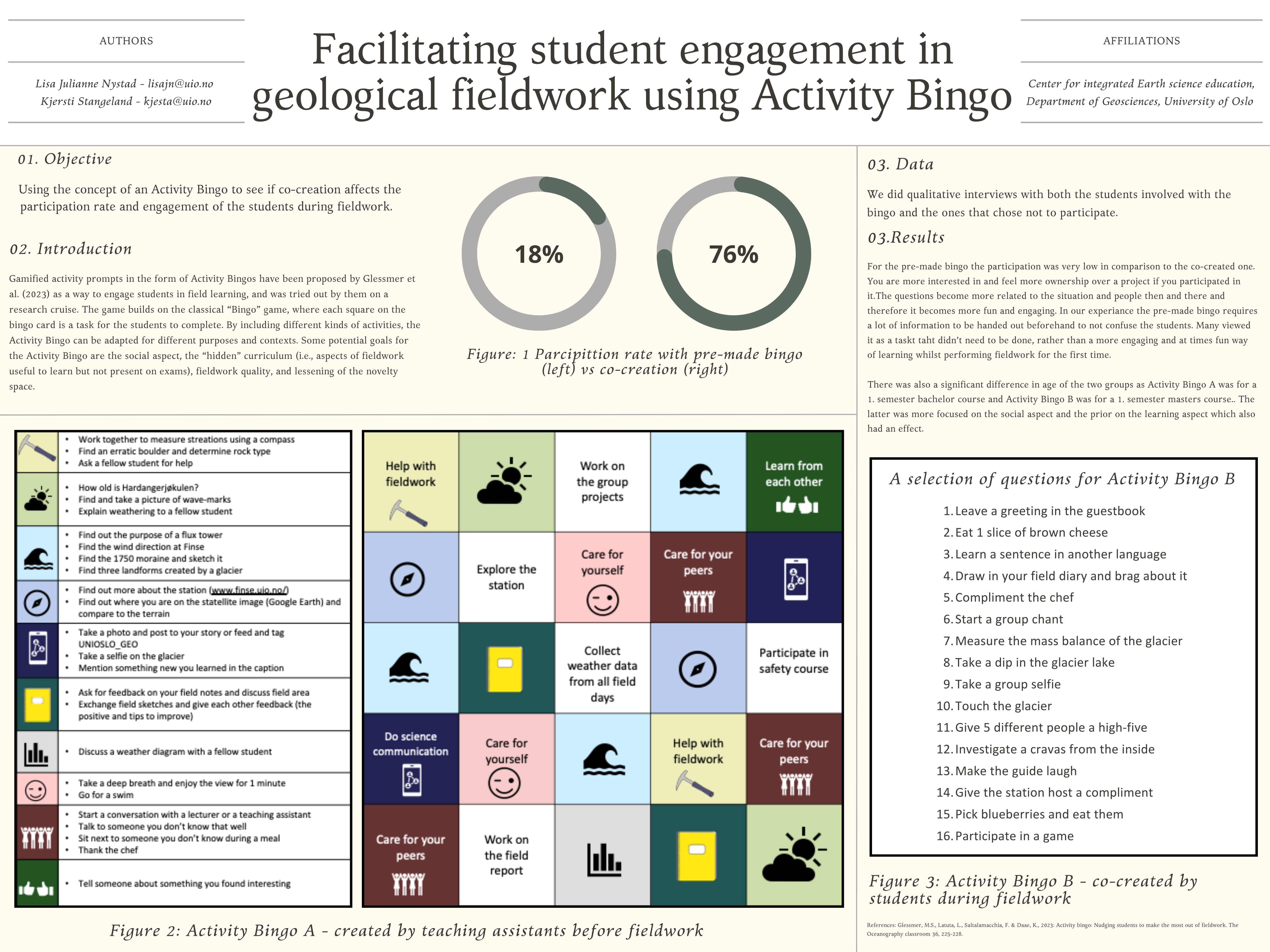
Lundmark and Dunnettt (2024) “The Earth is like a…” - teaching geoscience through analogies. Nordic Geological Winter Meeting 36, Gothenburg
Andersen et al. (2021) Bringing in the experts - an example of pro-active co-planning of a second semester bachelor course. ISSOTL, Perth.
Listen to podcasts
Anell (2024) From ‘real life’ to a fantastic quirky teaching tool EGU Blogs » GeoLog »
Anell (2024) Holding it in (the learning, not the pee) – The gendered importance of toilet breaks for geoscience students during field-courses EGU Blogs » GeoLog »