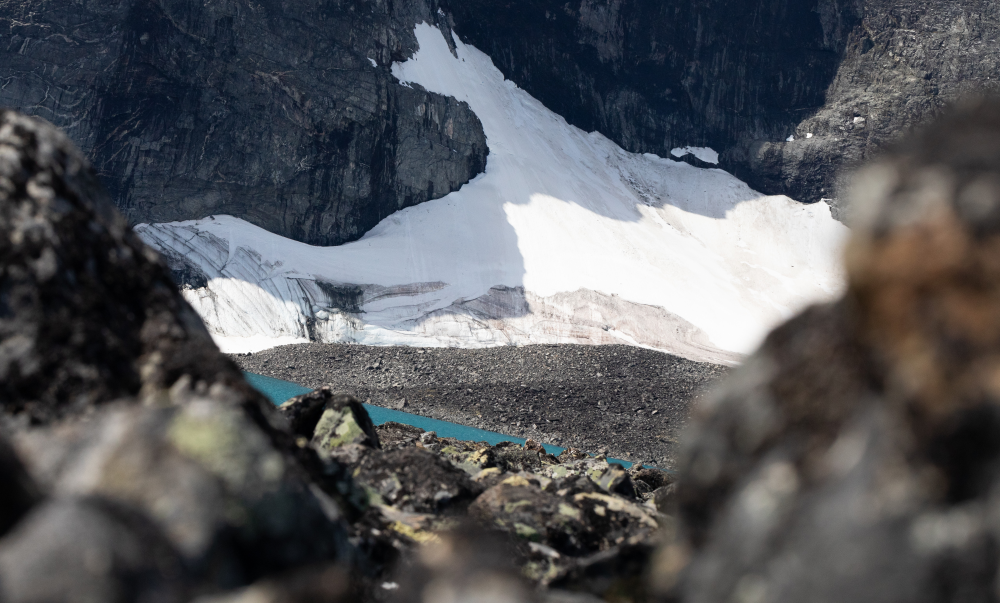
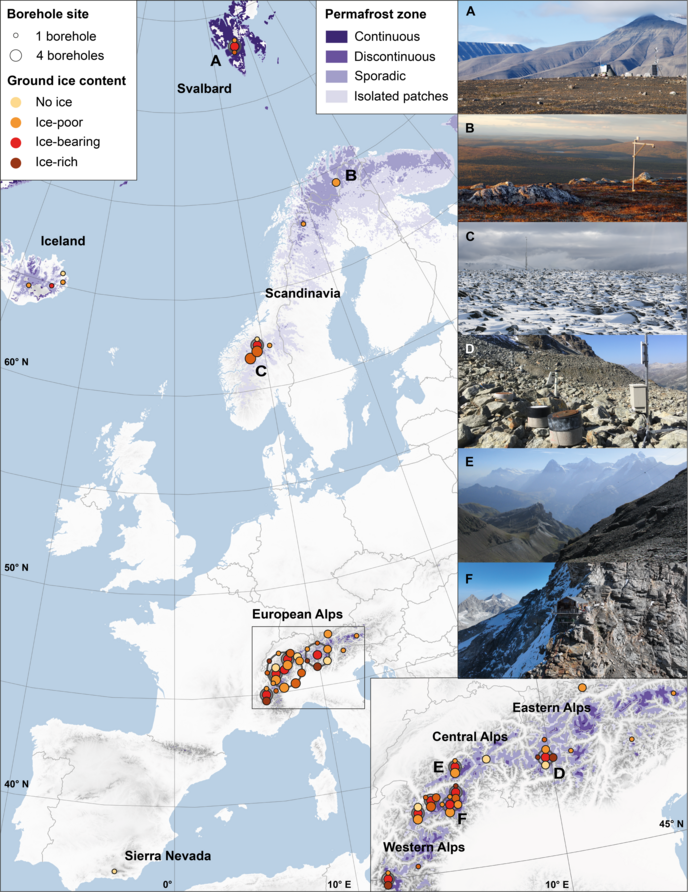
A dataset consisting of 64 time series of temperatures measured in permafrost from mountains in nine European countries has been collected and analysed by an international team of permafrost researchers. The data series extends geographically from Svalbard in the north to the Alps and Sierra Nevada in southern Spain.
The work has been led by Jeannette Nötzli, a researcher on permafrost for WSL Institute for Snow and Avalanche Research SLF. From University of Oslo, Professor Bernd Etzelmüller, an expert on the cryosphere and permafrost, is one of the contributors to the new study.
The results from the comprehensive study is now published in Nature Communications. The study shows for the first time that mountain permafrost is getting warmer throughout Europe.
Permafrost in mountain areas under pressure
The data series from the European mountain regions show that the temperature at a depth of ten meters has increased by more than 1°C in some places over the past ten years. Researcher Jeannette Nötzli, who led the work says:
– The warming of permafrost in the mountains is significant, and it is observed in all regions, depths and time periods that we have looked at.
Permafrost
Permafrost is the subsoil, such as rock and loose materials, that has temperatures below 0°C throughout the year, and is therefore permanently frozen. Permafrost covers about 10% of all the land on Earth. It is mainly found in the Arctic, such as Siberia, northern Alaska and Canada, and in high mountain areas.
The cold areas where permafrost occurs—the high mountains and polar regions—are particularly sensitive to climate change.
An unexpected finding is that the increase in permafrost temperatures in the mountainous regions of the European continent is partly similar to what we find in the Arctic. The researchers observed the greatest warming at the highest and northernmost locations.
New boreholes to monitor deep permafrost
Professor Bernd Etzelmüller from the Department of Geosciences, University of Oslo has been concerned with the state of permafrost and has researched permafrost in the Arctic, Iceland, the Norwegian mountains, and the ground in Finnmark over many years. He has observed rising temperatures in permafrost over a long period.
At the University of Oslo, physical geographers have been researching permafrost for many years. They drilled boreholes in the mountainsides of Jotunheimen in 2008 to measure the permafrost, and this fall (2024), Etzelmüller and researchers from NTNU, the Norwegian Meteorological Institute, and the Norwegian Mountain Center were able to drill two new deep boreholes in Jotunheimen. The new work is possible with support from Sparebankstiftelsen DNB.
Further reading (in Norwegian): Avslører permafrosten med milliondyr brønnboring

– The permafrost that is beginning to thaw is in some places several thousand years old, and when it thaws, it can pose a risk of rockslides and unstable conditions in the high mountains, says Bernd Etzelmüller.
The two new boreholes will be equipped with modern measuring instruments to monitor changes in the permafrost in real-time.

– Within 20 to 30 years, the temperature below ground will rise by one degree. This may not sound like much, but it can lead to geohazards such as rockslides.
The study
A total of 20 researchers participated in the study.
The work was led by Jeannette Nötzli, a researcher at the WSL Institute for Snow and Avalanche Research, together with Ketil Isaksen, a researcher at the Norwegian Meteorological Institute.
Professor Bernd Etzelmüller from University of Oslo, an expert on permafrost, is a co-author of the study. Researchers from UNIS and universities and institutions in Germany and Switzerland are also involved in the study.
The new study is mentioned in an news article in the Norwegian Broadcasting Corporation – NRK where they interviewed Per Arne Vole, chairman of the Galdhøpiggen Summer Ski Center. He is concerned that they may have to close the center as the snow and ice melt away in the summer. For many years, Galdhøpiggen Summer Ski Center in Jotunheimen has been a paradise for Norwegian top alpine skiers. But now they might have to close for good due to a lack of snow.
Thawing is an ongoing process
The researchers also found that when temperatures in ice-rich permafrost approach 0 °C, the warming slows down and almost stops. This is because the energy is then required to melt the ice first. Once the ice in the permafrost has melted, the temperatures continue to rise rapidly again.
The new comprehensive dataset from the international research collaboration includes decades of time series data from European mountains. The temperatures are measured at a depth of at least ten meters. This large dataset is unique and extremely valuable for research, consilting, and public authorities.
– The increasing changes and potential consequences of permafrost thawing in the high mountains for natural hazards and infrastructure pose a significant challenge in many mountain regions. Therefore, thawing permafrost should be monitored, concludes Etzelmüller.
The scientific article
Noetzli, J., Isaksen, K., Barnett, J. et al. Enhanced warming of European mountain permafrost in the early 21st century. Nat Commun 15, 10508 (2024). https://doi.org/10.1038/s41467-024-54831-9
Further reading (in Norwegian): Avslører permafrosten med milliondyr brønnboring Apollon, 6:11:2024