The current is not called the Gulf Stream, and the warm waters along the Norwegian coast do not originate in the Gulf of Mexico.
There are many myths about this current that transports warm water northward and contributes to mild winters and ice-free fjords along the Norwegian coast.
In recent years, there have also been news reports stating that this life-giving current of warm seawater is about to stop completely. This would lead to temperatures dropping by 50 degrees Celcius in cities like Oslo and Trondheim, according to a group of Dutch researchers.
— Absolute nonsense, says Joe LaCasce, a professor of oceanography at Department of Geosciences, at University of Oslo.
As long as the wind blows
He is concerned about how the dramatic headlines contribute to confusion and misinformation regarding climate issues.
— Many others and I find it irresponsible to inflate such claims as this. Our job is to inform people about the seriousness of climate change, and we have a responsibility to be careful. We need professional discussions, but we should have those at academic conferences not in the public domain, says LaCasce.
You can also read this article in Norwegian.
So what do we really know about ocean currents and their impact on the climate?
Let's start with the Gulf Stream. Known and beloved by all northerners. The idea that the Gulf Stream is responsible for warming the sea along the Norwegian coast has been part of our childhood education.
But this is not true, according to oceanographers.
— The Gulf Stream does not run along the coast of Europe. The Gulf Stream is a current that runs along the east coast of the United States, LaCasce points out.
The Gulf Stream is primarily a local current on the other side of the pond. A large fraction of the current is wind-driven, and turns southward into the North Atlantic.
— Therefore, we can immediately state that the Gulf Stream cannot stop as long as there is wind, LaCasce adds.
A colossal conveyor belt
However, it is not this current that comes along the Norwegian coast.
'Our' current is part of what is abbreviated as AMOC, which stands for the 'Atlantic Meridional Overturning Circulation.'
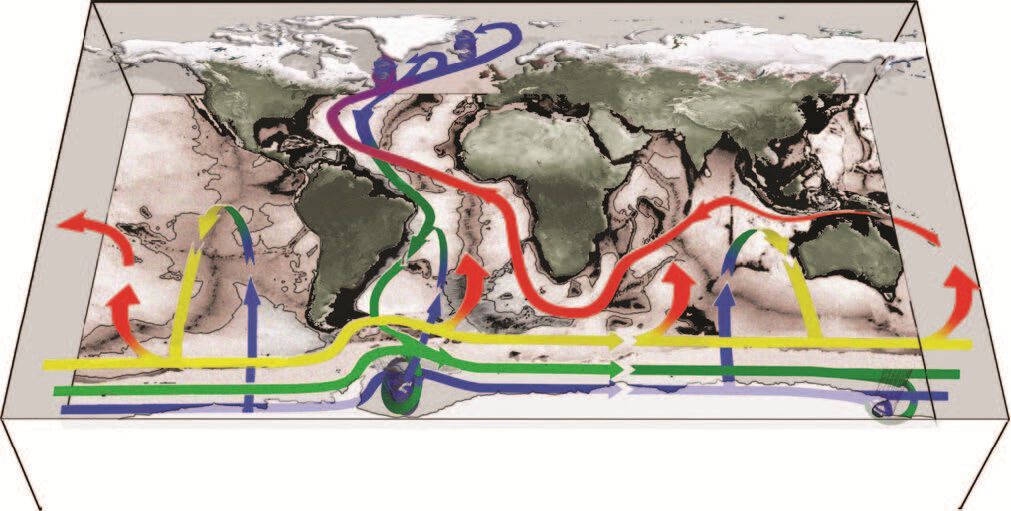
And here we need to pause a moment. Because even though it says 'Atlantic,' this current is also part of a global current system. This in turn is often referred to as the “conveyor belt” of the world's oceans. It moves water masses from one side of the earth to the other. From the Pacific Ocean to the Atlantic Ocean. From the South Pole to the North Pole.
One can think of the conveyor belt in terms of heavy, cold water flowing along the bottom in one direction, while lighter, warmer water at the surface flows in the opposite direction. In the Atlantic, the cold water moves southward, and the warm water moves northward.
— What creates confusion is that AMOC and the Gulf Stream are juxtaposed in the Atlantic, along the coast of North America. While the Gulf Stream is driven by wind, AMOC is also driven by differences in density. The two currents therefore separate in the North Atlantic, with AMOC continuing northward into the Norwegian Sea, explains LaCasce.
A little from the sea, more from the air
The warm water associated with the current comes from ocean areas further south in the Atlantic. From the tropics around the equator, between Africa and South America. Much of this warmth is actually lost before the water reaches the Norwegian coast.
— AMOC is important for climate because it transports heat from low to high latitudes. In this way, it contributes to a milder climate in Northern Europe. However, the ocean's contribution to global warming is actually greatest in the tropics. At mid- and higher latitudes, the largest contribution comes from the atmosphere, says LaCasce.
And now we are approaching the answer to why this ocean current will not collapse and cause a new ice age in the north, according to LaCasce. Many of the models that the Dutch researchers have used to calculate such a collapse do not take into account the atmosphere's contribution to the equation.
— The theory that the ocean current will collapse is based on simplified models. Models like these often have two states: one with full AMOC and one with zero AMOC. But climate models show a continuum of states, with slightly weaker or much weaker circulation.
The atmosphere is getting warmer. Not colder
An important element for AMOC is ice in the Arctic. When seawater freezes and forms sea ice, the water beneath becomes saltier. When sea ice melts, the water becomes fresher. Thus sea ice greatly affects seawater density at high latitudes.
— The strength of AMOC is related to the difference in density between the cold water in the north and the lighter, warmer water in the south. In many of the models used to show that AMOC could collapse, large amounts of freshwater were introduced in the system, in so-called “hosing experiments”. This makes the northern waters lighter, which reduces the overturning circulation.
But such models do not account for the fact that greenhouse gases, specifically CO2 emissions, are causing atmospheric temperatures to rise.
— If you double the amount of CO2 in the atmosphere, what happens? Well, it gets warmer, as we have experienced this summer. The ice in the Arctic is melting, yes, but that is because the temperature is going up. Not down.
Alarming developments
The Arctic is now experiencing the fastest warming on the planet.
— Here, temperatures are rising four times faster than elsewhere in the world. This is alarming, and it could contribute to the weakening of AMOC via freshwater from melting sea ice. But AMOC will not collapse. AMOC will continue to transport heat from south to north, even as it weakens, says LaCasce.
Thus, there are other consequences to worry about beyond an ice age, the researcher believes.
— Scandinavia is getting warmer, not colder. If global warming continues with the emissions we have today, the result will be catastrophic. It will have enormous consequences for humanity, concludes LaCasce.