.png)
Five of the most discussed geoengineering ideas for the polar regions could harm ecosystems and international relations. They may also reduce the chances of achieving the goal of net zero emissions by 2050, according to a new research study published in Frontiers in Science.
Over 40 researchers in the fields of polar and climate science have examined the most developed proposals for geoengineering that are being considered for use in Antarctica and the Arctic.
Fragile ice world especially vulnerable to climate change
The polar regions, the Arctic and Antarctica, are home to fragile communities and vulnerable ecosystems. In addition, most of the world's ice mass is found here.
There has been discussion about implementing technological climate measures in these regions. The goal is to delay or manage the consequences of climate change. Some proposals are still just ideas, while others are more developed.
The researchers behind the new study have assessed five geoengineering proposals.
Geoingeneering
Geoengineering (also known as climate engineering or climate intervention) is the deliberate large-scale interventions in the Earth’s climate system intended to counteract human-caused climate change.
Source: Wikipedia
They conclude that the measures are likely to cost billions in setup and maintenance. They also point out that implementing the measures would reduce the pressure on decision-makers and carbon-intensive industries to cut greenhouse gas emissions.
Reduced pressure on greenhouse gas emissions could, in turn, divert attention from the efforts to meet the goals of the Paris Agreement from 2015. The goals of the agreement are to limit global warming to 2 degrees Celsius, and preferably not more than 1.5 degrees above pre-industrial levels.
Measures that address symptoms instead of the cause
The researchers also found that the proposals could lead to further ecological, environmental, legal, and political problems in the polar regions.
According to the study, there is a risk of spending time and effort addressing symptoms instead of the causes of climate change. Regine Hock is a professor at the Department of Geosciences at the University of Oslo, Norway. She is one of the initiators of the study. She points out that the proposed geoengineering methods are nothing more than a band-aid on a serious wound.

"They do not address the underlying causes of the climate crisis but may cause serious damage and are extremely costly."
She is supported by Martin Siegert, a professor at the University of Exeter who is the lead author of the study, who stated this at the launch of the study:
"These ideas are often well-intentioned, but they‘re flawed. As a community, climate scientists and engineers are doing all we can to reduce the harms of the climate crisis—but deploying any of these five polar projects is likely to work against the polar regions and planet."
Sea ice management and ocean curtains among proposed measures
The researchers have examined five geoengineering proposals in the study.
One idea is to release tiny particles high up in the atmosphere, known as stratospheric aerosol injections (SAI). The particles act as a sort of solar filter that reflects some of the sunlight, thereby cooling the Earth slightly.
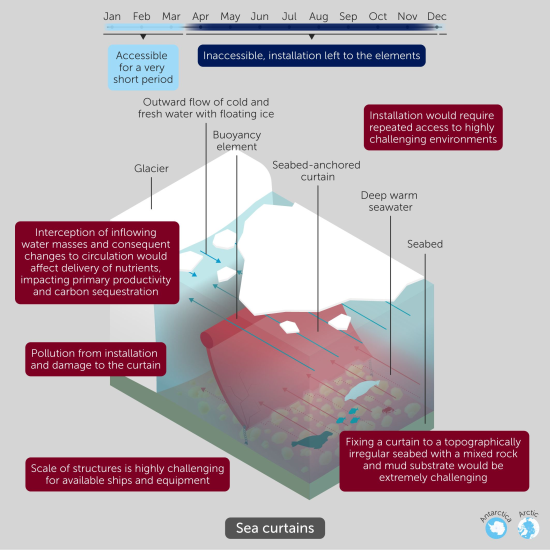
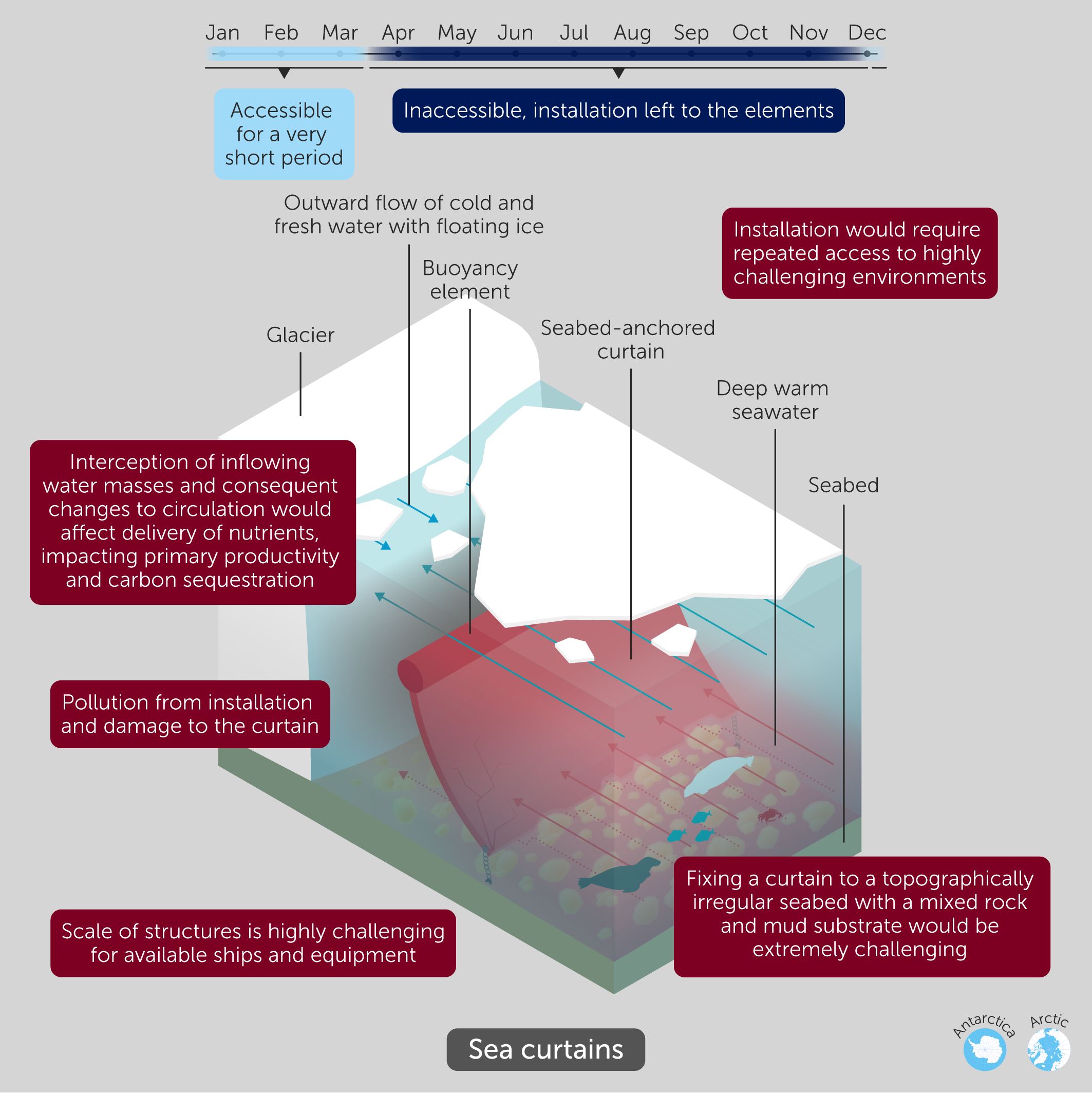
Another solution is to build 'ocean curtains' – large, floating walls in the ocean that can stop warm water before it reaches the ice and melts it.
Some researchers propose to make the ice thicker. This can be done by pumping seawater onto the surface so that it freezes, or by spreading small glass beads that cause the ice to reflect more sunlight – almost like giving it a mirror coating.
A fourth idea is to drain the water that lies beneath the glaciers. This water acts as a lubricant that allows the ice to slide more quickly into the sea. Without it, the glaciers may move more slowly, and melting may decrease.
Finally, there is the consideration of fertilizing the ocean with nutrients such as iron. This would promote the growth of phytoplankton, microscopic organisms that absorb CO2. When they die, they take the carbon with them down into the depths.
Each proposal was evaluated by the researchers based on likely implementation, effectiveness, feasibility, negative consequences, cost, and existing governance frameworks that would allow for rapid large-scale deployment.
Not tested for effectiveness and feasibility
The researchers conclude that none of the proposals have been tested in reality, neither for effectiveness nor feasibility. There are no experiments with ocean curtains or sea ice reflection, and SAI has only been tested using computer modeling.
Experiments conducted with ocean fertilization were inconclusive, and the removal of glacial water has not been demonstrated beyond limited drilling.
'All proposals will lead to inherent environmental damage, and sea ice management will pose significant ecological risks, such as glass beads potentially darkening the ice, and that water pumps require extensive infrastructure. The risks associated with SAI include ozone depletion and changes in global climate patterns,' the study states.
For ocean curtains, there is a risk that such large structures in the sea could disrupt habitats, feeding areas, and migration routes for marine animals, including whales, seals, and seabirds.
Removing water from glaciers could result in fuel contaminating the area beneath the ice. With ocean fertilization, there is uncertainty about which organisms will thrive or decline. There is also the potential to trigger changes in the natural chemical ocean circulation.
Geoengineering is costly and has political consequences
Siegert and colleagues estimate in the article that each proposal will cost at least 10 billion dollars to set up and maintain. Among the most expensive proposals are ocean curtains, with an estimate of $80 billion over 10 years for an 80-kilometer structure. Costs are likely to be higher when including secondary effects, such as environmental and logistical consequences, the researchers suggest.
From a political perspective, there are no governance frameworks in place to regulate SAI or sea ice management. Ocean curtains and the removal of glacial water would fall under the provisions of the Antarctic Treaty, while ocean fertilization is treated as marine pollution and is restricted under UN regulations. All proposals would require extensive political negotiations and the establishment of new governance structures and infrastructure.
The outlined geoengineering ideas could also have significant, possibly irreversible consequences.
"Any large-scale interventions in the Earth system carry a risk of large-scale unforeseen negative consequences. The Earth system is complex with many linkages between human, natural and biological systems", Regine Hock points out.
Can misallocate and tie up resources
Despite the significant uncertainties regarding effectiveness and the risk of negative consequences, as well as the legal and regulatory challenges, some argue that geoengineering could buy time while the world reduces emissions and warn against dismissing proof-of-concept research.
Although the authors of the study acknowledge the importance of exploratory research, they warn against pursuing the five geoengineering proposals for the polar regions. They believe it shifts the focus away from the urgent systemic change necessary to cut greenhouse gas emissions rapidly, and that we as a society risk misallocating financial resources and research efforts.
The authors conclude that while the geoengineering proposals offer some advantages, the measures cannot be implemented at a sufficient scale quickly enough to address climate change.
"If we instead combine our limited resources towards treating the cause instead of the symptoms, we have a fair shot at reaching net zero and restoring our climate’s health", said co-author Dr Heidi Sevestre from Arctic Monitoring and Assessment Programme Secretariat.
Reduction of greenhouse gases, measures that will be effective
The proposals that the research team has evaluated focus on climate fixing in the polar regions. They point out that other geoengineering ideas must also be critically assessed in terms of effectiveness, feasibility, consequences, and other factors—such as 'marine cloud brightening,' which aims to increase the reflective capacity of clouds over the ocean, and solar reflectors in space.
— The good news is that we have existing goals that we know will work. Global heating will likely stabilize within 20 years of us reaching net zero. Temperatures would stop climbing, offering substantial benefits for the polar regions, the planet, and all lifeforms, concludes Professor Siegert.
The scientific article
Martin Siegert et al. Safeguarding the polar regions from dangerous geoengineering: a critical assessment of proposed concepts and future prospects. Front Sci, September 9, 2025. Volume 3 - 2025.