Vacancies
A Postdoctoral fellowship in ice sheet modelling is open for application. Please find the advertisement on the application page: https://www.jobbnorge.no/en/available-jobs/job/302450/postdoctoral-research-fellow-position-in-ice-sheet-modelling
NEWS
DYNAMICE presentations at meetings and conferences in 2026:
- PRECISE Workshop (April, Hemsedal, NOR) - Á. Király gave a presentation on Anisotropic viscosity in ice and in mantle dynamics
- EGU GA (May, Vienna, AUT) - Y. Zhang gave a presentation titled: Mechanical anisotropy as a driver of shear margin and ice stream formation. Á. Király presented a poster titled: Modelled mantle texture evolution during periodic geodynamic cycles
- ADLAS Conference (May, Liblice, CZE) - T. Häußler presented a poster titled: The coupling of Mechanical Anisotropy to Post Glacial Rebound
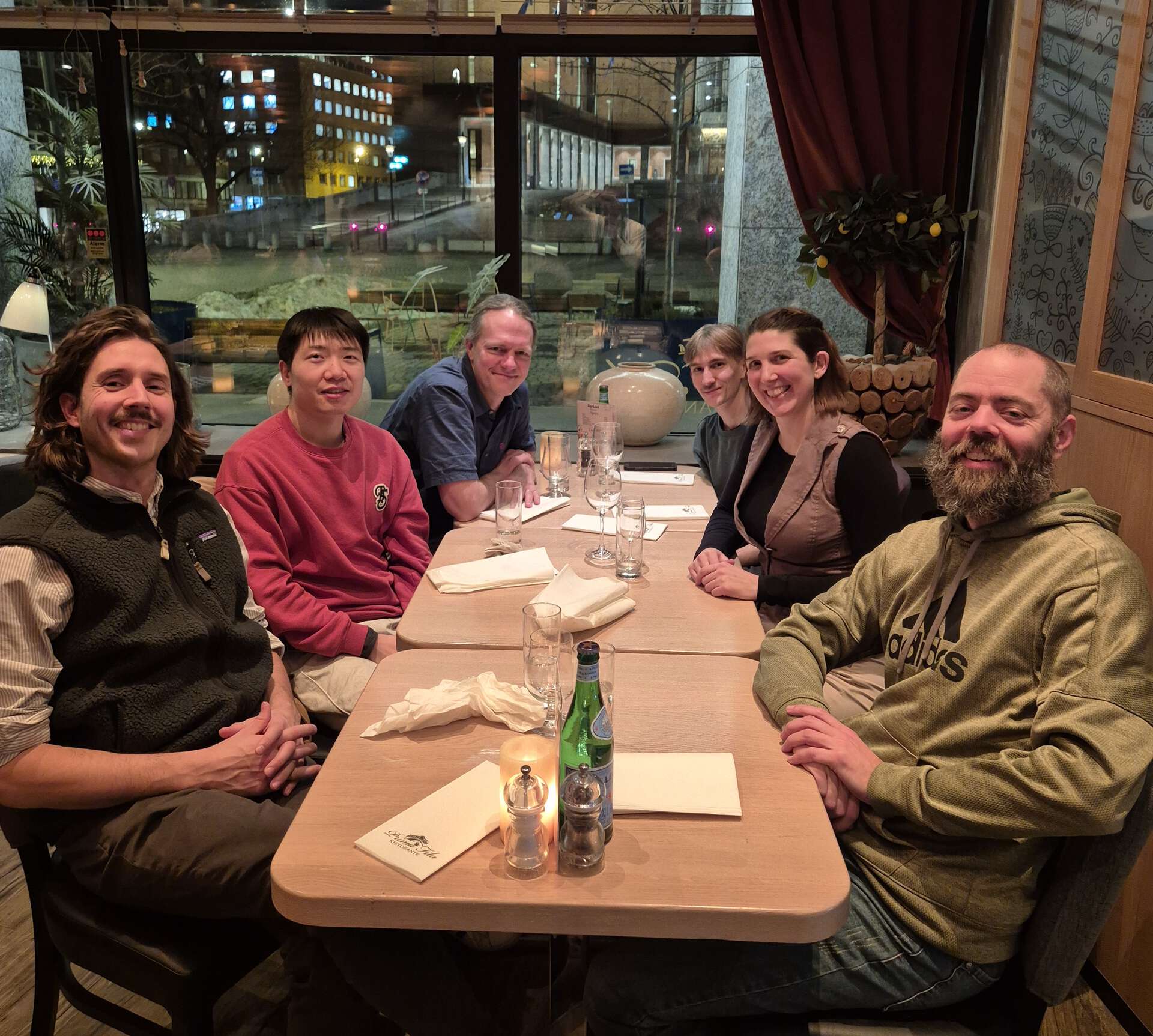
2026.01.26-27: DYNAMICE Startup meeting. We held a hybrid meeting to discuss ice and mantle rheology, numerical techniques, and future directions for DYNAMICE. We all learned a lot and had fun getting to know each other's research.
2025.11.17: The DYNAMICE Team is growing! We are welcoming in the team Yu Zhang, who will work as a Postdoctoral Research Fellow on DYNAMICE. Yu has recently defended his PhD at the University of Tübingen. In his PhD work, Yu has been combining geodynamics and glaciology to study large-scale folds and ice streams using a geodynamic code Underworld. During his Postdoctoral work, Yu will be focused on working on WP1 and WP2, which concern ice rheology and implementing ice dynamics into ASPECT.
2025.09.29: We’re thrilled to welcome our newest PhD team member, Theo Häußler! Joining us from Germany after earning his Master’s from Copenhagen University, Theo will be working on WP3, with the goal of understanding the role of anisotropic mantle textures and viscosity on glacial isostatic adjustment processes. Welcome to the DYNAMICE team, Theo!
2025.09.23-25, Elmer/Ice course, Erlangen, Germany: PI Ágnes Király has attended a short course on the ELMER/Ice code. This numerical code is widely used in glaciology and ice sheet modelling, and will serve as a potential benchmark for DYNAMICE's own implementations using the ASPECT code.
 Model of the Midtre Lovénbreen Glacier in Svalbard
About the project
 The loss of ice mass from polar and high-elevation regions is a significant contributor to global sea level rise and affects climate and biosphere changes. Due to its importance, a better understanding of the dynamics of ice sheets is considered a priority for scientific advancement by the Intergovernmental Panel on Climate Change (IPCC).
Ice and olivine, the main building crystals of ice sheets and the mantle, respectively, are two of the most anisotropic crystals on Earth. This means that individual crystals have preferred slip systems, along which it is easier to deform them. Depending on the deformation direction with respect to the mean orientation of crystals in both ice and mantle rock, the bulk viscosity can vary by a few orders of magnitude.

Such variations in viscosity can greatly affect the flow of ice from ice divides to the sea, as well as the mantle’s viscous response to the unloading of deglaciated ice. As a result, spatial differences in ice texture can locally enhance or slow down ice flow, leading to some areas with faster than average ice loss and others where ice is stabilized.
Moreover, in locations where ice loss is fast and where mantle textures are favourably oriented, the viscous response of the mantle can be fast enough to uplift the ice and slow further ice loss, potentially stabilizing the ice sheet. Hence, anisotropic viscosity might play a critical role in the interplay between ice and mantle dynamics.
Objectives
The aim in the DYNAMICE project is to enhance our understanding of ice sheet dynamics and ice mass loss by investigating the coupled flow dynamics of polar ice and the deforming mantle below, with a focus on the role of anisotropic viscosity for determining deformation rates.
The main objective of the project is to implement a framework to infer anisotropic viscosity from both ice and mantle textures in a numerical flow model. This will open new avenues for understanding solid earth and cryosphere dynamics, and their critical interactions that affect the future of Earth’s ice sheets.
Background
The project DYNAMICE is related to the former research project Anisotropic viscosity in mantle dynamics (ANIMA), at the Department of Geosciences and CEED – Centre for Earth Evolution and Dynamics, a Norwegian Centre of Excellence from 2013 to 2023, both University of Oslo.
The ANIMA research project was dedicated to evaluating the importance of anisotropic viscosity and olivine texture formation for multi-scale geodynamics processes in the Earth’s mantle. Read more about the ANIMA project here.