In the Paris agreement, countries agreed to limit global warming to a maximum of 2 degrees C by the end of the century. With the current emission patterns, this target is increasingly harder to achieve. Because of this, alternate plans on how to reduce global warming are becoming more interesting. One such proposed plan is Solar Radiation Management (SRM). SRM is defined as the deliberate large-scale actions intended to decrease global temperatures by reducing the amount of incoming solar radiation.
There are several methods for achieving this, and the most studied method is stratospheric aerosol injections (SAI). This method injects sulfate particles into the stratosphere to form an aerosol layer that reflects the incoming solar radiation. Many studies have found that this method is quite effective in reducing surface temperature, but it also has effects on other components of the surface climate, like precipitation. One effect that has not been studied extensively yet is the economic impact.
In this project, the master student will use the climate model NorESM coupled with the economic model DIAM to study the impact on the economy after implementing SAI. The sulfate forcing for the SAI experiment will be created using the set-up of the GeoMIP7 experiments without interactive chemistry. Depending on the student's interests, the project can involve doing parts of the modelling themselves or working with provided simulation results.
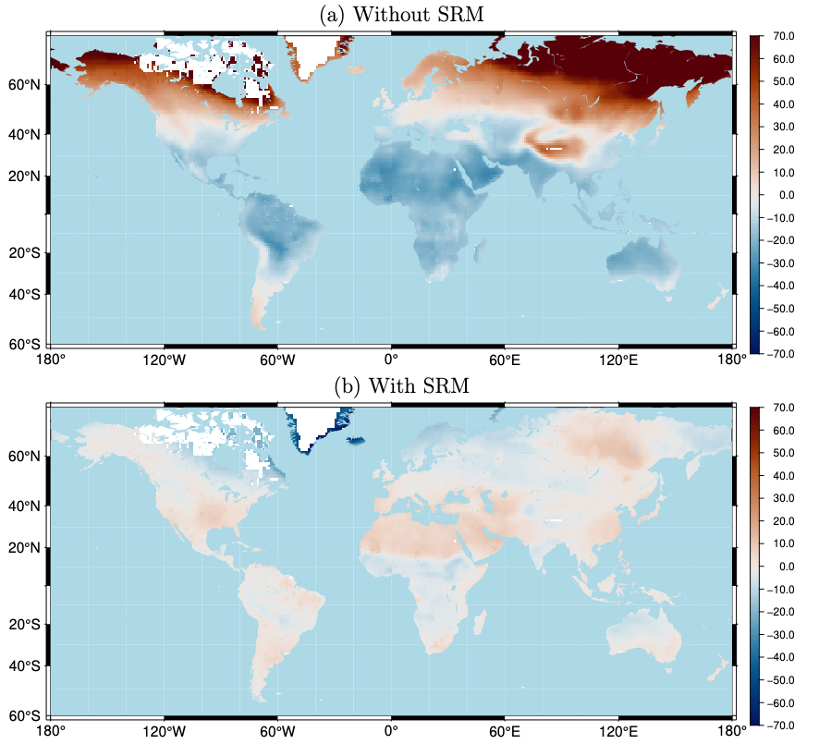
The study can be compared to a similar study that was conducted using a dimming of the sun instead of an actual SRM strategy (Figure 1). This project is suitable for a master student who is interested in interdisciplinary research, as it combines modeling of climate change with calculations of the associated economic consequences.