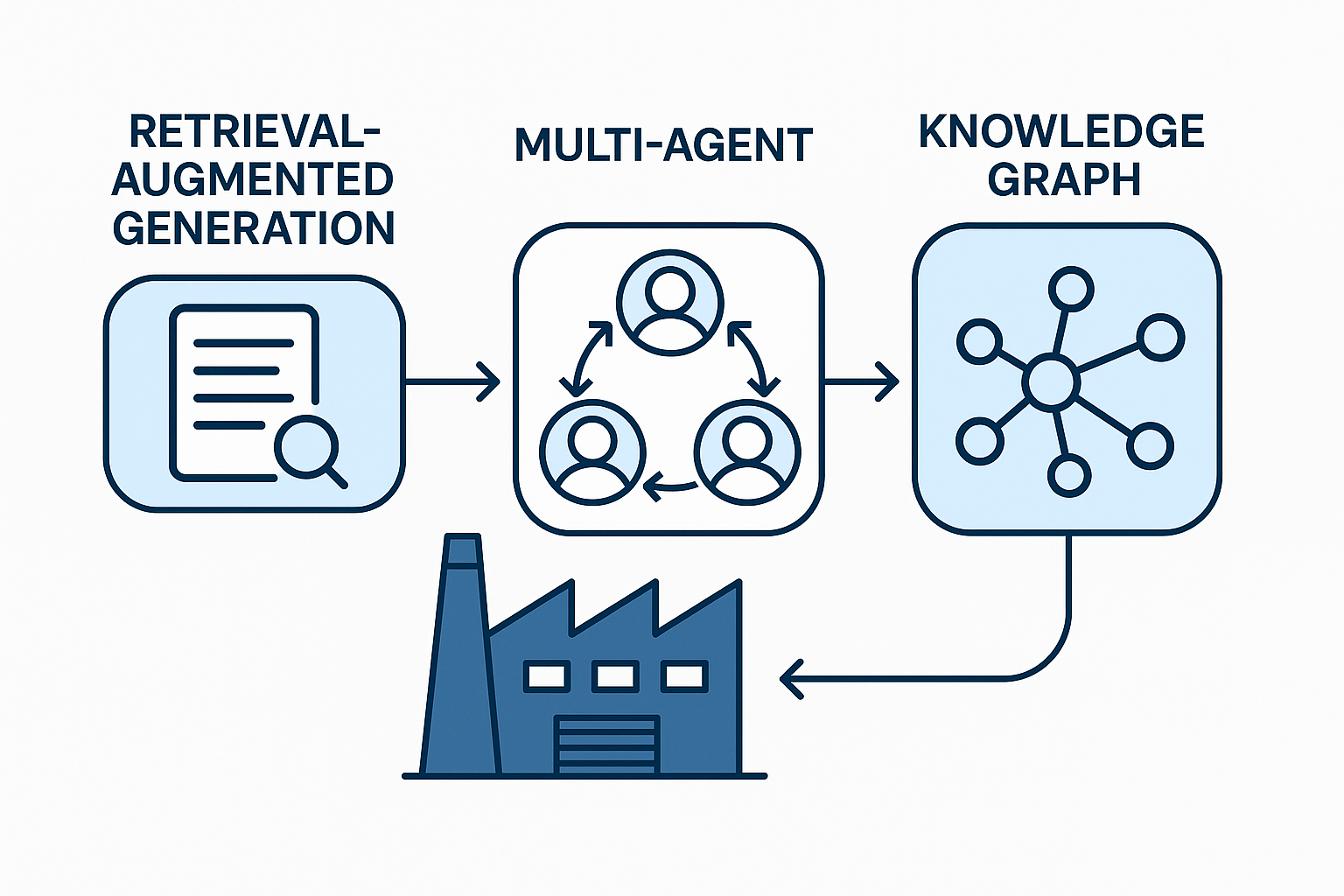
Traditional single-agent RAG systems struggle with complex queries requiring diverse expertise and multi-perspective reasoning. Multiagent systems offer a promising solution by distributing retrieval and generation tasks across specialized agents, each focusing on specific domains or employing different reasoning strategies. The challenge lies in coordinating these agents effectively to produce coherent, comprehensive responses while avoiding redundancy and conflicting information.
Research Objectives
Design and evaluate novel architectures for multiagent RAG systems that demonstrate improved performance over single-agent approaches on complex, multi-domain question-answering tasks. Specific aims include developing coordination mechanisms for agent specialization, creating dynamic role assignment strategies, designing conflict resolution methods for contradictory information, and conducting comprehensive performance evaluations against baseline approaches.
Methodology
Phase 1: Literature review and basic multiagent RAG framework implementation with agent specialization strategies (domain-specific, retrieval-method-specific, reasoning-type-specific).
Phase 2: Development of coordination algorithms, consensus mechanisms for information synthesis, and conflict resolution strategies for contradictory retrievals.
Phase 3: Implementation of advanced features including adaptive retrieval strategies, hierarchical agent structures, and computational efficiency optimization.
Phase 4: Comprehensive evaluation on standard benchmarks (MS MARCO, Natural Questions, HotpotQA), ablation studies, and comparative analysis with state-of-the-art single-agent RAG systems.
Technical Approach
The system will explore three coordination mechanisms: centralized coordination with a master orchestrating agent, decentralized consensus through peer-to-peer communication with voting, and hierarchical structures with multi-level coordination. Agent specialization will include domain experts, retrieval specialists using different methods, and reasoning agents for various reasoning types. Information synthesis will employ weighted aggregation based on confidence scores, debate-style synthesis with evidence presentation, and iterative refinement through cross-agent feedback.
Expected Contributions
Technical: Novel multiagent RAG architectures, coordination algorithms balancing specialization with collaboration, conflict resolution mechanisms, and adaptive agent assignment strategies. Empirical: Comprehensive evaluation framework, trade-off analysis between complexity and performance, identification of optimal query types for multiagent approaches, and scalability studies. Theoretical: Framework for understanding information flow in multiagent RAG systems and analysis of emergent collaborative behaviors.
Evaluation
Performance metrics include accuracy, completeness, coherence, and faithfulness of responses. System metrics cover efficiency, scalability, and robustness. Comparative analysis will measure performance gains over single-agent baselines and include human evaluation of response quality.
Industrial Collaboration
The project is connected to research at the Bosch Center for Artificial Intelligence. Visits to Bosch in Germany can optionally be a part of the work on this thesis.