How to get there
We recommend using public transport, cycling, or walking. There is no parking available outside the building. By tram or metro: Get off at Forskningsparken, then walk 1–2 minutes to the Life Sciences Building.
About the Birkeland Lecture
The Birkeland Lecture is an annual event that has been held since 1987. The event is a collaboration between the Norwegian Academy of Science and Letters, the University of Oslo, and Yara International. This year’s introductory lecture, related to research and innovation, is on plasma chemistry – the fourth state of matter.
Language: The introduction of the speaker and the lecture will be given in English.
Introductory lecture 2026
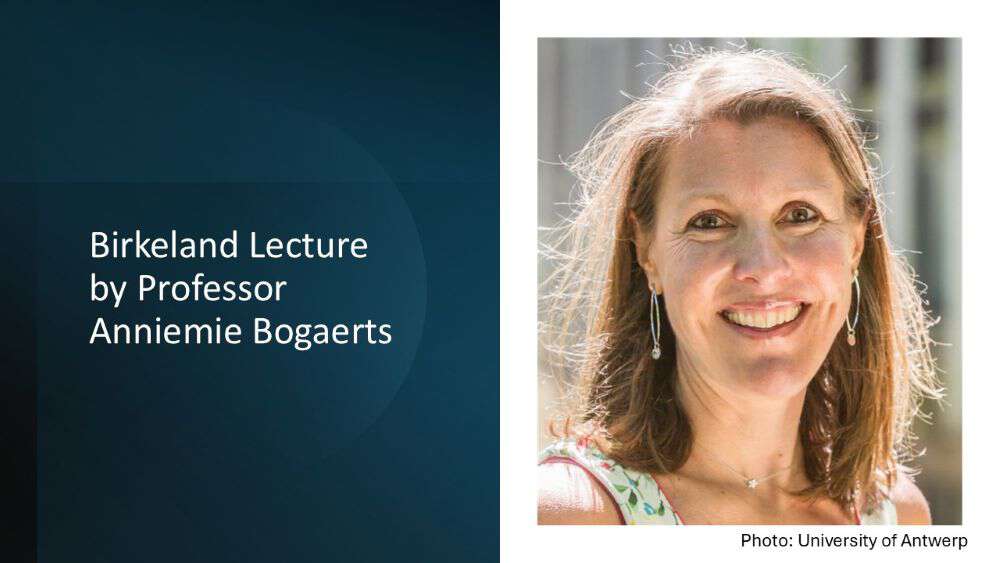
Speaker: Professor Annemie Bogaerts, University of Antwerp.
The main lecture will take place on 22 September 2026 at the Norwegian Academy of Science and Letters.
About Annemie Bogaerts: her research activities include studies of plasma and plasma–surface interactions using computational modelling and experiments, for various applications, mainly CO₂, CH₄ and N₂ conversion into value-added chemicals and fuels, plasma medicine, and microelectronics.
Welcome to the lecture!
Plasma: a novel tool for green chemistry
"Plasma technology is very promising for green chemistry, or the electrification of chemical reactions, because it operates with electricity and can quickly be switched on/off, so it is very suitable in combination with renewable electricity [1,2]. The performance, however, greatly depends on the type of plasma reactor. Dielectric barrier discharges (DBDs) operate near room temperature, and are suitable for combination with catalysts, for in-plasma catalysis, where the reactive plasma species (radicals and excited molecules) can activate the catalyst, but the underlying mechanisms to reach plasma-catalyst synergy are still far from understood, and moreover, their energy cost for gas conversion applications is quite high. On the other hand, so-called warm or quasi-thermal plasmas, such as microwave, gliding arc and arc plasmas, operate at much higher temperatures (up to 6000K), so they cannot accommodate catalysts inside the reactor, but catalysts can be thermally activated in post-plasma catalysis. Furthermore, these warm plasmas have much lower energy cost.
Typical applications include CO2 splitting, CH4 conversion into olefins, H2 and valuable carbon, the combined CO2 and CH4 conversion (dry reforming of methane, DRM) for syngas production, CO2 hydrogenation or partial oxidation of CH4 for oxygenates synthesis, N2 fixation into NH3 or NOx for fertilizer production, and NH3 cracking for green H2 formation. In this lecture, I will describe the state-of-the-art of these applications, in terms of performance metrics (conversion and energy cost). Subsequently, I will present several examples from our Plasma Lab for Applications in Sustainability and Medicine – ANTwerp (PLASMANT), both on experiments and modeling, to gain more insights and improve the various applications."
References:
1. Bogaerts, A. Plasma technology for the electrification of chemical reactions.Nature Chem. Eng. 2, 336-340 (2025).
2. Snoeckx, R. & Bogaerts, A. Plasma technology – a novel solution for CO2 conversion? Chem. Soc. Rev. 46, 5805-5863 (2017).