Electrochemical devices for clean energy technologies such as fuel cells and electrolyzers are in many cases limited by the performance of the electrodes. Due to the complexity of the electrode processes, involving mass transfer, charge transfer and diffusion, it is challenging to determine the rate limiting steps. The project focuses on the solid-solid interface between a state-of-the-art electrolyte (BaZrO3) and palladium which exhibits high bulk diffusivity of atomic hydrogen. This serves as model system to study proton and charge transfer mechanisms, and Pd has also shown great potential as an interfacial layer to boost electrode performance. The project can be combined experimental and computational.
The experimental part includes sample preparation, electrode deposition including thin-film techniques, and electrochemical impedance spectroscopy (EIS). The computational part includes density functional theory (DFT) studies of the electrode interface and transfer mechanism of hydrogen between the materials.
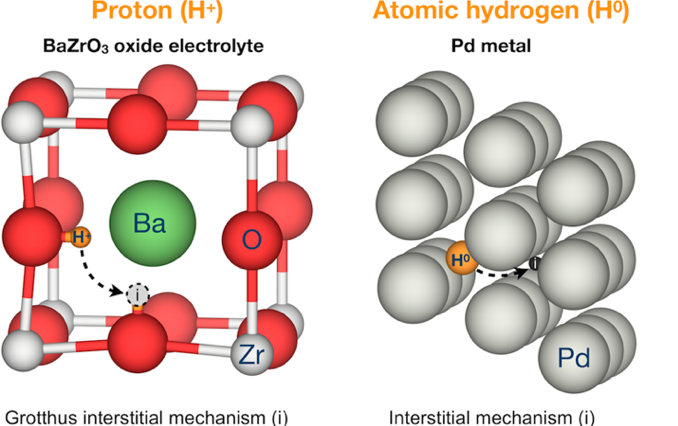
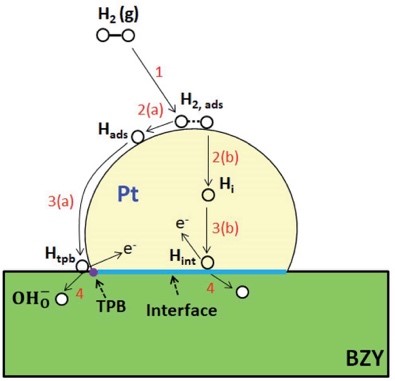
Figure: Chemical state and hydrogen migration mechanisms in the oxide electrolyte and Pd metal (left) and schematic view of gas-solid and solid-solid electrode reactions from Chen et al., J. Mater. Chem. A, 2020, 8, 12566.