
The Disputation will be live streamed for everyone else.
The livestream will be activated 15 minutes before the Defense starts.
Trial lecture
September 4th, 09:15 AM, Auditorium 2, Chemistry building
Trial lecture title: "Beyond lithium-ion batteries - perspectives and challenges"
Kreeringssammendrag/Conferral summary
Forståinga av korleis aktive batterimaterialar oppfører seg på atomnivå er viktig for å utvikle morgondagens batteri. Dette doktorgradsarbeidet undersøkte reaksjonsmekanismane til utvalde anodematerialar i litium- og natriumionebatteri ved å nytte operando røntgenbaserte metodar. Arbeidet er todelt – den første delen forklarar korleis Li-ion røyrar på seg inni grafittanodar etter at straumen har vorte skrudd av, mens den andre delen skildrar opp- og utladingsmekanismane til antimonkalkogenid (t.d. Sb2Se3).
Main research findings
An efficient approach for storing electricity on a large scale is by rechargeable batteries. Li-ion batteries (LIBs) is the leading commercial technology used in everyday applications such as smartphones, laptops, and electric cars. The ever-increasing demand of LIBs has created significant pressure on the materials used in their production, raising concerns about potential resource depletion. One strategy to solve this issue involves diversifying battery technologies to include alternative materials and chemistries. However, advancing and optimizing these materials depend on understanding how they operate at a fundamental level. Thus, operando characterization methods have emerged as a powerful tool for gaining insights into the chemical changes that occur during actual use.
In this work, operando X-ray-based techniques have been used to investigate the reaction mechanisms of anode materials for Li- and Na-ion batteries. The first part describes what occurs to Li-ions inside partially lithiated materials when the electrochemical cycling has been interrupted. The second, and main part of this work, focuses on promising anode materials for Na-ion batteries, namely antimony chalcogenides (Sb2X3 where X = S, Se, Te). Notably, this research identifies a new phase, Na5SbSe, as the fully sodiated product of Sb2Se3, revealing a more complex reaction mechanism than previously thought. This new phase allows Sb2Se3 anodes to operate under high (dis)charge rates.
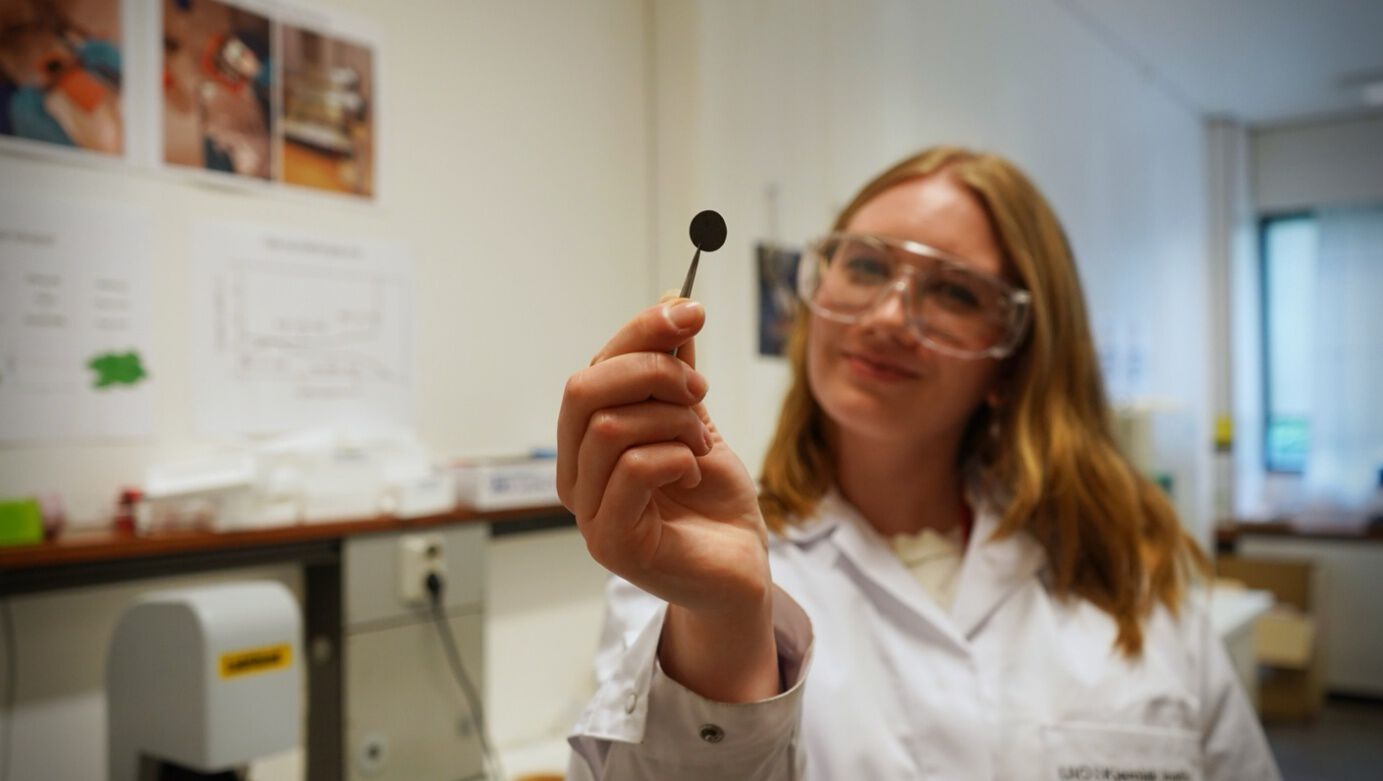
Foto: Elina Melteig for Titan.uio.no
Candidate contact information
https://www.linkedin.com/in/amalie-skurtveit/
amalie.skurtveit@kjemi.uio.no
+47 92082648
Adjudication committee
Professor Emma Kendrick
University of Birmingham, United Kingdom
Professor Poul Ægidius Norby
Technical University of Denmark, Denmark
Professor Reidar Haugsrud
Department of Chemistry, University of Oslo, Norway
Supervisors
Associate professor Alexey Yevgenyevich Koposov
Department of Chemistry, University of Oslo, Norway
Researcher Carmen Cavallo
Department of Chemistry, University of Oslo, Norway
Chair of defence
Professor Harald Walderhaug
Department of Chemistry, University of Oslo, Norway