Arrangementer - Side 3
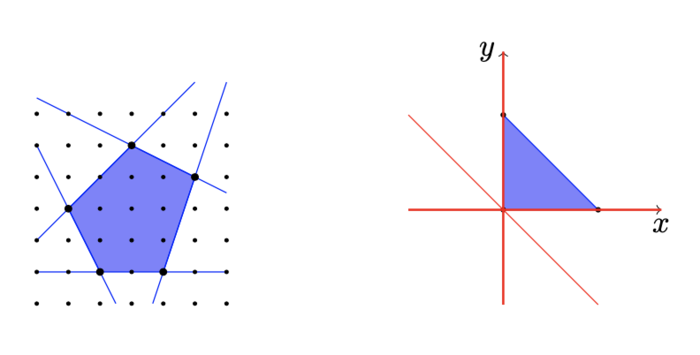
In 1962 Ehrhart proved that the number of lattice points in integer dilates of a lattice polytope is given by a polynomial — the Ehrhart polynomial of the polytope. Since then Ehrhart theory has developed into a very active area of research at the intersection of combinatorics, geometry and algebra.
The Ehrhart polynomial encodes important information about the polytope such as its volume and the dimension. An important tool to study Ehrhart polynomials is the h*-polynomial, a linear transform of the Ehrhart polynomial which is given by the numerator of the generating series. By a famous theorem of Stanley the coefficients of the h*-polynomial are always nonnegative integers. In this talk, we discuss generalizations of this result to weighted lattice point enumeration in rational polytopes where the weight function is given by a polynomial. In particular, we show that Stanley’s Nonnegativity Theorem continues to hold if the weight is a sum of products of linear forms that a nonnegative over the polytope. This is joint work with Esme Bajo, Robert Davis, Jesús De Loera, Alexey Garber, Sofía Garzón Mora and Josephine Yu.
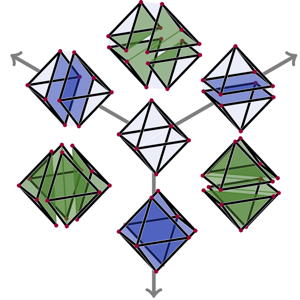
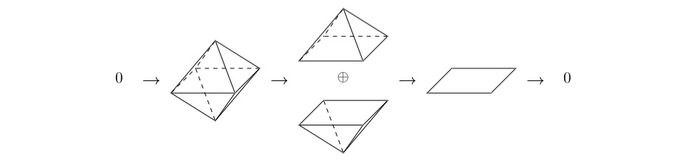
In this talk we define a new category of matroids, by working on matroid polytopes and rank preserving weak maps. This lets us introduce the concept of categorical valuativity for functors, which can be seen as a categorification of the ordinary valuativity for matroid invariants.
We also show that this new theory agrees with what we know about valuative polynomials: several known valuative polynomials can be seen as a Hilbert series of some graded vector space and we prove that these graded vector spaces let us define a valuative functor in the new sense.
Lastly, we sketch how to categorify a Theorem by Ardila and Sanchez, which states that the convolution of two valuative invariants (respectively, valuative functors) is again valuative.
This is based on a joint ongoing project with Ben Elias, Dane Miyata and Nicholas Proudfoot.
Oslo Stability and Enumerative Geometry Workshop 2023
We prove that (logarithmic, Nygaard completed) prismatic and (logarithmic) syntomic cohomology are representable in the category of logarithmic motives. As an application, we immediately obtain Gysin maps for prismatic and syntomic cohomology, and we precisely identify their cofibers. In the second part of the talk we develop a descent technique that we call saturated descent, inspired by the work of Niziol on log K-theory. Using this, we prove crystalline comparison theorems for log prismatic cohomology, log Segal conjectures and log analogues of the Breuil-Kisin prismatic cohomology, from which we get Gysin maps for the Ainf cohomology.
I will discuss the “geometric method” for syzygies and discuss applications to the study of tautological bundles of linear spaces. From this, I will explain how to pass from realizable matroids to all matroids via initial degenerations. This is joint work in progress with Alex Fink and Chris Eur.
A finite graph determines a Kirchhoff polynomial, which is a squarefree, homogeneous polynomial in a set of variables indexed by the edges. The Kirchhoff polynomial appears in an integrand in the study of particle interactions in high-energy physics, and this provides some incentive to study the motives and periods arising from the projective hypersurface cut out by such a polynomial.
From the geometric perspective, work of Bloch, Esnault and Kreimer (2006) suggested that the most natural object of study is a polynomial determined by a linear matroid realization, for which the Kirchhoff polynomial is a special case.
I will describe some ongoing joint work with Delphine Pol, Mathias Schulze, and Uli Walther on the interplay between geometry and matroid combinatorics for this family of objects.
Many have tried to adapt Clemens and Griffiths's approach to irrationality of cubic threefolds to higher dimensions, using different invariants in place of H^3(X,Z): the transcendental part of H^4, derived categories, quantum cohomology... I will report on my attempt to use higher algebraic K-theory, which turns out to be strictly weaker than what Voisin and Colliot-Thélène have already gotten from Bloch-Ogus theory, but (I think) in an interesting way. For a positive result, I can show that the higher K-theory of Kuznetsov's K3 category for a cubic or Gushel-Mukai 4-fold looks the same as that of an honest K3 surface.
I will talk about some new examples of varieties where the coniveau and strong coniveau filtrations are different. This is joint work with Jørgen Vold Rennemo.
Fano manifolds are complex projective manifolds having positive first Chern class. The positivity condition on the first Chern class has far reaching geometric and arithmetic implications. For instance, Fano manifolds are covered by rational curves, and families of Fano manifolds over one dimensional bases always admit holomorphic sections. In recent years, there has been some effort towards defining suitable higher analogues of the Fano condition. Higher Fano manifolds are expected to enjoy stronger versions of several of the nice properties of Fano manifolds.
In this talk, I will discuss higher Fano manifolds which are defined in terms of positivity of higher Chern characters. After a brief survey of what is currently known, I will present recent joint work with Carolina Araujo, Roya Beheshti, Kelly Jabbusch, Svetlana Makarova, Enrica Mazzon and Nivedita Viswanathan, regarding toric higher Fano manifolds. I will explain a strategy towards proving that projective spaces are the only higher Fano manifolds among smooth projective toric varieties.
Nakajima quiver varieties are a class of combinatorially defined moduli spaces generalising the Hilbert scheme of points in the plane, defined with the aid of a quiver Q (directed graph) and a fixed framing dimension vector f. In the 90s Nakajima used the cohomology of these varieties (in fixed cohomological degrees, and for fixed f) to construct irreducible lowest weight representations of the Kac-Moody Lie algebras associated to the underlying graph of Q. Since the action is via geometric correspondences, the entire cohomology of these quiver varieties forms a module for the same Kac-Moody Lie algebras, suggesting the question: what is the decomposition of the entire cohomology into irreducible lowest weight representations?
In this talk I will explain that this question is somehow not the right one. I will introduce the BPS Lie algebra associated to Q, a generalised Kac-Moody Lie algebra associated to Q, which contains the usual one as its cohomological degree zero piece. The entire cohomology of the sum of Nakajima quiver varieties for fixed Q and f turns out to have an elegant decomposition into irreducible lowest weight modules for this Lie algebra, with lowest weight spaces isomorphic to the intersection cohomology of certain singular Nakajima quiver varieties. This is joint work with Lucien Hennecart and Sebastian Schlegel Mejia.
A tropical curve is a graph embedded in R^2 satisfying a number of conditions. Mikhalkin's celebrated correspondence theorem establishes a correspondence between algebraic curves on a toric surface and tropical curves. This translates the difficult question of counting the number of algebraic curves through a given number of points to the question of counting tropical curves, i.e. certain graphs, with a given notion of multiplicity through a given number of points which can be solved combinatorially. To get an invariant count, real rational algebraic curves are counted with a sign, the Welschinger sign and there is a real version of the correspondence theorem. Furthermore, Marc Levine defined a generalization of the Welschinger sign that allows to get an invariant count of algebraic curves defined over an arbitrary base field. For this one counts algebraic curves with a certain quadratic form.
In the talk I am presenting work in progress joint with Andrés Jaramillo Puentes in which we provide a version Mikhalkin's correspondence theorem for an arbitrary base field, that is a correspondence between algebraic curves counted with the above mentioned quadratic form and tropical curves counted with a quadratic enrichment of the multiplicity. Then I will explain how to use this quadratic correspondence theorem to do the count of algebraic curves over an arbitrary base field.
Following Givental, enumerative mirror symmetry can be stated as a relation between genus zero Gromov-Witten invariants and period integrals. I will talk about a relative version of mirror symmetry that relates genus zero relative Gromov-Witten invariants of smooth pairs and relative periods. Then I will talk about how to use it to compute the mirror proper Landau-Ginzburg potentials of smooth log Calabi-Yau pairs.
Consider the singularity C^4/(Z/2), where Z/2 acts as the matrix diag(-1,-1,-1,-1). This singularity is special, in that it does not admit a crepant resolution. However, it does admit a so-called noncommutative crepant resolution, given by a Calabi-Yau 4 quiver. The moduli space of representations of this quiver turns out to share a lot of similarities with moduli spaces of sheaves over Calabi-Yau fourfolds, and it turns out that we can reuse techniques from studying moduli of sheaves to define and compute invariants of this moduli space of representations. In this talk, I will explain how these invariants can be defined, and give conjectures about the forms of these invariants. This talk is based on joint work with Raf Bocklandt.