
With climate change and temperatures rising, the sea ice covering most of the Barents Sea in winter is disappearing. This environmental shift is altering the habitat and behaviour of many fish species, particularly those that are highly dependent on sea ice for survival and reproduction. Boreal species previously restricted by sea ice are now extending their range northward increasing their predation on or competition with Arctic species. In particular, the interactions between Atlantic cod, capelin, and polar cod have become more complex as their ranges overlap more frequently due to ice loss.
Atlantic cod is a major top predator in the Barents Sea predating both boreal capelin and Arctic polar cod. Barents Sea capelin and polar cod are two pelagic fishes that ensure the transfer of energy from the producers upward the food chain. The redistribution of these fish species due to ice loss may lead to a shift in balance that could have profound impacts on the ecosystem. However, there are still many unknowns regarding how predicted environmental change may influence the joint dynamics of these populations.
Durant et al. (2024) used 32-year long time series to develop a statistical model describing jointly the observed population change of the Atlantic cod, Barents Sea capelin and polar cod. Using this new model, they simulated the effect a reduced sea-ice extent in the Barents Sea may have on these populations.
The simulation showed that the effects of reduced sea ice and associated warmer sea temperatures would lead to declines in polar cod populations and an increase in the Barents Sea capelin population (figure 2). Surprisingly, the projection showed a decline in the Atlantic cod population and indicated a large shift in the food web.
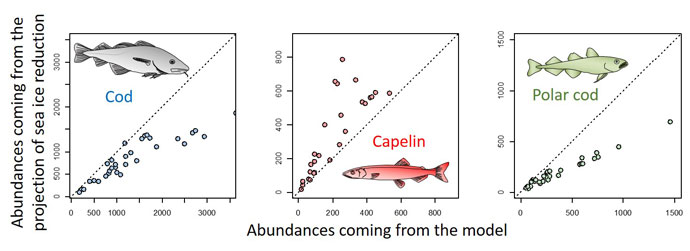
This work shows that climate change in the Arcto-boreal system can generate different trophic interactions. This research underlines the importance of understanding how environmental changes like sea-ice loss are reshaping species interactions. The study not only highlights the direct impact of climate change on Arctic ecosystems but also calls for comprehensive ecosystem-based management strategies based on trophic interactions. Improving our understanding of the variables influencing population interactions can benefit ecology and help develop new approaches to climate change adaptation and mitigation.
Reference:
Durant JM, Dupont N, Ono K, Langangen Ø (2024) Interaction between three key species in the sea ice-reduced Arctic Barents Sea system. Proceedings of the Royal Society B: Biological Sciences, 291, 20241408.
Log in to comment